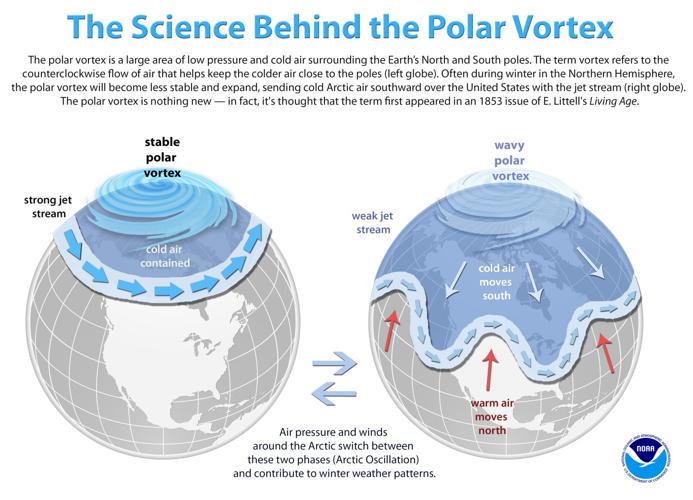

The polar vortex is a large area of low pressure and cold air surrounding both of the Earth’s poles. It ALWAYS exists near the poles, but weakens in summer and strengthens in winter. The term "vortex" refers to the counter-clockwise flow of air that helps keep the colder air near the Poles. Many times during winter in the northern hemisphere, the polar vortex will expand, sending cold air southward with the jet stream (see graphic above). This occurs fairly regularly during wintertime and is often associated with large outbreaks of Arctic air in the United States. The one that occurred January 2014 is similar to many other cold outbreaks that have occurred in the past, including several notable colder outbreaks in 1977, 1982, 1985 and 1989.

There are several things the polar vortex is NOT. Polar vortexes are not something new. The term “polar vortex” has only recently been popularized, bringing attention to a weather feature that has always been present. It is also not a feature that exists at the Earth’s surface. Meteorologists examine the polar vortex by looking at conditions tens of thousands of feet up in the atmosphere; however, when we feel extremely cold air from the Arctic regions at Earth’s surface, it is sometimes associated with the polar vortex. This is not confined to the United States. Portions of Europe and Asia also experience cold surges connected to the polar vortex. By itself, the only danger to humans is the magnitude of how cold temperatures will get when the polar vortex expands, sending Arctic air southward into areas that are not typically that cold.
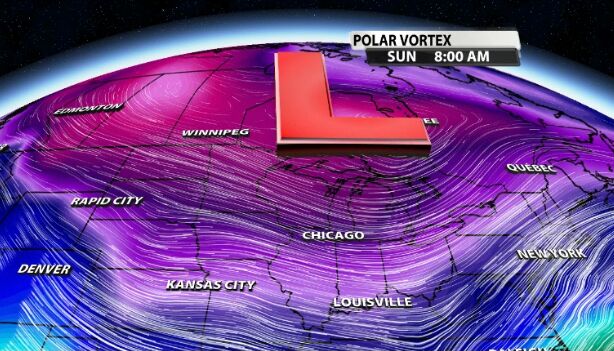
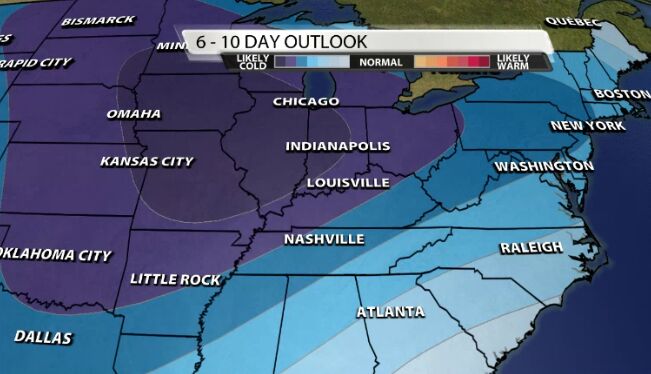
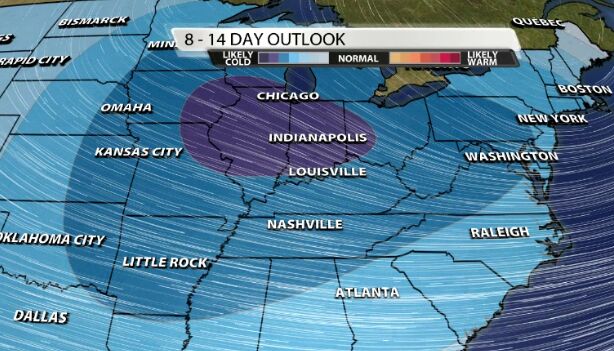
In short, there is no cause to be alarmed when you hear about the polar vortex, but you should be prepared for colder temperatures. The crazy cold gets stuck around the Great Lakes this weekend, but it's close. All it would take is another storm to pull down the true arctic air and that's definitely in the cards next week. That's why the Climate Prediction Center has a very high probability of colder than average temperatures in their 6 -10, as well as their 8 -14 day outlook. That means colder than normal temperatures are likely through the middle of February! Keep in mind our average high is in the mid 40's right now so numbers would remain well below that for the near future. Stay warm!