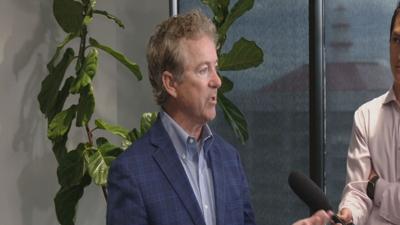


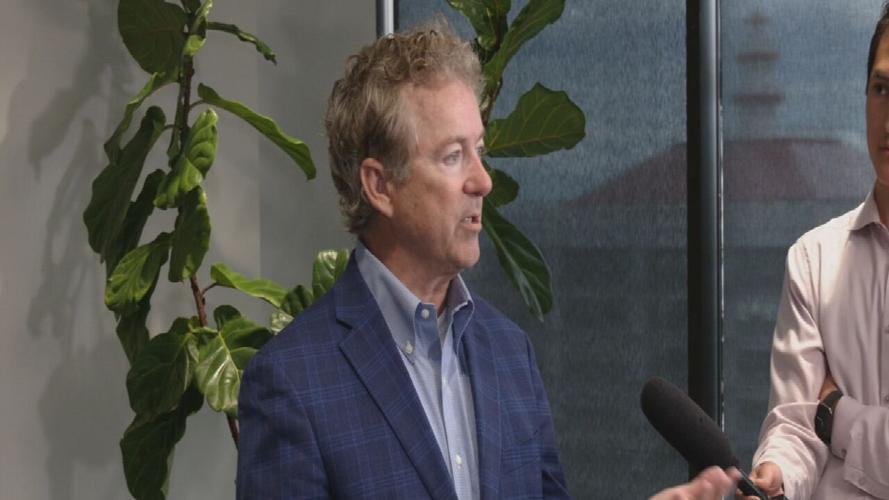
LOUISVILLE, Ky. (AP) — In solidly Republican Kentucky, resistance to President Donald Trump’s trade wars has sprung up from a cross-section of key business sectors, GOP Sen. Rand Paul said Monday.
Paul said he’s heard concerns from agriculture, the auto sector, bourbon production, home building and package shipping in response to Trump’s aggressive use of tariffs. Paul — among the few GOP senators willing to challenge Trump on tariffs — met with a group of Louisville business leaders on Monday.
“Virtually every business that I have met in Kentucky has said they’re not excited about having tariffs and that international trade has been good for their company and good for the consumer by bringing lower prices,” the libertarian-leaning Paul told reporters afterward.
Paul welcomed the sudden de-escalation of the trade conflict between the U.S. and China, when the two global economic powerhouses agreed Monday to slash their massive recent tariffs. The 90-day truce creates time for U.S. and Chinese negotiators to reach a more substantive agreement.
As for prospects of a longer-term deal, the senator said: “We’ll see how it shakes out.”
“Anything we can do to bring down tariffs is good,” Paul said. “I said I’ll be the first person to compliment President Trump if the end of this shakes out and in six months, all the tariffs are lower and there’s more trade. I’m perfectly willing and big enough to say: ‘Good job, Mr. President.’”
Trump used tariffs in his first term and has been even more aggressive and unpredictable about imposing them in his second. He’s slapped a 10% tariff on a myriad of countries, blowing up the rules that had governed global trade for decades.
Trump dominated Kentucky in each presidential election since 2016, but the GOP lawmakers willing to speak out against his trade wars include Paul and Sen. Mitch McConnell.
Trump’s tariffs forged a rare bipartisan alliance in Kentucky among the senators and Democratic Gov. Andy Beshear. They raised concerns that trade wars would drive up prices for consumers and damage key business sectors, including the bourbon industry. In Canada, some liquor stores cleared American spirits from their shelves amid trade acrimony and Trump’s calls to make Canada the 51st state.
Trump views tariffs as an all-purpose economic tool that can raise money for the U.S. Treasury, protect American industries, lure factories to the United States and pressure other countries to bend to his will, even on issues such as immigration and drug trafficking.
Paul, who ran for president in 2016, has called for Congress to reassert its authority on the issue.
“Tariffs are taxes, and the power to tax belongs to Congress — not the president,” Paul said in a release last month. “Our Founders were clear: tax policy should never rest in the hands of one person.”
Asked Monday if he trusts the president’s tactics on trade, Paul replied: “I would prefer we weren’t putting tariffs on.”
Paul also raised concerns about the on-again, off-again nature of Trump’s tariff policies, noting that “businesses like certainty.”
“It’s really why most of us who believe in the free market think that government shouldn’t be involved in so many decisions,” he said. “These are the decisions that should be left to the marketplace to determine prices.”
Among the business leaders who met with Paul on Monday was Sarah Davasher-Wisdom, CEO of Greater Louisville Inc., the metro chamber of commerce in Kentucky’s largest city. Participants updated the senator on what impacts the tariffs are having on their businesses, she told reporters.
“The tariffs are creating a lot of uncertainty for businesses, and that makes it very difficult to operate. And it’s driving up prices,” she said. “And the uncertainty itself is making it difficult for businesses to plan capital expenditures, making it difficult for them to plan out 90 days, 120 days.”
Paul has heard from a variety of business sectors on tariffs.
"I've heard from the car manufactures, their opposition, I've heard from people who ship packages internationally, I've heard from the bourbon industry, their opposition, I've heard from the farm bureau, their opposition, I've heard from the realtors and the home builders, their opposition," Paul said. "Home prices have been rising dramatically anyway. Interest rates are up. And then all of the sudden if you're going to raise lumber and steel prices for homes, you got problems there, too. So we are definitely hearing from Kentucky businesses, I can't give you the exact number but it's large."
Paul said people need to be conscious of the effects of tariffs.
"It's really why most of us who believe in the free market think that government shouldn't be involved in so many decisions," Paul said. "These are the decisions that should be left to the marketplace to determine prices. And adding a huge tax in the middle of the system and higher for some countries and lower for others and then you lobby to try to get an exemption. I don't think it's a good way to run the government."
The United States and China agreed Monday to slash their massive recent tariffs, restarting stalled trade between the world’s two biggest economies and setting off a rally in global financial markets.
But the de-escalation in President Donald Trump's trade wars did nothing to resolve underlying differences between Beijing and Washington. The deal lasts 90 days, creating time for U.S. and Chinese negotiators to reach a more substantive agreement. But the pause also leaves tariffs higher than before Trump started ramping them up last month. And businesses and investors must contend with uncertainty about whether the truce will last.
U.S. Trade Representative Jamieson Greer said the U.S. agreed to drop the 145% tax Trump imposed last month to 30%. China agreed to lower its tariff rate on U.S. goods to 10% from 125%.
Top Stories:
2.8 magnitude earthquake recorded in central Kentucky early Sunday
Robotics teams tour CRG Automation in Louisville, learn real-world engineering skills
Foster child expresses gratitude to late adoptive mother for life-changing impact
Copyright 2025 WDRB Media. The Associated Press contributed to this report. All Rights Reserved.


