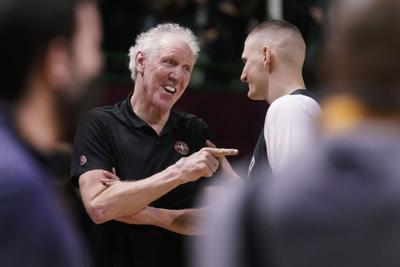
LOUISVILLE, Ky. (WDRB) — He made 21 of 22 shots in the NCAA basketball championship game and left America wondering, “Who remembers the one shot he missed?”
He took his spot in the final years of college basketball’s dazzling dynasty and somehow made it more dazzling — powering UCLA through most of its 88-game winning streak while twisting the spotlight from the coach (John Wooden) to the player (the Walton Gang).
He won multiple championships at the high school, college and professional levels in ways that put him on the fast track to the Naismith Basketball Hall of Fame.
Then, on Monday when colon cancer claimed Bill Walton at the age of 71, there was overwhelming confirmation that the life lessons Walton preached and lived about joy, love, passion and friendship resonated so forcefully that they turned Walton’s remarkable basketball achievements into footnotes.

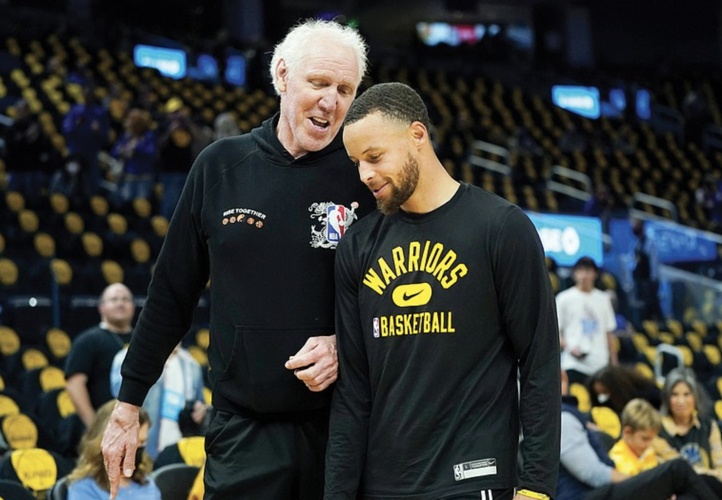
Bill Walton (left) chats with Steph Curry before a Warriors' game in 2022. AP Photo
Shine on, Bill. That is a life remarkably lived.
From President Obama to Adam Sandler to Julius Erving to members of the Grateful Dead to Kareem Abdul-Jabbar to Bill Russell’s legacy account to Larry Bird to Rolling Stone magazine to Sister Jean to Tony Kornheiser and Michael Wilbon to John Fogerty to David Axelrod to Bob Ryan to James Worthy to Warren Moon … I could not turn off my screens without trying to read every tribute tweet to a player who helped me fall in love with college basketball.
Thank you Bill Walton (and Kareem, Pete Maravich, Austin Carr, George McGinnis, Cazzie Russell, Charlie Scott, Wes Unseld, Dan Issel, Sidney Wicks and others) for that.
X (formerly Twitter) is generally a toxic cesspool of snark and adolescent Gotcha Lasts. On Monday love and admiration conquered snark in a way I have not seen on that social media platform, even after Kobe Bryant’s passing more than four years ago.
Why?
Walton was an absolute original, whose second act as a gadfly broadcasting philosopher far exceeded his first act as a basketball force. All his first act entailed was proving himself as one of the five (some say two, behind only Abdul-Jabbar) greatest college players ever.
One of my favorite Walton stories is one former University of Louisville coach Denny Crum shared. Crum served as Wooden’s top UCLA assistant from 1967-1971.
The time frame is important. Crum’s first two seasons were the second and third collegiate seasons for Kareem Abdul-Jabbar, then known as Lew Alcindor, when the UCLA Bruins added the 1968 and 1969 national titles to the one they earned in 1967. The Bruins lost twice in three seasons.
Crum’s final two seasons were highlighted by Walton. Crum loved to tell the story about the day after he drove from Los Angeles to San Diego to watch Walton play at Helix High School. Standing outside Wooden’s office the following day, Crum said he had just scouted the best high school basketball player he had ever seen.
Wooden, an understated Hoosier with little use for hyperbole, waved Crum into his office. He shut the door. He advised Crum never to say something like that around other basketball people, lest they wonder how well Crum truly knew basketball. What would Alcindor think of that statement?
Crum let it go and complied. His only request was the next time that he drove to San Diego to scout Walton that Wooden had to tag along.
Wooden did. It was his first introduction to seeing Bill Walton do Bill Walton things. Wooden fell in line.
Crisp, accurate, unmatched outlet passes. An unrelenting assortment of bank shots from multiple angles and distances. Dependable hands that transformed lob passes into layups. Firm, two-handed rebounds, elbows spread wide as his feet touched the ground to clear space, precisely the way rebounding used to be taught in the instructional videos.
And then a Walton trademark — shot-blocking as an offensive as well as defensive technique. Somehow Walton regularly made certain that the shots he blocked landed in the hands of a UCLA teammate to launch another fast break.
That is how Walton won two state titles at Helix High, contributed mightily to the unrivaled 88-straight game winning streak, the 30-0 1972 and 30-0 1973 NCAA titles with the Bruins and the 1977 NBA title with the Portland Trailblazers.

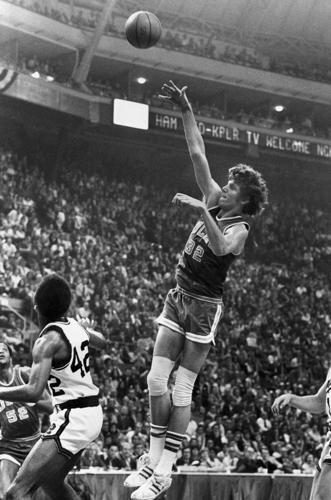
FILE - UCLA center Bill Walton (32) shoots for two of his record 44 points against Memphis State in the final game of the NCAA college basketball tournament in St. Louis, March 26, 1973. Walton's performance against Memphis State is still one of the greatest individual games in history. Walton, who starred for John Wooden's UCLA Bruins before becoming a Basketball Hall of Famer and one of the biggest stars of basketball broadcasting, died Monday, May 27, 2024, the league announced on behalf of his family. He was 71. (AP Photo, File)
But there was always more than basketball percolating inside Walton. In a time when college athletes generally shut up and dribbled, Walton was famously against the Vietnam War with an arrest record to show for it.
According to his obituary in the New York Times, Walton was an advocate for racial justice in an era when not every major college basketball program was fully integrated.
“The Blacks have gotten a raw deal for a long time,” he told the sportswriter Bill Libby after his arrest, according to The Nation. “A lot of my teammates are Black, and I really admire the way they’ve risen above their raw deal. They’re my friends, and I feel for them. I know I’ve gotten twice as much as I deserve because I’m white.”
Between basketball seasons, Walton was more likely to quote Jerry Garcia and other members of the Grateful Dead than he was to listen to Wooden, with whom he famously quarreled.
None of those were small things in the early 70s. Not that many people outside Walton’s inner circle truly knew Walton.
His primary stance with the media was standoffish, highlighted by the night he made 21 of 22 shots when UCLA beat Memphis State for the 1973 national title in St. Louis and then Walton mostly brushed off the media to celebrate with friends.
My primary encounter with Walton was during the period of his life when he was more likely to tell a sports writer to get lost than to tell every one of them how much “he enjoyed reading your stuff.”
It was January 1985. I was in Los Angeles between assignments in Arizona and San Diego. Three former University of Louisville players (Derek Smith, Junior Bridgeman and Lancaster Gordon) were Walton’s teammates on the Los Angeles Clippers.
I attended a Clippers’ practice at Loyola Marymount while gathering information for a story. Foot, leg and back injuries plagued Walton throughout his career. As the team practiced, Walton rode a stationary bike at the far end of the practice court.
After I talked to the three former Cards, Smith asked if I’d like to speak with any other players. Walton, of course. Who didn’t want to interview Bill Walton? Smith pointed me in the direction of the exercise bike.
I walked next to the bike in view of the star player, whose head was down and ears were wrapped in headphones while he continued to pedal. I waited for several minutes, waving my hands once or twice. Walton ignored me.
I returned to the other end of the court. Smith asked me how it went. I explained what happened.
Smith asked me to follow him back to the exercise bike. He removed Walton’s headphones and told him that I was a friend of his from Louisville and he wanted him to stop pedaling for a few minutes and talk to me.
And talk to me Walton did, in typical verbose charming hyperbole.
I mentioned that story to Walton once, a half-dozen years later when he was a guest at a Final Four party Sports Illustrated organized for its college basketball stringers. He apologized and launched into another long monologue about his love of Derek Smith.
That was the Bill Walton that American sports fans celebrated for the next three decades after he conquered his fear of stuttering, adolescent shyness and reluctance to deal with the media.
He was spontaneous, imaginative, joyful, creative, irreverent, insightful, contradictory, passionate, commanding, convincing and enthusiastic — on any subject, ranging from surfing to music to the Pac-12 conference history to philosophy to Wooden.
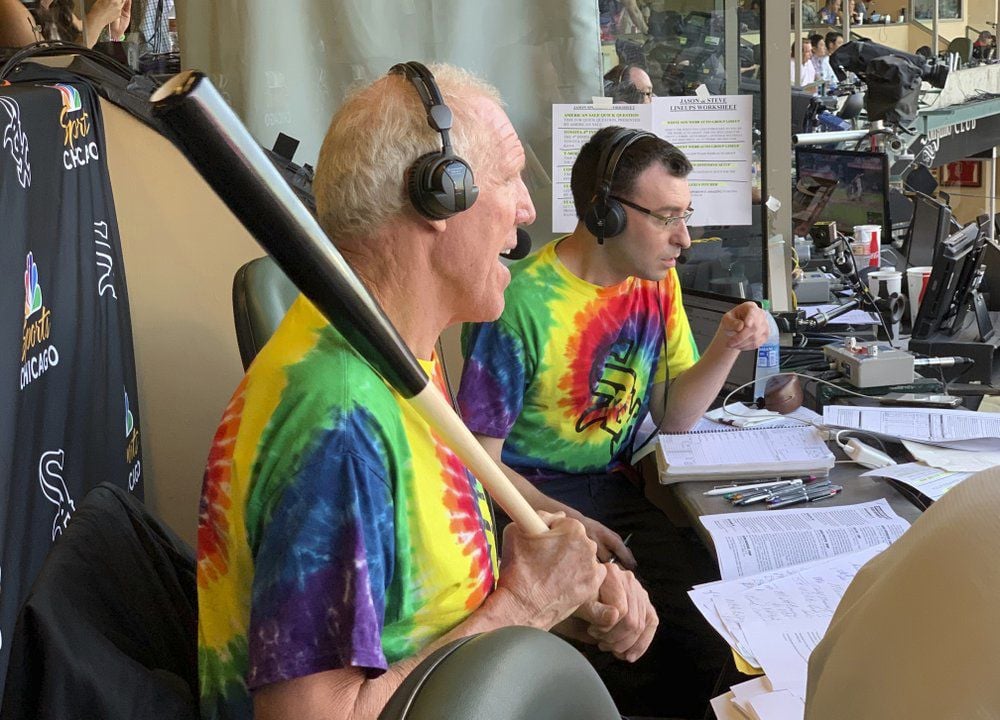
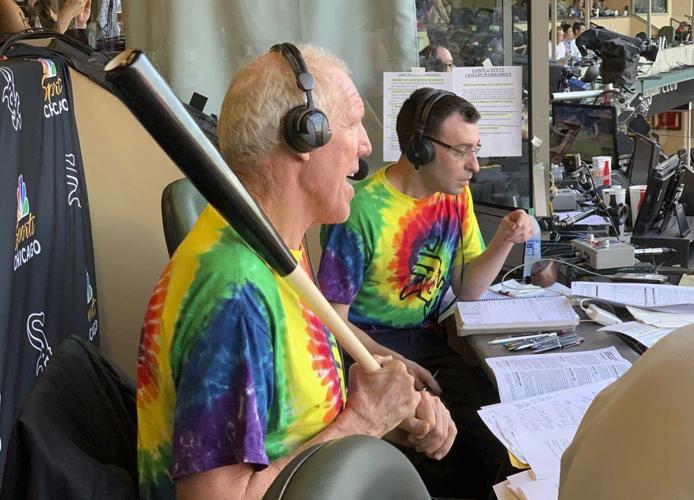
Bill Walton does commentary on NBC Sports Chicago for the Chicago White Sox's baseball game against the Los Angeles Angels on Friday, Aug. 16, 2019, in Anaheim, Calif. Walton was calling the game on an invitation from the White Sox and announcer Jason Benetti, right. (AP Photo/Joe Reedy)
The guy who couldn’t or wouldn’t talk talked relentlessly any time the microphone was turned on. Listen to his podcast interview with Axelrod, Obama’s political strategist. Go directly to YouTube and search for clips of the night Walton called a White Sox/Angels’ baseball game with his friend Jason Benetti. Everybody fell in love with his work with ESPN announcer Dave Pasch or stuff at the Maui Invitational.
The Bill Walton experience was unlike anything you’d get from Billy Packer, Al McGuire, Dick Vitale, Bill Raftery, John Thompson, Jay Bilas or the thousands of guys fixated on explaining how to defend the pick and roll.
Walton mixed in music recommendations, pop psychology, world history, Pac-12 cheerleading, orthopedic advice, UCLA adulation, hallucinogenic experiences and occasional basketball tidbits.
Bill Walton was always the Most Interesting Man in the Room.
On Monday morning the room became considerably less interesting. I've never seen love for a sports guy like the love I saw for Bill Walton on social media Monday.
Thanks Bill Walton, for making me a college basketball fan, teaching me about the Grateful Dead, spreading your irrepressible joy for life and talking to me about Derek Smith.
Copyright 2024 WDRB Media. All rights reserved.


