
LEXINGTON, Ky. (WDRB) – I’ve said it before in this space, and I almost feel a little guilty saying it, where the current University of Kentucky basketball team is concerned. It is a team that has everything. The only question mark is coaching.
This Kentucky team has John Calipari written all over it. Whoever you are in college basketball, on this team, he has more NBA talent than you have. He has four NBA guards. He has size and shot blocking. He doesn’t have a ton of experience, but he has enough experience.
There are very few college freshmen in the country who were more ready to play high level competition, right out of the box, than Reed Sheppard, Robert Dillingham and DJ Wagner.
All of the pieces are there.
The only question is whether Calipari will be able to put them together. On that, the jury remains out, a little more than halfway through the season. But the jury at this point has some cause to be skeptical.
On Wednesday night, Kentucky was down a couple of pieces. Wagner was out with an ankle injury, and Justin Edwards was out with a knee injury. That still leaves five NBA-caliber players on Kentucky’s roster. Florida may not have any.
To call Kentucky “shorthanded” is to invite eyerolls from most coaches in the SEC, if not the country.
Yet that was one of the explanations offered when the Wildcats walked away with a 94-91 overtime loss to Florida after leading by four with 37 seconds left in regulation. It was the second time in the past two-and-a-half weeks that Kentucky had scored better than 90 points but lost in overtime to an unranked team. And this time was at home.
Up two with 13.5 seconds left, Dillingham made one of two free throws. Kentucky did not foul Florida as it got into its halfcourt offense, and Walter Clayton Jr. made them pay, pump faking, waiting for Sheppard to fly by, then draining an open three to tie the game with three seconds left.
There was much to question about the late-game strategy: Inbounding the ball to Dillingham, instead of Sheppard or Antonio Reeves – in the late free throw situation. The decision not to foul and send Florida to the line when up 3 with less than 10 seconds to play. The decision not to call a timeout before trying to inbound the ball and score with three seconds left. Indeed, the decision not to substitute – at all – for nearly 13 minutes of game time (the last 10:35 of regulation and first 2 minutes and change of overtime).
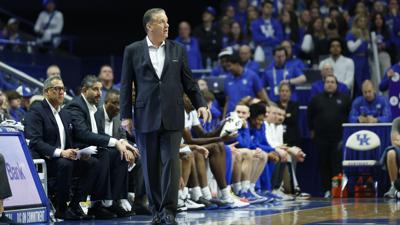
“There was a little more time than we wanted,” Calipari said when asked why he didn’t foul at the end of regulation. “But everything we were doing was to make them shoot some, too. And the kid drove it in the lane and one of my guys just left his man and he threw it out. So if we were going to foul with that much time against a really good rebounding team, it’s just dangerous and I would rather play it out. And I thought they played it out pretty good.”
The player that left Clayton was Sheppard. Calipari said of his lapse, “I’m owning it up to, they were exhausted. Like the last three, why did you leave that guy? We were guarding the three-point line and he stopped in the lane and you left your man. Why did you do that? Well, he’s probably exhausted.”
Sheppard played all 45 minutes of the game and scored a team-high 24 points to go with eight rebounds and six assists.
Calipari said others were tired. Dillingham played 39 minutes off the bench. Tre Mitchell played 38.
But over on the bench, Calipari had Aaron Bradshaw, who played only nine minutes. Adou Thiero played just 15. Jordan Burks clocked two minutes.
“Let’s put it to playing too many minutes,” Calipari said. “I had no choice. I had to. . . . Adou hurt his back and was giving us whatever he could.”
That Calipari would say he had no choice is a concern. Coaches always have a choice. There was more talent on his bench than Florida’s. Kentucky played basically six guys. Florida played seven.
All of that game management stuff, however, is secondary to a bigger question about defense. Many of us, convinced that Kentucky has an abundance of talent, have argued that the defense would come in time, and that the offense is good enough that the defense doesn’t have to be elite.
But Kentucky does have to be able to stop drives to the basket. And it has to stop giving up three-pointers in big numbers. It gave up 12 to Florida, and that was the difference in an otherwise close game.
It needs weapons defensively, to be able to switch defenses once in a while, to pick up all over the court as a change of pace.
I still don’t think it is time for Kentucky to panic. These games can make Kentucky tougher come March. But losses like Wednesday’s also will give Kentucky a worse seed come March. Kentucky can beat anyone in the country. But throw it into a tough 4-5 matchup and anything can happen. And lately those postseason things haven’t been good. Kentucky hasn’t been to a Final Four since 2015.
Kentucky, with this kind of roster, shouldn’t have home losses to UNC Wilmington and Florida on its resume. This roster was supposed to call back the echoes of great UK teams that overwhelmed opponents – especially visitors to Rupp Arena.
Instead, it is calling back the echoes of recent NCAA flameouts.
And it is calling into question Calipari’s ability to get the program back where it wants to be. He is a Hall of Famer, deservedly so. He has never completely gotten his due as a coach of the game. And again, he has amassed a wonderfully talented team. And it’s a tough thing, when there are so many young players involved.
But as fans watch other top programs take turns making Final Four runs, Kentucky can’t help but ask, more insistently now than in other seasons, when its turn will come again?
And will Calipari be the one landing the plane when it gets there?
Copyright 2024 WDRB Media. All Rights Reserved.