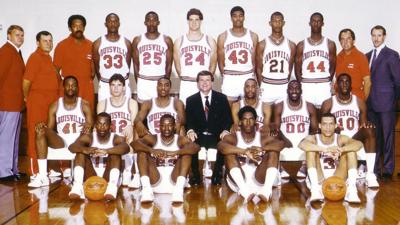

LOUISVILLE, Ky. (WDRB) -- They didn’t walk into arenas. They arrived. Shoulders back, warmups crisp. The 1986 Louisville Cardinals didn’t just play basketball, they made it look like jazz in sneakers.
It may be tough for fans who weren’t around in the 1980s to understand how big Louisville basketball was. But when they talk about the program getting “back to where it belongs,” those are the teams it wants to get back to.
Louisville | Kentucky | Indiana | Eric Crawford
“I remember as a young player, when Louisville took the court, it was hard for me to imagine anyone cooler than those guys at that time,” Duke guard Johnny Dawkins once said.
They walked into arenas like they owned the floorboards. They played like they were cutting their own highlight reel. They dunked because layups were too quiet. Forty years ago, the 1986 Louisville Cardinals weren’t just a team — they were a vibe.
And this weekend, the champions return. They’ll be honored at the KFC Yum! Center Saturday when Louisville faces SMU.
No, not all of them. Denny Crum, sadly, is gone. So are Jerry Jones and Dr. Rudy Ellis. Pervis Ellison can't make it back. Kenny Payne, now an Arkansas assistant, has a game against Kentucky. Mark McSwain, who now owns Subway shops in Belgium, couldn’t swing the trip. But enough of them are coming to make the KFC Yum! Center shake with echoes of Freedom Hall.
Billy Thompson, a minister who will be preaching in Southern Indiana on Sunday morning, will be back, Milt Wagner, Herb Crook, Robbie Valentine, Jeff Hall, Tony Kimbro and most all of the others will be back.
It’s easy to forget now — in an age of NCAA droughts and coaching changes and tortured rebuilds — but from 1980 to 1986, Louisville basketball wasn’t just great. It was gospel. The Cardinals didn’t just win, they influenced. They didn’t just contend, they styled. And in 1986, they were the last team standing.
But they didn’t exactly waltz to the podium.
“We always did things the hard way,” Milt Wagner said, grinning.
Midway through February that year, the Cards were 15-7. They’d lost to Kentucky, Memphis, Cincinnati, Kansas — twice — and N.C. State. They were down in the polls, down in the Metro, and down in most people's NCAA bracket projections. Maybe the magic that had led the program to a national title and three Final Fours in four years had gone away.
Not quite.
Nine straight wins. Metro champs. A No. 2 seed. Drexel in Round 1 (famously described by Wagner as “one of those academic schools”). Then Hersey Hawkins and 31-2 Bradley. Then Brad Daugherty, Kenny Smith and mighty North Carolina. Then Chuck Person and Auburn. Then LSU, who’d upset Kentucky, the matchup Louisville wanted.
Then came Duke. Johnny Dawkins. Tommy Amaker. Jay Bilas. A team so sure of itself it had already sized its championship rings.
Bad idea.
“They were tired by the end,” Wagner said. “We wore them down. We threw fresh bodies at them. Eventually, they stopped making the shots they made early.”
Denny Crum, calm as bourbon in a Waterford glass, switched to a box-and-one and sent Jeff Hall to tail Dawkins like a detective with a notepad. On offense, it was Billy Thompson, and then Pervis Ellison, the freshman who didn’t know he wasn’t supposed to dominate.
“We didn’t even know how special he was yet,” Wagner said. “He just kept getting better.”
Ellison finished with 25 points and 11 rebounds. He vacuumed up a Hall airball and dropped it in to make it 68-65. Then Wagner — who’d missed the entire ’85 season with a broken foot, redshirted, and come back with only one thing on his mind — stepped to the line.
Two shots. Game on the line. No three-point arc. Two seconds left.
“I always wanted the ball in money time,” Wagner said. “Always.”
Swish. Swish. Raise the hands. Raise the trophy.
And Robbie Valentine? He didn’t play a minute that night.
But his story — and his smile — shone just as bright.
“I’ll tell you what that game did for me,” Valentine said. “It helped me in life. To know I was part of something that big.”
Valentine, who helped organize the reunion, reminisced about summers at Crawford Gym, where young Cards took beatings from Darrell Griffith, Junior Bridgeman, Scooter and Rodney McCray. “They didn’t just show us how to win,” he said. “They taught us.”
Both he and Wagner spoke with emotion about Denny Crum, their Hall of Fame coach who rarely swore, who turned boys into men, who found diamonds in the rough and fashioned them, patiently, into champions.
“He never had to curse to get his point across,” Wagner said. “But you knew exactly what he meant.”
“He sat in that same chair in the Yum! Center for 15 years,” Valentine added. “I walk by it every day. It still feels like his seat.”
(A quick aside. I've written about my last little "moment" with Crum. At the Dedication of Denny Crum Hall. He'd gone to some effort to be there, and sat with many fans and friends who wanted pictures with him. At some point, he was sitting there by himself and his attention was drawn by a giant screen showing highlights from old games. I just started snapping photos of him, lost in the game. One of the games playing was the 1986 NCAA Tournament win over North Carolina. I always wondered what he was thinking as he watched that. He noticed me taking his photo shortly after and winked.)
And then there’s Payne. The wounds of his two-year coaching tenure are still fresh for some fans. (My online friend and frequent correspondent Jerry Tubb says "some" is an understatement. Perhaps he is right.) I wonder if it has soured the opinion of some fans on the accomplishments of those players.
I hope it hasn't. What they did was part of the foundation for everything that came after. They changed the course of the city, and the university. Payne was part of that. His coaching failures here should not tarnish the legacy of those years.
That brotherhood, forged in film sessions, fueled by full-court presses, and made eternal in March, is why they’ll walk out to center court Saturday, older, grayer, slower, but no less proud. Crum said they ran his offense better than any team he ever coached.
And Wagner could still hit two free throws, if you put him at the line.
The banners don’t lie.
On Saturday, if only for a few shining minutes, they’ll be young again.
And still the coolest team in the room.
More Louisville Sports Coverage:
CRAWFORD | Pat Kelsey owns 'butt kicking' at Duke. But is there a fix for Louisville?
CRAWFORD | The art of vanishing: Louisville demolished at Duke, 83-52
Louisville's 2026 football schedule: Friday nights, Ole Miss opener, FSU visit
No. 8 Louisville extends win streak to 12 games with 85-56 victory over Boston College
Copyright 2026 WDRB Media. All Rights Reserved.


