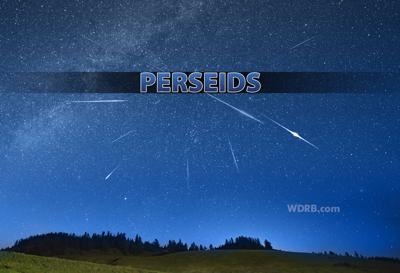

The Perseids meteor shower, which peaks in mid-August, is considered the best of the year. With swift and bright meteors, Perseids frequently leave long “wakes” of light and color behind them as they streak through Earth’s atmosphere. The Perseids are one of the most plentiful showers with about 50 to 100 meteors seen per hour.
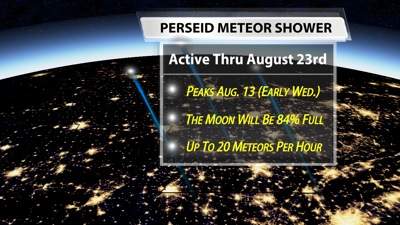
This year, visibility will be hampered by an 84%-full Moon on the peak night. Brighter meteors may still be seen in the pre-dawn hours, but moonlight may wash out fainter meteors. Up to 20 meteors per hour should be the average, which offers one every three minutes. While viewing conditions aren't ideal, my advice would be to get as far away from city lights as possible. Give your eyes about 30 minutes to adjust, sit back, relax, and enjoy the show.

Viewing Tips
The Perseids are best viewed in the Northern Hemisphere during the pre-dawn hours, though at times it is possible to view meteors from this shower as early as 10 p.m.
Where Do Meteors Come From?
Meteors come from leftover comet particles and bits from broken asteroids. When comets come around the Sun, they leave a dusty trail behind them. Every year Earth passes through these debris trails, which allows the bits to collide with our atmosphere and disintegrate to create fiery and colorful streaks in the sky.
The Comet
The pieces of space debris that interact with our atmosphere to create the Perseids originate from comet 109P/Swift-Tuttle. Swift-Tuttle takes 133 years to orbit the Sun once. It was Giovanni Schiaparelli who realized in 1865 that this comet was the source of the Perseids. Comet Swift-Tuttle last visited the inner solar system in 1992.
Comet Swift-Tuttle was discovered in 1862 by Lewis Swift and Horace Tuttle. Swift-Tuttle is a large comet: its nucleus is 16 miles (26 kilometers) across. (This is almost twice the size of the object hypothesized to have led to the demise of the dinosaurs.)
The Radiant
Their radiant – the point in the sky from which the Perseids appear to come – is the constellation Perseus. This is also where we get the name for the shower: Perseids. However, the constellation for which a meteor shower is named only serves to aid viewers in determining which shower they are viewing on a given night. The constellation is not the source of the meteors.


