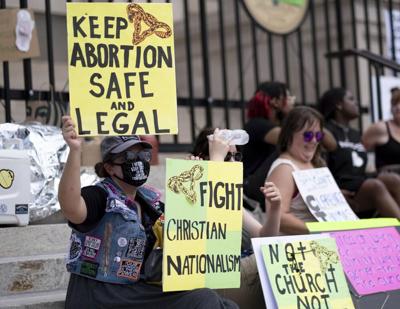


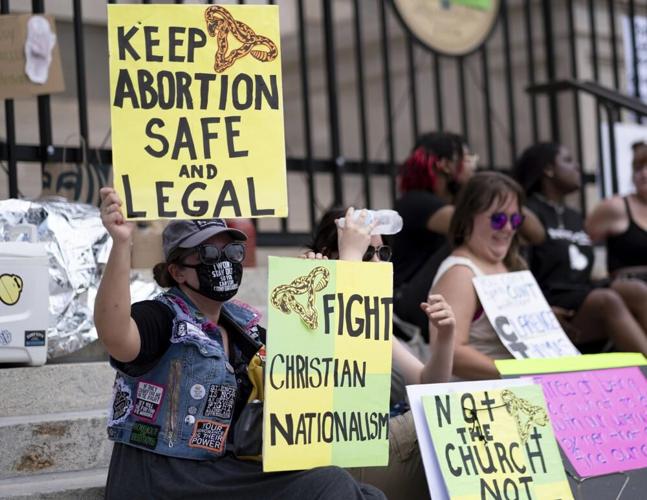
FRANKFORT, Ky. (WDRB) -- Kentucky's abortion ban will remain in effect for now, the state Supreme Court ruled on Thursday.
The high court sided with Attorney General Daniel Cameron and ruled that a Louisville circuit court "abused its discretion by granting abortion provider's motion for a temporary injunction."
The court, which was weighing challenges to the state’s near-total ban and a separate one that outlaws abortion after the sixth week of pregnancy, sent the case back to a lower court for further consideration of constitutional issues related to one of the bans.
While the temporary injunction was improper, Justice Debra Hembree Lambert, who authored the majority opinion, wrote, "To be clear, this opinion does not in any way determine whether the Kentucky Constitution protects or does not protect the right to receive an abortion, as no appropriate party to raise that issue is before us.
"Nothing in this opinion shall be construed to prevent an appropriate party from filing suit at a later date."
Following the ruling, Cameron released this statement:
“Since the U.S. Supreme Court overruled Roe v. Wade last June, we have vigorously defended Kentucky’s Human Life Protection Act and Heartbeat Law. We are very pleased that Kentucky’s high court has allowed these laws to remain in effect while the case proceeds in circuit court.
"This is a significant victory, and we will continue to stand up for the unborn by defending these laws.”
The case before the court is the first legal test since voters in Kentucky and three other states signaled their support for abortion rights in the midterm elections.
Kentucky’s near-total trigger law ban was passed in 2019 and took effect when the U.S. Supreme Court overturned Roe v. Wade. It bans abortions except when they're carried out to save the life of the mother or to prevent disabling injury. It does not include exceptions for cases of rape or incest.
Leaders from Planned Parenthood Federation of America, the American Civil Liberties Union, the ACLU of Kentucky on behalf of EMW Women’s Surgical Center and Planned Parenthood Great Northwest, Hawaii, Indiana, Kentucky issued a statement saying "the fight is not over."
“Once again, the Kentucky Supreme Court failed to protect the health and safety of nearly a million people in the state by refusing to reinstate the lower court order blocking the law," according to the statement. "Even after Kentuckians overwhelmingly voted against an anti-abortion ballot measure, abortion remains banned in the state. We are extremely disappointed in today’s decision, but we will never give up the fight to restore bodily autonomy and reproductive freedom in Kentucky."
In July, a Louisville judge said the new, post-Roe abortion bans likely violate "the rights to privacy and self-determination" protected by Kentucky's Constitution.
Jefferson Circuit Court Judge Mitch Perry said it was not the court's role to determine whether the state Constitution contains the right to abortion, but whether the state's restrictive laws violate freedoms guaranteed by its Constitution.
Perry had issued a temporary restraining order blocking the state's abortion ban. The fact that the temporary injunction was granted meant the state ban was suspended while the case is litigated.
The Supreme Court ruled Friday the "temporary injunction was unsupported by sound legal principles, and as a result, the temporary injunction must be vacated, and this action must be dismissed for lack of standing."
Justice Angela Bisig disagreed with the majority, writing the justices were retreating from "the duty of judicial review by failing to evaluate whether Plaintiffs present substantial allegations that the Bans unconstitutionally prohibit the women of this Commonwealth from obtaining reproductive healthcare.
"In so doing, the majority’s decision permits the criminal prosecution of persons who assist incest and rape victims in terminating a resulting unwanted pregnancy"
And Bisig was especially critical of the majority opinion that allowing the ban to stand until the case is litigated would not cause irreparable harm.
"If the Bans’ result of causing physicians to withhold 'life-saving treatment' from patients—the obvious result of which is death of the patient—is not irreparable harm, what is?" she wrote.
The case has been sent back to Perry so a "full evidentiary process" can be completed and he can make a decision on the merits of the case and then be ready for an appeal to the higher courts, Justice Kelly Thompson wrote.
"It is frustrating that we cannot reach the ultimate issues at this juncture, but in light of the current posture of the case, we must return the matter to the trial court to resolve expeditiously," he wrote. "We can then engage in a full review of the constitutionality of these statutes, as soon as reasonably possible."
In arguments on Nov. 15 before the high court last year, ACLU of Kentucky attorney Heather Gatnarek represents Kentucky's last two remaining facilities that provide abortions, EMS Women's Surgical Center and Planned Parenthood in Louisville. She argued that the state's ban on abortions interfere with a woman's right to medical care.
"Doctors are supposed to treat their patient holistically and with an eye toward the patient's needs, interests, self determination through that time, and they are currently unable to do so while these laws are enjoined," Gatnarek said.
Kentucky voters said no to Amendment 2 on election day, which would have denied constitutional protections for abortion, so the arguments before the state's high court took on an added urgency, as abortion opponents seek a temporary stay on the ban.
Matthew Kuhn, from the Kentucky Attorney General's office, asked the court to ignore the outcome of Amendment 2 during the arguments.
"I think if the court is going to read an implicit right to an abortion in, you have to have got to have historical evidence, and there's none -- none at all -- from our constitutional debates," Kuhn argued.
He argued that the General Assembly hasn't had a chance to weigh in since election night when Constitution amendment was struck down, but Deputy Chief Justice Lisabeth Hughes said it's not all up to the General Assembly. She added that it is the job of the courts to interpret the constitution.
"I think history agrees there were no women at the 1890 constitution. Women did not have the right to vote in 1890. Women could not even own their own property," Hughes said.
Arguments focused on Kentucky's trigger law, which does not have any abortion protections for victims of rape and incest. Kuhn suggested that state legislators could fix that in next session. While Justice Michelle Keller said timing is critical since pregnancies are time sensitive and could be a life or death situation.
Cameron has said there's "no right to abortion hidden in Kentucky's Constitution." He said abortion policy should be left up to the state's legislature, where GOP majorities have passed a series of anti-abortion measures in recent years. Cameron is among several Republicans vying to challenge Beshear's reelection bid in 2023.
This story will be updated.
Copyright 2022 WDRB Media. The Associated Press contributed to this article.