
LOUISVILLE, Ky. (WDRB) -- Jefferson County Public Schools Superintendent Marty Pollio understands the daily struggle of getting kids ready for school and out the door in time to catch the bus.
The first wakeup call for his daughter, who is in high school, comes at 6 a.m. Monday through Friday so she can make her 6:50 a.m. bus ride. The alarm clocks for those who must traverse longer distances throughout Jefferson County go off earlier, and not getting to the bus stop in time can mean missing school entirely for thousands of middle and high school students in west Louisville.
“Students that are traveling a good distance — many of them primarily in west Louisville that have to get on a bus and go across town — are going to have to get up before 6 a.m.,” Pollio said. “...If my child misses the bus, I put her in the car real quick, and I get her there, but if you're going to have to go 20, 25 miles, that becomes very challenging.”
As JCPS looks at ways to improve student attendance, Pollio believes pushing back start times for middle and high schools as little as 20 minutes will have a significant impact on that front and others affecting students.
Some 55,000 students missed at least six days of classes in the 2018-19 school year, more than half of the nearly 100,000 students who attend JCPS, he said.
Pollio publicly raised the prospect of changing school start times Wednesday during his State of the District address, and he told WDRB News on Friday that such a move would dovetail with the district’s efforts to revamp its student assignment plan, particularly an option on the table for families in west Louisville to have the option of attending middle and high schools closer to home rather than being bused across the county.
“We have nearly 7,000 students in west Louisville that are middle and high school students, and about 70% of those students leave the community every day get on a bus go up many miles away, and it's not their choice to do that,” Pollio said.

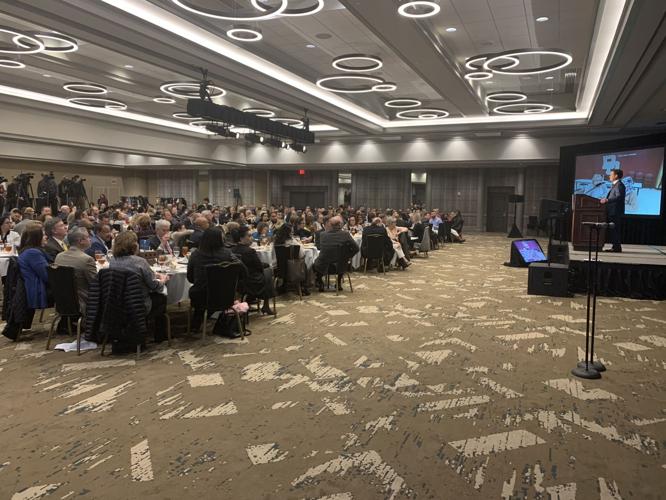
JCPS Superintendent Marty Pollio gives his second State of the District address at the Galt House on Feb. 26, 2020.
Pollio and his team are exploring various options to allow older students to start school later in the morning. If successful, the new school start times would likely take effect in the 2021-22 school year alongside any revisions to the district’s student assignment plan, he said.
One idea would flip the 9:05 a.m. start times for elementary schools and the 7:40 a.m. start times for middle and high schools. Another would keep all JCPS schools from starting before a certain time, like 8 a.m. or 8:30 a.m. Still another would add a third start time to the mix, allowing some schools to start as late as 8:45 a.m. and potentially saving the district more than $10 million with fewer buses on the roads.
“I think it does a lot of things around their mental health, around their attendance in school, around their ability to be engaged at school,” Pollio said Friday. “All of those things come into play.”
There’s no concrete proposal on the table for the Jefferson County Board of Education’s consideration, but Pollio stressed that delaying school start times for older students at JCPS is an initiative he’ll be advocating for as the district contemplates changes to its student assignment plan.
He expects the board will vote on student assignment changes at its June business meeting, and if he has his druthers, approval of a new middle school in west Louisville will also be on the agenda that day.
Pollio noted that the Academy @ Shawnee’s long-condemned third floor will be undergoing renovations in a matter of weeks, soon increasing the school’s enrollment capacity. A new middle school in west Louisville could be open in time for the 2022-23 school year, he said.
“There are a lot of moving parts in this to make it work, but in the end, the goal is to give families more options, to really take away that any of that talk around forced busing,” Pollio said. “… No one will be forced to go anywhere. Everyone will have choice and options to have new facilities and to actually have a later start time for the health of our kids.”
Pollio isn’t alone in his thinking that pushing back start times will positively impact attendance and other areas of student achievement.
Robin Weiss, a parent of four current JCPS students and five graduates, says her older children must be up by 5:30 a.m. to catch their 6:09 a.m. bus to start school at 7:40 a.m. The early start and the rush to get to school means her kids aren’t getting the eight hours of sleep they need, particularly when you factor in afterschool activities like jobs, sports and other extracurriculars, she said.
“It's harder to get them up in the morning,” Weiss said. “They really struggle. Even when they're at school they're very grumpy, and we know that's not their natural circadian rhythm for teenagers. We act like this is a character flaw, but it's truly, literally just about their body chemistry.”
Studies have shown that delaying school start times by 30 minutes can make a major difference in students’ daily lives, said Weiss, who specializes in maternal child health.
The U.S. Centers for Disease Control and Prevention recommends at least eight hours of sleep for teenagers, saying early school start times are to blame for older students not getting enough rest.
The American Academy of Pediatrics suggests that middle and high schools not start classes earlier than 8:30 a.m. In a 2014 study, the group cited research that found pushing start times back an hour resulted in about half an hour of extra sleep for youth while delaying school half an hour allowed students to get an extra 45 minutes of shuteye.
“We know that when we get enough rest we're in better moods, we're less easily annoyed, less likely to pick fights, more likely to pay attention,” Weiss said, adding that such changes can make a difference in student achievement and behavior.
“All of that seems like it's in everyone's favor,” she said.
Getting community support behind such a substantial change will be a challenge, and Pollio says various factors, such as older students who provide childcare for their younger siblings or hold jobs to help their families make ends meet, will need to be considered before a proposal can be finalized.
“I've always felt like if we keep children at the center of the decision, what's best for children and what's best really for their health, their achievement, their attendance, if we keep that number one then we'll make the right decision even if that means folks some folks are upset,” Pollio said.
Copyright 2020 WDRB Media. All Rights Reserved.


