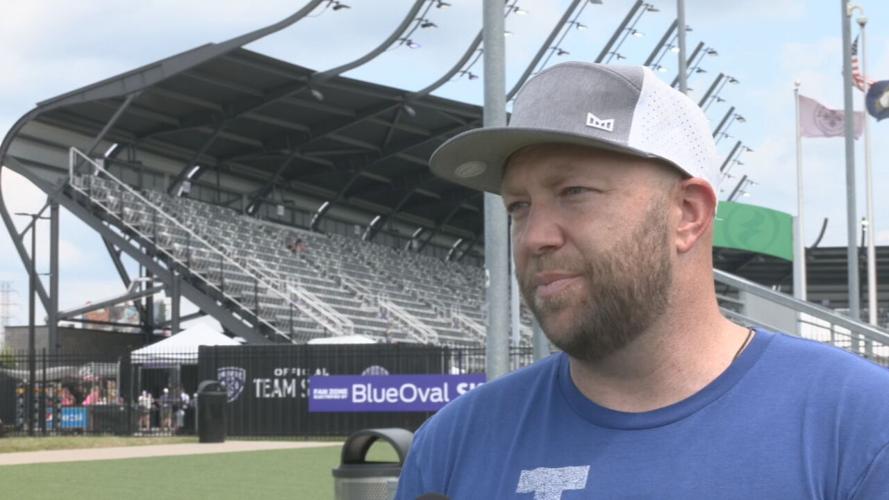
LOUISVILLE, Ky. (WDRB) -- On a sweltering day in late June, Adam Lapidus took in his first views of Lynn Family Stadium before Racing Louisville FC kicked off against Bay FC in a National Women's Soccer League game. Lapidus, who was visiting from Missouri, called it a "beautiful stadium."
But he noted that soccer clubs in places like St. Louis and Dallas have something Louisville does not: development surrounding the sports venues.
"I think it's fantastic, because everything's very walkable and easy to get to," Lapidus said of those other cities. "And that's really how you're going to bring more people in and really expose them to this great game that we have."

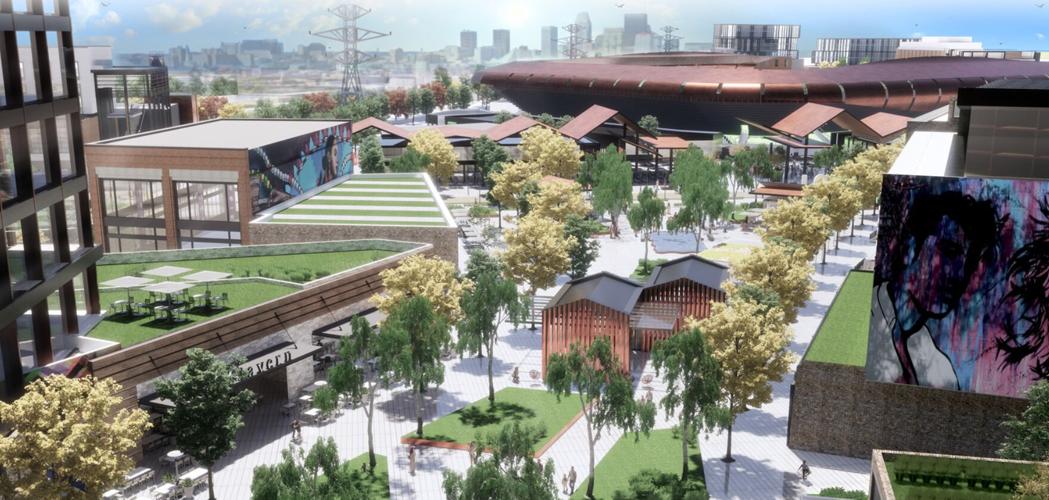
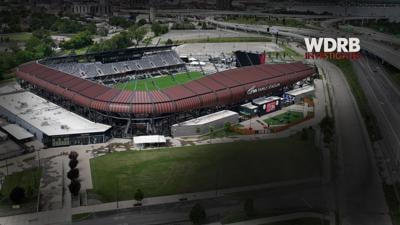
The stadium's backers proposed an entirely new district on more than 30 blighted acres near Waterfront Park: two hotels with 308 rooms between them, 340,000 square feet of office space and roughly 70,000 square feet of retail and restaurant space. Photo courtesy of NB Develop/ButchertownLou.com.
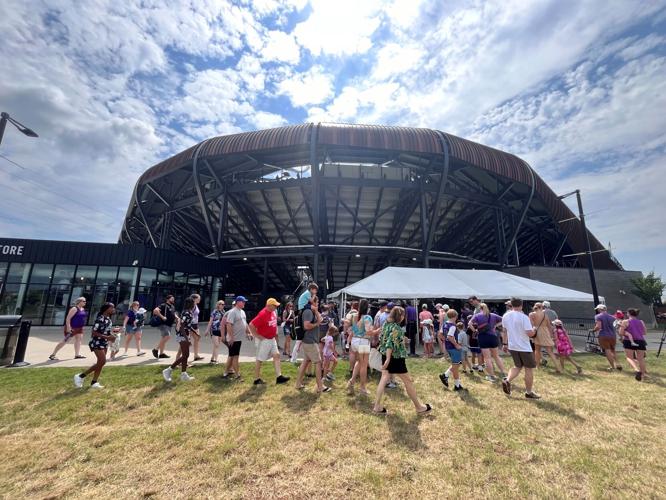
Built on a former industrial site in Butchertown, Lynn Family Stadium has been home to pro teams Racing Louisville and Louisville City FC since opening in 2020 and has hosted concerts, farmers' markets and other events, including a Juneteenth celebration last month.
Yet the broader plan for the entire 37 acres remains years behind schedule. In pursuing city and state funds, the ownership group promised to have a stadium-centered district with hotels, offices and restaurant and retail space in place by now.
A WDRB News investigation last year found that those initial plans had changed, with apartments now part of the mix along with a "large family entertainment opportunity." Announcements on the next phase of the overall development were expected by fall 2023, but that didn't happen.
Now, more than four years after the stadium opened, there still is little to show for the nearby areas. As a result, the economic boost predicted for local and state governments hasn't materialized — a shortcoming being noted in Louisville's halls of power.
"There's nothing going on at the soccer stadium but good soccer — let me make that real clear," Robin Engel, R-22, said at a June meeting of the Metro Council's labor and economic development committee.
Engel, the committee's vice chair, was taking aim at a proposal to use tax increment financing (TIF) for the Urban Government Center redevelopment project. The soccer stadium district was approved for more than $20 million in state TIF subsidies, while the Metro Council agreed to dedicate local property tax revenue to reimburse the city for its upfront contribution.
"There's good soccer going on, and I was for soccer," Engel said. "You know, we throw these TIFs around anymore these days like it's chump change."
While there has been no movement at the site or public updates on the plans, ownership group Soccer Holdings told WDRB in response to emailed questions that the sports district project is "moving forward."

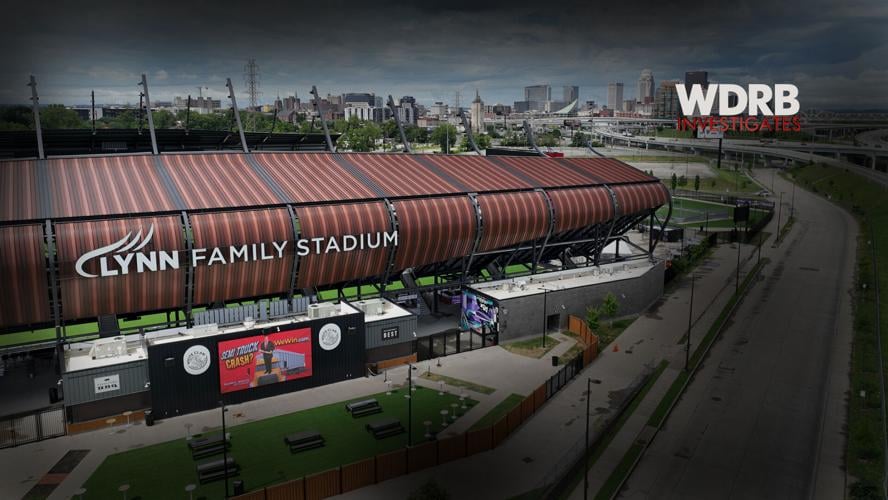
Lynn Family Stadium, June 29, 2024 (WDRB photo)
"We faced obstacles in transforming the surrounding land from the beginning given (that) Lynn Family Stadium opened during the COVID-19 pandemic," the group said in a statement. "However, we are happy to report that we've narrowed our search for a developer to two. Our focus is on choosing the right partner to make the Butchertown Sports District a reality."
It declined to answer a question about what is currently planned there and a timeline for the next steps, saying only that stadium owners are working with Mayor Craig Greenberg's office and "we look forward to announcing more in due time.
"As with our soccer teams and our stadium, when we do this, we are going to do it right," the statement said.
The Butchertown district got a boost this year when the Kentucky General Assembly included it among six downtown-area Louisville projects that will receive $100 million over the next two years.
Greenberg spokesperson Kevin Trager said in an email that "discussions are ongoing" about how exactly the money will be used. In March, as the mayor was lobbying the legislature, he suggested the funds could be used to help raise part of the site out of the floodplain and make it safe for pedestrians.
"There is a significant amount of infrastructure work that needs to be done to develop these projects into a mixed-use neighborhood, but we're still early in that process," he said.
Metro government issued $30.4 million in bonds to buy the Butchertown land and cover other site development costs. Factoring in interest, the city's overall commitment on the bonds is $43.7 million by 2039.

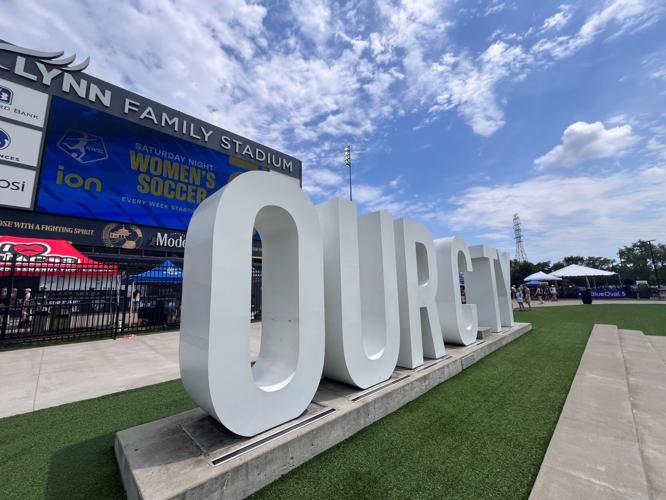
Soccer fans outside Lynn Family Stadium before the June 29, 2024 match between racing Louisville and Bay FC (WDRB photo)
The development agreement brokered by former Mayor Greg Fischer's administration requires the soccer group to pay the city $14.5 million through lease and other payments, such as the purchase price from any lots that are sold.
The city also dedicated local property taxes generated at the site to help reimburse its upfront investment. Those revenues are estimated at $12.8 million over a 20-year period starting in 2020.
But with the adjacent development not yet built, those receipts are well below expectations.
In a four-year period from 2020-23, estimates called for $1.6 million in new property tax revenues for Metro government. But the city has instead received roughly $145,184, according to WDRB's analysis of the site's most recent annual tax bill.
State taxes also have fallen below expectations, according to reports obtained under public records requests. In 2022, the most recent year for which documents were available, the site generated $1.03 million in state sales, property and withholding taxes. A consultant had predicted $2.8 million in those taxes for that full year.
The stadium site's tax obligation has been kept down as a result of successful appeals in recent years of the value proposed for tax purposes by Jefferson County Property Valuation Administrator Colleen Younger's office.
Her office reassessed the property at $11.1 million in 2021, but the ownership group asked for it to be $5 million instead, according to the PVA. Ultimately, online tax records show, the assessment was dropped to $7.7 million.
The property was later reassessed once again at $11.1 million, but the owners also challenged and got it lowered to $7.5 million in 2023, the records show. It's that amount that the current taxes are based on.
In 2023, state government coffers received roughly $8,527 in property taxes from the site, according to the WDRB analysis, compared with $84.4 million originally projected with the stadium district up and running.

Adam Lapidus, who was visiting from the St. Louis area, attended the Racing Louisville match against Bay FC, June 29, 2024 (WDRB photo)
The city's overall financial contribution to the district, which was initially estimated to cost $190 million, is about 16%, according to estimates presented to the Metro Council in 2017.
And the clock is ticking on the state TIF, which began in 2019. As a result, the longer the ownership group waits to build around the stadium, the less public money it stands to gain. The 20-year subsidy expires in 2039.
The initial arrangement with Metro government that allowed the stadium to move forward is still "a good deal," said Metro Council member Kevin Kramer, R-11, who noted that the COVID-19 pandemic explains why some of what was planned at the site hasn't materialized.
"The hope would be that that they have something not just in the works, but that they have something that we will see soon," he said.
Meanwhile, attendance is growing at Racing Louisville matches at Lynn Family Stadium. Through the first seven home games this year, the average attendance of 7,314 is up 38% from the same period a year ago, when those games attracted 5,300 people on average.
"It's gotten a lot bigger," Alex Blair of Louisville said before the June 29 home game.
And while the crowds are increasing, Blair said she would welcome additional development around the stadium.
"A few more places down here that people could go to maybe before and after might be nice to bring more people in," she said, "just because it's a little isolated."

The Butchertown district got a boost this year when the Kentucky General Assembly included it among six downtown-area Louisville projects that will receive $100 million over the next two years.
Copyright 2024 WDRB Media. All Rights Reserved.