


LOUISVILLE, Ky. (WDRB) -- After more than four hours of debate and scrutiny, Jody Dahmer thought he and fellow neighborhood organizers had convinced a Metro government board to grant landmark status to a group of shotgun houses in Louisville's Meriwether neighborhood.
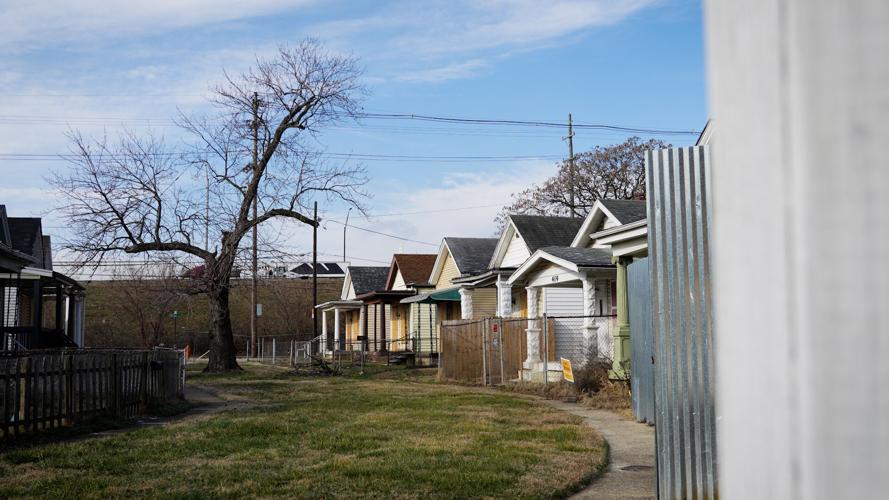
Their petition sought the designation for Lawton Court, a pedestrian avenue wedged in an industrial area near Preston Street and Burnett Avenue, not far from Interstate 65. Most of the houses are boarded up and owned by a nearby manufacturing company, CEPEDA Associates Inc., and set to be demolished.
The city's Historic Landmarks and Preservation Districts Commission agreed with the neighbors by a vote of 6-4. Ashlyn Ackerman, the acting chair, told those assembled at the city's Old Jail Building downtown: "All right, the motion passes."
Except it hadn't. Under a city ordinance amended in 2019, a majority of the total membership of the 13-person commission must approve individual landmarks — regardless of how many members actually are in attendance.
With two members absent and one abstaining during the Jan. 24 meeting, the Lawton Court proposal needed seven of 10 total votes to pass. The six votes fell one short.
"We had a majority vote and we had that sense of winning," Dahmer said. "And then it was pulled out from under us within five minutes."
The case highlights a rare standard among public boards and commissions in Louisville, where few have similar voting requirements, a WDRB News review has found. It's also believed to be the first time that a landmark petition failed while getting a majority of votes, according to the Louisville Forward economic development agency.

Jody Dahmer helped lead a petition drive to get landmark status for Lawton Court.
Martina Kunnecke, president of the Neighborhood Planning & Preservation Inc. advocacy group, said she is working with neighbors on possibly appealing the landmarks commission's action to Jefferson Circuit Court.
She questions why the "high bar" that applies to landmark cases isn't more widely used for other city business and notes that the vote threshold wasn't even mentioned at the January meeting.
"Why didn't they during the meeting say, 'Hey, folks, this is where we are quorum-wise and what the requirements of the law are.' There was nothing like that stated," Kunnecke said. "And many people are very, very upset that the landmarks commission appears not to know its own rules."
Metro Council approves changes
Most boards and commissions in Louisville need just a simple majority of members present to approve an action during a meeting.
WDRB reviewed the voting rules for more than 30 such panels whose duties are laid out in local legislation. Only the landmarks commission mentions the requirement that a majority vote of the overall body is needed for a particular action, such as approving a landmark petition.
Elsewhere, state law says a majority of the Louisville Metro Planning Commission's total membership is needed to adopt or amend the city's comprehensive land-use plan. Kentucky statutes also apply the same threshold for the Metro Council when voting to override a zoning recommendation.
The landmarks commission used to allow a simple majority for all its business, including designating landmarks. But that changed in 2019 when the Metro Council voted — without any opposition — to overhaul the ordinance after a special committee reviewed it.
Former Metro Council member Brandon Coan sponsored the ordinance and also chaired the special committee that met throughout 2019. Coan said he believed the landmarks commission faced an "existential threat" at the time because the council often took issue with the panel's rulings.
Coan's bipartisan committee, working with staff of the landmarks commission, made a number of changes to the ordinance. Among other things, it shifted the burden onto those seeking a landmark designation to provide information about the property and separated the process for an individual landmark and a broader district.
"We went over all the different changes and talked about how it was meant to be balanced and efficient and be good for preservation, but also make sure that it wasn't weaponized and abused in cases," he said.

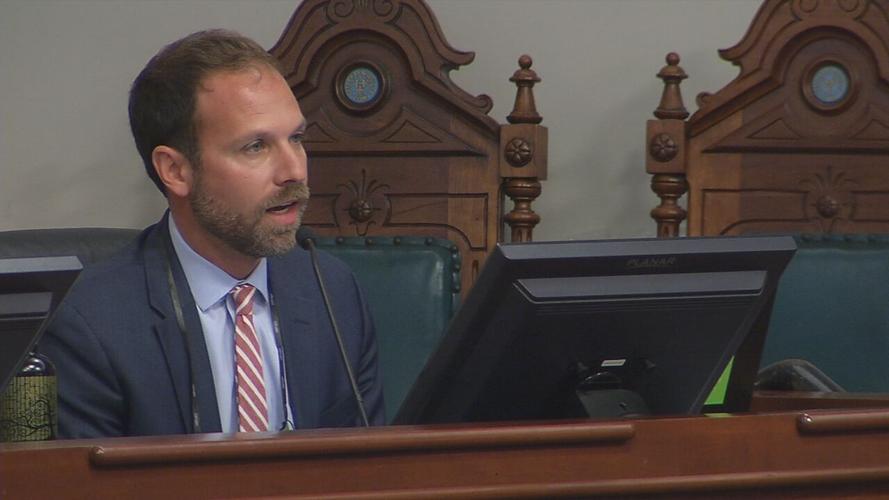
Louisville Metro Councilman Brandon Coan, D-8, speaks during a meeting Thursday, Oct. 22, 2020.
Coan recalled that changing the vote threshold was appropriate because designating a landmark or historic district has significant property rights implications. In addition, he added, members believed there should be broad agreement among the commission members that a property is special.
Coan said he personally would prefer a simple majority vote of the landmarks commission members present to approve a landmark petition.
"But the rule change we made was as a committee made up of all sorts of different people with varying levels of interest in preservation," he said. The ultimate legislation that passed the council "takes into account all those different perspectives."
'Unusual' voting threshold
From a national perspective, the landmarks commission's requirement is "really unusual," said John Pelissero, senior scholar in government ethics at the Markkula Center for Applied Ethics at Santa Clara University. Nothing similar in other cities came to mind during an interview this week.
"We have these bodies created for a reason and that is to act on behalf of those that they represent -- the public," he said. "And to be in a situation where public policymaking can be stymied because of this unusual higher threshold for a body to be able to take action certainly doesn't help the cause of good public policy."
David Morgan, who previously served as Kentucky's state historic preservation officer, spent three years on the landmarks commission but wasn't reappointed in late 2022 by then-Mayor Greg Fischer.
He said members were never notified of the different vote threshold during any of the landmarks petitions the board heard during his tenure. In fact, Morgan told a reporter: "Until you told me that, I don't think I knew it."
Before the Lawton Court hearing, he said commissioners should have been notified that seven votes would be needed for the petition to be approved.
"Staff should have sent out that notice saying, 'This is very important that you attend, because if you don't, we won't be able to get seven,'" Morgan said.
Louisville Forward spokeswoman Jody Hamilton said landmarks staff highly encourages attendance during cases like the Lawton Court petition, which usually are complicated and need a thorough review.
"Before this case specifically, Commissioners were not reminded of the voting requirement," Hamilton said in an email. "They have been informed in prior training and have copies of the ordinance during the hearing."
Two commissioners – Emily Liu, Director of Louisville Metro's Office of Planning and Design Services, and John Mays – did not attend the January meeting. Liu had a family matter that night, and Mays had a scheduling conflict, Hamilton said.
She said another commissioner, chair Morgan Ward, abstained from voting because his law firm, Stites & Harbison, does work with CEPEDA, and his participation could be viewed as a conflict of interest.
A narrow vote overturned
Advocates like Sarah Fisher pushed for the historic designation for the Lawton Court homes, helping collect 245 signatures for the petition that ultimately went before the landmarks commission.
Fisher, who lives in Meriwether, said she learned of CEPEDA's plans after it began filing demolition notices for the houses.
"I'm passionate about historical preservation. This is a unique street," she said. "Even before I knew about it, I saw it was visually unique. I had never seen anything like it before and wanted to be involved."
And, while outside of the scope of the landmarks commission, supporters of the landmark designation also were concerned about houses being torn down while Louisville has a documented lack of affordable housing.
Lawton Court is one of 22 pedestrian courts in Louisville, a list that includes examples such as the well-known Belgravia Court in Old Louisville, according to the landmarks commission's staff report. Most of those courts have bungalow or Craftsman-style houses.
The report found that Lawton Court is the only one with shotgun houses, which began being built in 1909.

The petition sought to categorize Lawton Court as an individual landmark, or "one of significant importance to the city, the Commonwealth, or the nation and which represents irreplaceable distinctive architectural features or historical associations that represent the historic character of the city, the Commonwealth, or the nation," according to the city ordinance.
Cliff Ashburner, an attorney representing CEPEDA, argued that the court doesn't meet those standards and said it would fit better under the landmark designation for a broader historic district.
"Lawton Court is old. Lawton Court is an old residential street," he said at the January 24 meeting. "Being an old residential street does not automatically make you significant."
After the 6-4 vote to approve the neighbors' petition, Ashburner moved to the podium and told the commission that the motion had, in fact, failed.
"The only way you can designate an individual landmark is by a majority of the entire commission," he said. "You needed seven votes in order to designate; you got six."
Maria Gurren, president of the Shelby Park Neighborhood Association, was among those who worked on the Lawton Court petition. She said advocates would have accepted a majority of the commission present voting against their proposal.
"I even said when I left the meeting: 'You hear folks in government talk all the time about wanting residents to get involved and be active and be engaged,'" she said. "And then people do turn out and show up to something like that and it's like, 'Well, you won, but you still lost' because of this loophole that no one knew about."

Copyright 2023 WDRB Media. All Rights Reserved.


