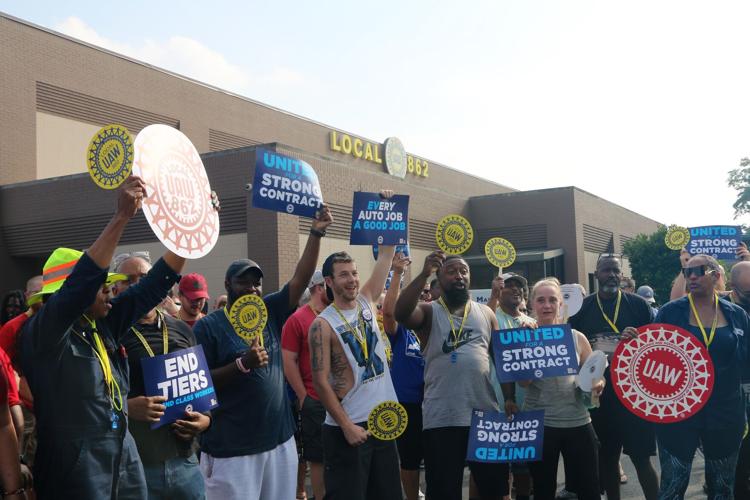
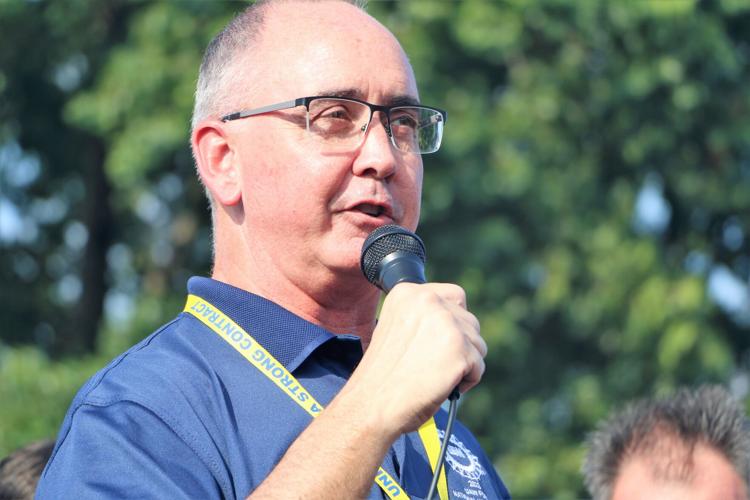
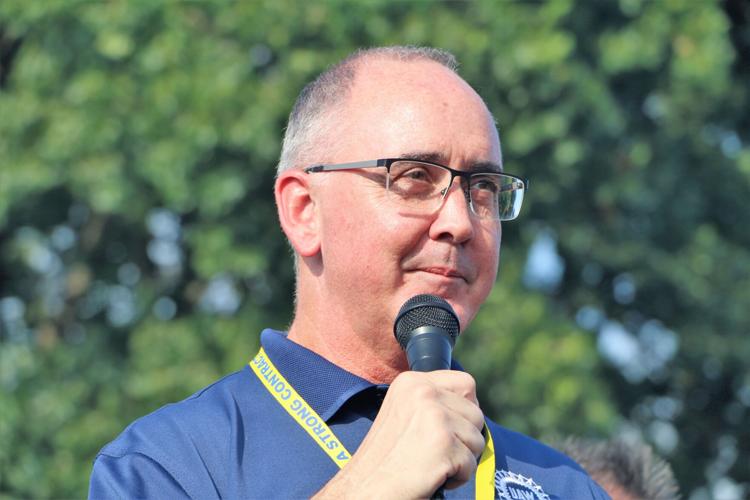
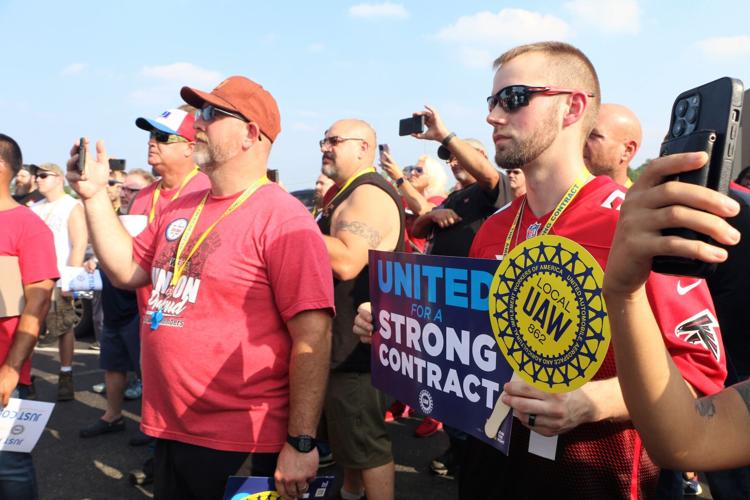
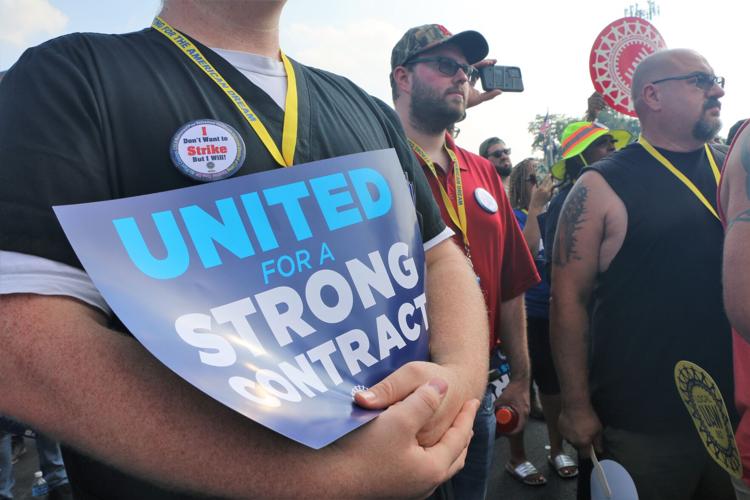



LOUISVILLE, Ky. (WDRB) — Perched on the bed of a Ford F-150 pickup on Thursday, United Auto Workers President Shawn Fain told dozens of Kentucky Truck what the UAW is fighting for in Detroit: double-digit wage increases, traditional pensions — even a four-day workweek with a fifth day of paid time off.
Fain frames the union’s ongoing contract negotiations with the Detroit Three automakers – Ford, General Motors and Chrysler-parent Stellantis – as a fight not just for autoworkers, but for a broader “working class” whose members keep falling behind their white-collar counterparts.
“During the pandemic, our members are going into plants … putting their health on the line. Some of our members died working during COVID. You know, we were expected to risk our lives to keep the supply chain, and the product, moving,” Fain told Louisville workers Thursday.
Meanwhile, “corporate people” at the automakers are still often working “from their living room,” Fain said.
If the UAW were to strike Ford and other Detroit automakers next month — as it is threatening to do — the absence of the Louisville workers who gathered in the union hall parking lot on Thursday would be acutely felt.
Kentucky Truck, or KTP, is the biggest Ford vehicle plant by employee headcount and the maker of six-figure Super Duty pickups that deliver hefty profits to the company.
Fain was in Louisville Thursday to drum up support for a potential strike that would start after Sept. 14, when the UAW’s existing labor contracts with the three automakers expire.
He said the union – which represents more than 143,000 rank-and-file workers across the three American automakers – doesn’t want to strike.
But, “taking into account the companies’ continued desire to put a race to the bottom first, we may end up there,” he told the Louisville crowd. “So we have to plan for every scenario possible and we are doing that.”
Ambitious goals
The negotiations come at a time when organized labor is resurgent, emboldened by low unemployment and a desire to right perceived wrongs. After months of talking a big game, Teamsters leaders got what they described as the richest contract in their history from shipping giant UPS.
Fain has set ambitious goals, including undoing many of the concessions the union made in 2007 amid an economic meltdown.
The American car companies are on much firmer footing today, and to hear Fain tell it, union workers are owed for what they gave up at previous bargaining tables and during the pandemic.
For its part, Ford said the company is “proud to build more vehicles in America and employ more UAW-represented hourly workers in America than any other automaker.”
“We look forward to working with the UAW on creative solutions during this time when our dramatically changing industry needs a skilled and competitive workforce more than ever,” the company said.
Fain laid out the union’s demands in a video earlier this month. They include:
- “Double-digit pay increases.” Ford’s UAW production workers earn an average hourly base of $28.24 as of 2022, according to the company. They also receive benefits including an annual profit-sharing check that has averaged $7,653 the last ten years.
“We’re demanding pay increases equivalent to the 40% raises that the Big Three CEOs have given themselves,” he said at an Aug. 20 rally.
Fain has said hourly workers’ earnings have been eroded by inflation. UAW members used to have a “cost of living adjustment” that indexed their pay to real-world prices, but in 2009 they agreed instead to predetermined increases.
“The Big Three have come roaring back since the Great Recession. The cost of living (adjustment), which was suspended then, has not,” Fain said on Aug. 1.
Ford says the current system has worked out better for workers over the long run, though the company concedes that traditional “COLA” hikes would have been worth more than the predetermined increases as inflation soared in 2022.
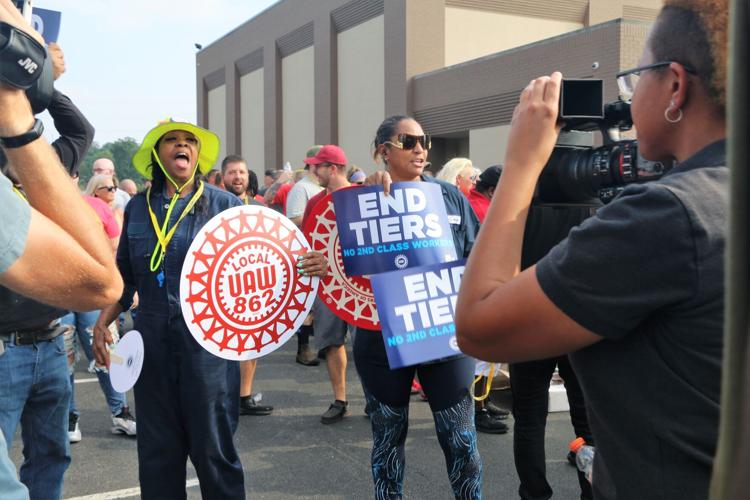
- Ending “tiers.” Beginning in 2007, the UAW agreed to less generous pay and benefits for new hires, but now the union wants to see all its members on the same footing.
During his Aug. 1 video, Fain lamented that as recently as 2007, new hires at the Detroit Three started at $19.60 per hour, the equivalent of $28.68 in 2023. Today, new hires start at $18.04, and it takes them eight years to reach the veteran UAW wage scale of about $32 per hour.

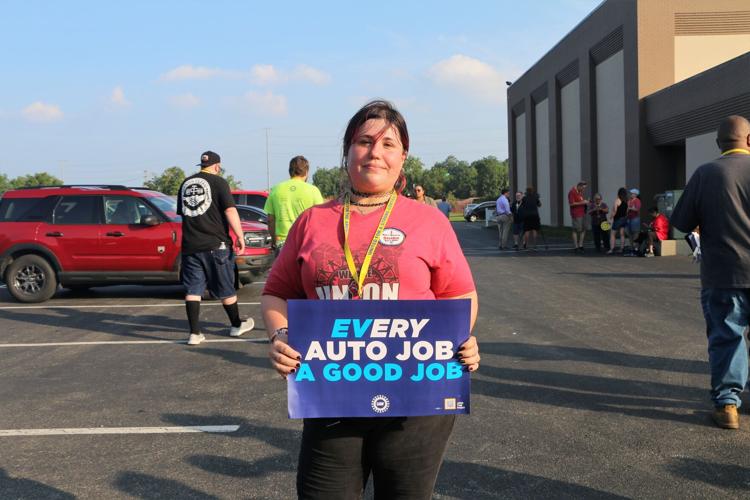
Kentucky Truck Plant worker Jenn Thompson at a rally at the UAW Local 862 union hall on Aug. 24, 2023.
Jenn Thompson, a nighttime worker at Kentucky Truck Plant, said she’s looking forward to reaching the veteran wage scale next month after being on the job since 2016.
“It’s frustrating to be doing the same work as someone else who is already at top pay,” she said.
- Restoring pensions. Older “legacy” workers (hired before Nov. 19, 2007) also get a traditional defined-benefit pension, while the majority of the workforce hired after 2007 gets a 401(k)-style defined contribution plan that shifts investment risks from the company to the worker.
Ford workers do get company contributions to their 401(k)-style plans — 6.4% of pay, plus up to $2,080 based on hours worked, according to the company.
Fain wants to reinstate a traditional pension, along with medical insurance coverage that UAW retirees once enjoyed.
Speaking to workers in Louisville on Thursday, he said retirement insecurity is one the biggest issues facing the country.
“People work their asses off their whole life. And they're given the decision to choose between paying for medicine or getting food. It’s inexcusable in the wealthiest country in the world,” he said.
Louisville stakes
Ford makes vehicles at nine assembly plants across Michigan, Ohio, Kentucky, Illinois and Missouri.
No area has a higher concentration of hourly workers than Louisville, where Ford’s two plants employ 11,935 rank-and-file workers as of Jan. 1, according to Ford.
Louisville’s primacy in the Ford landscape is mainly owed to Kentucky Truck Plant in eastern Jefferson County, which churns out Ford’s highly profitable F-Series Super Duty pickups. Kentucky Truck, or KTP, employs 8,699 hourly workers, according to Ford.
Because of the success of the large trucks — whose prices can easily top $100,000 — KTP’s workload and employment look secure for the long term.
“The strong demand for our flagship work product is going to fuel our earnings growth for years to come,” Ford CEO Jim Farley said in on the company’s July 27 earnings call, referring to the Super Duty pickups.
The future is less clear for Louisville Assembly Plant, or LAP, on Fern Valley Road, which employs 3,236 hourly workers.
RELATED: Here's what Ford's CEO says about the future of Louisville Assembly Plant
LAP’s main product, the Escape SUV, is not nearly as popular as it used to be amid a torrent of competition in the small crossover segment.
However, the Escape now serves as a low-cost entry model to the Ford brand after the automaker gave up producing passenger cars like the Fiesta and Focus, analysts have noted.
UAW Local 862 President Todd Dunn has said securing a product commitment to sustain LAP is a key goal of the 2023 negotiations.
Sam Fiorani, vice president of industry consultant AutoForecast Solutions, told WDRB News earlier this year that his firm sees LAP adding an electric vehicle by mid-decade.
Electrification
Looming over the negotiations is the industry’s capital-intensive shift to battery-powered vehicles.
Ford’s largest electric vehicle battery site is going up about 45 minutes south of Louisville in Glendale, Ky., with production slated to start in 2025.
Wages and working conditions for the future 5,000 battery park employees are not subject to the current UAW negotiations. Like General Motors, Ford is building battery plants as joint venture partnerships with Korean technology companies.
The employer of the twin battery plants under construction in Kentucky is not Ford itself but BlueOval SK, a joint venture formed by Ford and Korean partner SK On.
The UAW would like to represent workers at the battery plants, but Ford has said it will be up to the battery plant workers whether to join a union.
At the Louisville rally Thursday, Fain accused the automakers of “circumvent(ing)” unionized workforces at the battery plants with their joint ventures.
He said the union is working to bring those plants into the fold.
“We’ll get there,” he told the crowd.
BlueOval SK recently released its anticipated wage scale for hourly workers at the Kentucky battery park, saying regular production jobs will start at $21 per hour while skilled-trades workers will start at $26.
Ford previously set a target of producing 2 million electric vehicles by the end 2026. But when the EV market started to appear oversupplied this summer, the company in July backed off that timing, saying it was not clear when the EV production goal would be reached.
Ford sources said the uncertainty of how quickly the industry will transition to EVs makes it more difficult than in previous negotiations to make firm commitments to the UAW.
But Fain has rejected that.
“When the Big Three say the future is uncertain, and that the EV transition is expensive, remember that they’ve made a quarter of a trillion (dollars) in North American profits over the last decade, and have poured billions of it into special dividends, stock buybacks and supersized executive compensation,” he said on Aug. 1. “Our message going into bargaining is clear: Record profits mean record contracts.”


