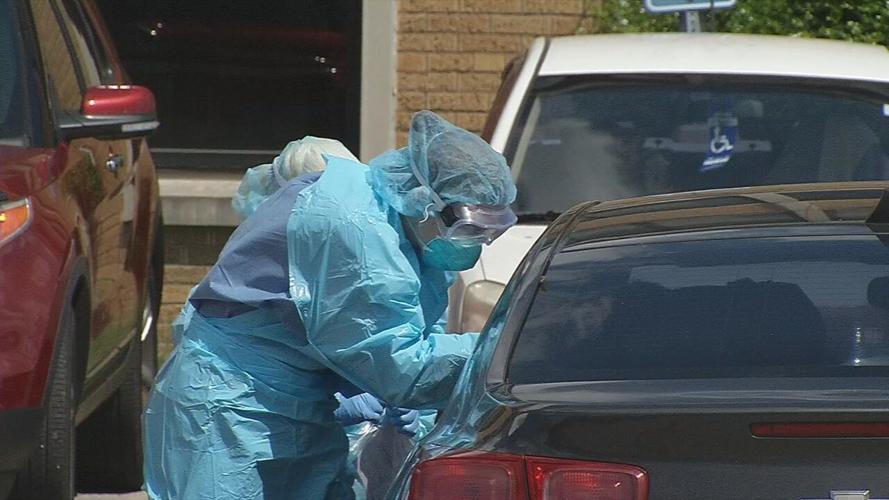



LOUISVILLE, Ky. (WDRB) -- When Gov. Andy Beshear felt ill Tuesday, he canceled two press conferences, took a COVID-19 test and learned that his result was negative within hours.
Back to work the governor went, but Tina Johnson wasn't so lucky. She'd been waiting for her COVID-19 test results since July 27 with no answers.
"I called. They said, 'I don't know what to tell you. Your results aren't back yet,'" Johnson said.
The 57-year-old woman wasn't ill but said she took a coronavirus test at a Norton Healthcare location after her husband tested positive while exhibiting no symptoms.
"I was afraid I was going to be one of those that got in the hospital," she said.
Johnson said it took 15 days to get her negative result back, which came on Tuesday, Aug. 11.
"Staying in the house forever, it was ... you go crazy," she said. "You just think, 'Why does this take so long?'"
That lag in testing came up in Mayor Greg Fischer's digital roundtable Thursday. Fischer called the delays "a sad state of affairs" and admitted that some tests results aren't returned until a patient has already cleared the virus.
"For the supply chain to be able to supply our hospital systems with the supplies they need to do tests locally, it's limited," said Grace Simrall, the chief of civic innovation and technology for Metro Louisville. "So we have to send off our test results to national labs where we are competing against Arizona and Texas and Florida to get our batch of tests processed too ... Unfortunately, that's really created a chokepoint."
One of those national labs is Vikor Scientific, based in Charleston, South Carolina.
"Everything from plastics to the swabs you are hearing about, sourced by all the major companies, became totally on back order," said Scotty Branch, co-founder of Vikor Scientific. "Then the second reason is the bad reason is people just weren't willing to scale with the growth."
The viral growth in diagnostic tests during the pandemic forced some molecular labs to invest in new equipment, more employees and excess labor costs. The shortage of supply hits on both ends via tools needed to administer and process the test.
"Scaling becomes difficult, because in the diagnostic world, the reimbursement sometimes doesn't come," Branch said. "And when it does come, it's 60 days later. So you have to make the investment to the mission up front."
But Branch said he "owns" his supply chain, which allows him to process COVID-19 tests more quickly. He said the facility in South Carolina operates 24 hours a day, seven days a week, processing 9,000-11,000 COVID-19 tests a day from all across the country, including Kentucky and Indiana.
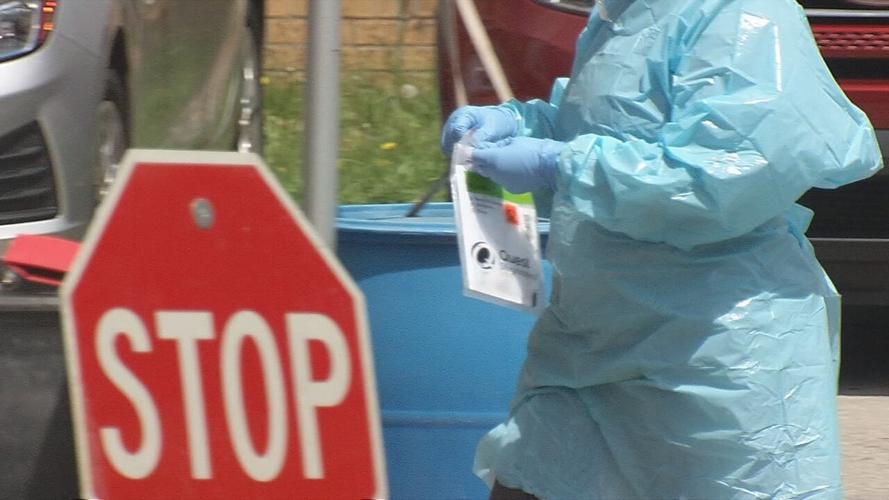
Those tests are sent in via FedEx overnight, and the results are sent digitally back to medical practices like the Town Family Doctor in Norton Commons.
"Right now, the turnover time is 3-5 days," said nurse practitioner Dzanan Gusic, who runs the Town family Doctor's office with his father, Dr. Vedad Seremet. "For antibodies, it is 2-3 days."
As the number of positive COVID-19 results increases, so does the number of people being tested due to possible exposure. And as the nation continues to reopen and people head back to work or school, demand is increasing as supplies grow scarce.
Last month, Norton Healthcare warned Kentucky legislators that its ability to test for COVID-19 is vulnerable due to the reallocation of testing resources to other states. According to a letter that was sent by the healthcare giant to Kentucky U.S. Rep. John Yarmuth, the federal government is diverting tests manufactured by Hologic away from Kentucky and to other states.
"Each time we make a financial investment in a platform for testing to maintain services in the state of Kentucky, we find ourselves at the mercy of the Federal Government moving these supplies to other states," the letter states. "We understand the challenges and attempts to prioritize, but leaving our state without a sufficient capacity for testing creates significant challenges to protect our communities. This will leave us vulnerable in our testing capacity and much more reliant on sending out testing to an outside laboratory, thereby greatly delaying appropriate therapy and procedures for our patients."
The delay can be a real dilemma.
"The sooner you know, the better you treat," Gusic said, adding that a delay can conversely "cause a patient to expose more people."
Medical experts say those tested for COVID-19 after a possible exposure should quarantine until they get the results.
Branch said patients should ask questions and seek practitioners and labs that turn the most accurate results quickly.
"The anxiety has been created because of a lack of execution by other entities that are extending this turnaround time deeming the result basically worthless," Branch said. "So you're just going to have to do your due diligence and find the labs that are executing."
It's important to note that sometimes faster tests are not always free, and cost vary by insurance.
For a list of COVID-19 testing sites in Kentucky, CLICK HERE.
For a list of COVID-19 testing sites in Indiana, CLICK HERE.
Copyright 2020 WDRB Media. All Rights Reserved.