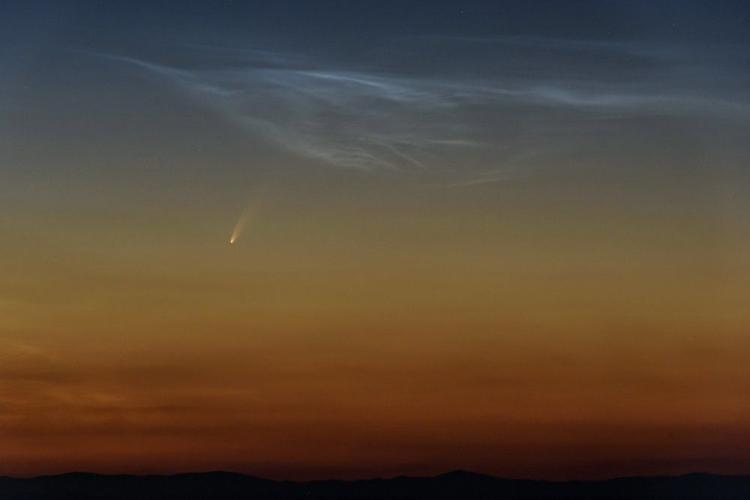
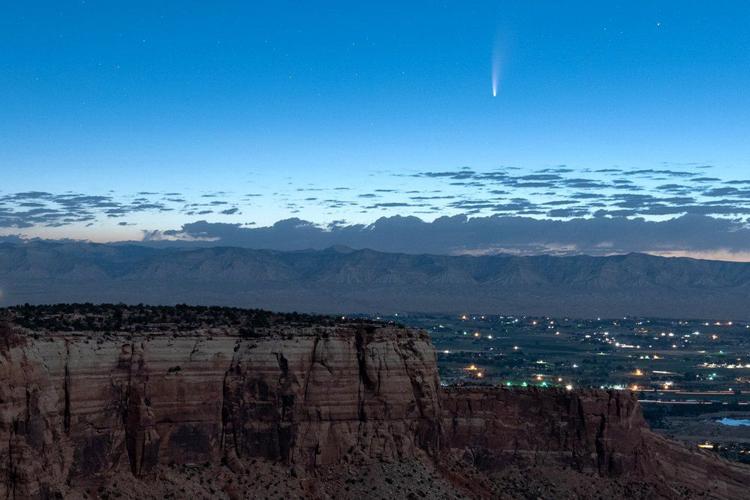
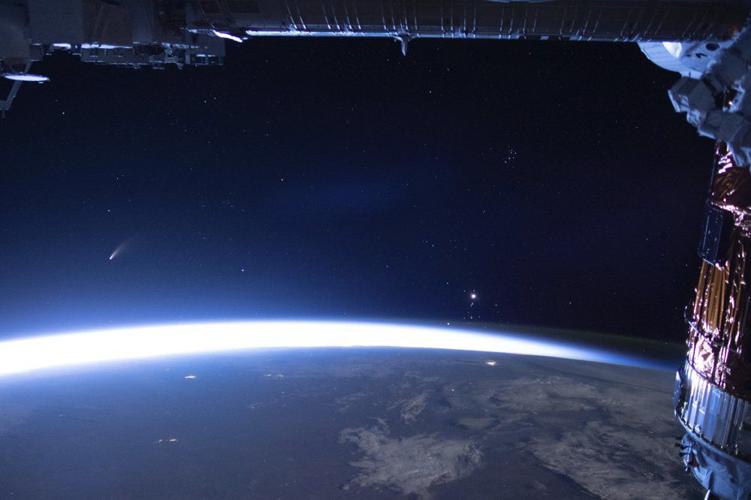
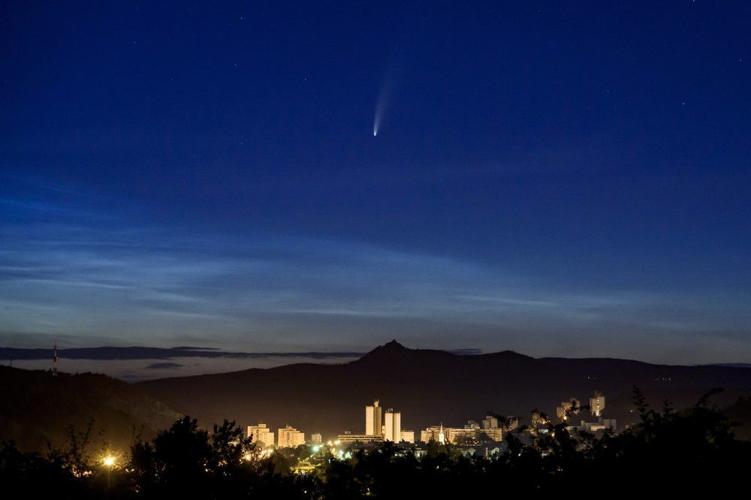


(FOX NEWS) -- As stargazers try to catch a glimpse of NEOWISE as it soars across the nighttime sky, careful viewers may notice the comet has two tails trailing behind it.
The comet’s main tail or dust tail, which are always whitish in color because its particles easily reflect sunlight at every wavelength, is made of fragments from the comet that have been ejected from its nucleus and curves outside the path of the comet’s trajectory, according to Fox News based on a report from Forbes.
The dust that makeup up the main tail are pulled by three forces: the sun, the comet itself and the force from the sun’s radiation.
Differently sized particles are all subjected to the same amount of gravitational acceleration but smaller dust grains are affected more than larger ones by solar radiation and move at different speeds, making the tail appear wider.
The second slightly narrower tail, however, actually becomes prominent before the main dust tail, according to Forbes.
At some point in the comet’s trajectory, ultraviolet light radiating from the sun becomes strong enough that it heats up and ionizes the comet’s carbon monoxide – the weakest ice-based molecule in the makeup of a comet, according to the magazine.
The carbon monoxide absorbs the sunlight and fluoresces at 4200 Angstroms, the wavelength for blue light, making it appear blue, according to an article from Case Western Reserve University.
The main dust tail is always a grayish-white, the same color as the comet itself.
The ion tail always points away from the sun in a straight line because it distorts magnetic field lines as it interacts with charged wind particles from the sun, according to the university.
The ion tail is made up of single molecules that are all equal in mass, meaning they’re affected by the forces around them equally and follow the same, narrower path, according to Forbes.
In early photos, the blue ion tail is the only one visible.
NEOWISE, the brightest comet in the sky since Hale-Bopp in 1997, was discovered in March and can be seen by the naked eye to most viewers in the Northern Hemisphere this month.
While many comets have two tails, including all "great comets," it’s also possible NEOWISE has an extra ion tail.
"The lower tail, which appears broad and fuzzy, is the dust tail of comet NEOWISE — created when dust lifts off the surface of the comet’s nucleus and trails behind the comet in its orbit," NASA added in the statement.
"The upper tail is the ion tail, which is made up of gases that have been ionized by losing electrons in the sun’s intense light. These ionized gases are buffeted by the solar wind — the sun’s constant outflow of magnetized material — creating the ion tail that extends directly away from the sun," NASA continued. "Parker Solar Probe’s images appear to show a divide in the ion tail. This could mean that comet NEOWISE has two ion tails, in addition to its dust tail, though scientists would need more data and analysis to confirm this possibility."
Copyright 2020 WDRB Media and Fox News. All rights reserved.