



LOUISVILLE, Ky. (WDRB/InvestigateTV) — Victims of car crashes often recall such events happening "in the blink of an eye," when in reality, it takes less than half that amount of time.
Particularly when the impact is coming from the side.
In lateral crashes, even when hit at a modest speed, it takes just 0.17 seconds for someone sitting in one of the front seats to be thrown toward the center of the vehicle, where data shows they’re at higher danger of experiencing organ damage or severe head injury — especially if someone is sitting beside them.
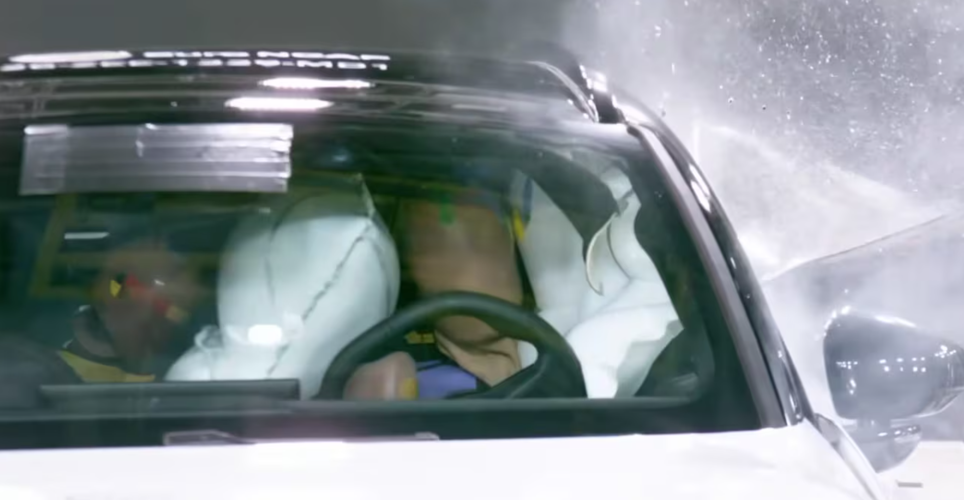
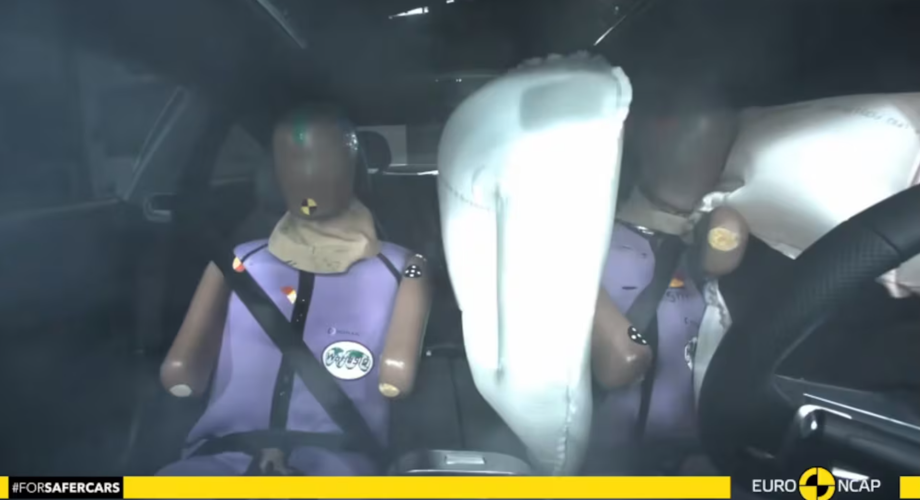
A safety device designed to prevent that kind of injury was introduced more than a decade ago: Front-center airbags deploy from the seat or center console to keep a driver from hitting the passenger side door or to prevent a driver and passenger’s heads from colliding.
"Even from the get-go, we could see, at least in our tests, that they have a benefit," said James Ellway, the technical manager for Europe’s New Car Assessment Programme, which in 2020 updated its protocols to the effect that these airbags are now standard in the majority of new passenger vehicles models safety tested by the program over the last five years.

A still image from a Euro NCAP crash test video shows a front-center airbag being deployed during a simulated side-impact crash.(Courtesy of Euro NCAP)
"These airbags do keep the occupants apart, particularly when it comes to head-to-head contact," he said.
But in the United States, InvestigateTV found the safety advancement is often only available in luxury vehicles or through more expensive trim package — and in many cases isn’t an option at all.
And unlike their European counterparts, the arbiters of vehicle safety assessments in the U.S. have declined to prioritize testing that would encourage further adoption by manufacturers.
'I never had anyone warn me of colliding with another passenger in a car'

Singer-songwriter Lynsea Rohde during an interview with InvestigateTV.(InvestigateTV)
Singer-songwriter Lynsea Rohde, named 2024’s “Best Pop Artist” by a Charlotte, North Carolina arts and culture publication, said she remembers some of what happened on September 20, 2025.
Rohde said she remembers she was enjoying a visit from her sister, and recalled the pair had gone to lunch and patronized some local businesses.
She does not remember the moment the driver of a stolen SUV ran a red light, slamming into her and her sister, who was in the front passenger seat, as they entered an intersection just a few blocks from her apartment.
"I don’t remember getting in the car. I don’t remember driving to the light, and I don’t remember anything until three weeks later, waking up in a hospital bed with a breathing tube and a lot of other IVs and things," she said.

Lynsea Rohde was navigating this Charlotte, NC intersection when she was hit by a driver who ran the red light.(Scotty Smith, InvestigateTV)
But while she may not be able to recall the details of that day, she said she’s certain she has no memory of ever being told about the possibility of what she now believes happened in the milliseconds after being hit.
"I never had anyone warn me of colliding with another passenger in a car," she said.
In addition to severe injuries to her pelvis, which is a common injury experienced by occupants when the impact occurs on their side of the car, the right side of Rohde’s skull was shattered, and her sister, who was on the far side of the vehicle, also sustained a concussion.
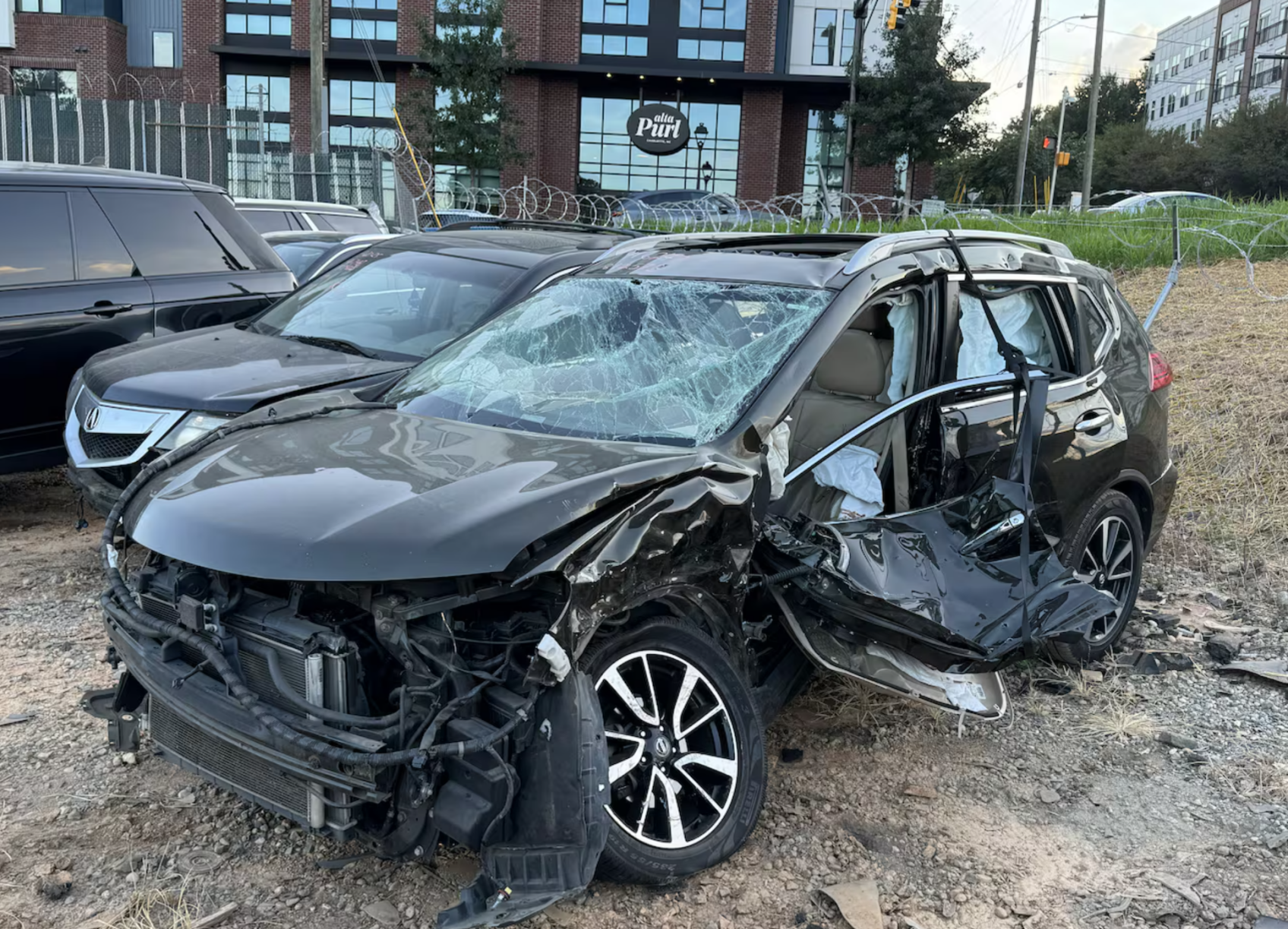
Lynsea Rohde's crossover SUV after the September 20, 2025 crash(Courtesy of Melony Block)
At first, she said there were different theories about what exactly happened, but that details from the police report and the location of the two sisters’ head injuries eventually led to her conclusion they had collided after the initial impact.
"The whole front cabin was rotated slightly, but because it was directly on my side, it propelled me towards the center and her towards the center, my right," she said.
Rohde said once she put the picture together, she became angry.
"Oh, I was mad," she said, "Because I felt like it could have been prevented. Everything that I went through, everything my family went through because they didn’t know if I would survive. All of this could have been prevented."
Prevented, she believes, if her car had been outfitted with a front-center airbag.
'The surprise was how severe it was'
Research over the last two decades has found that while occupant-to-occupant contact during side-impact crashes is not common, the consequences when it does occur are almost always serious.

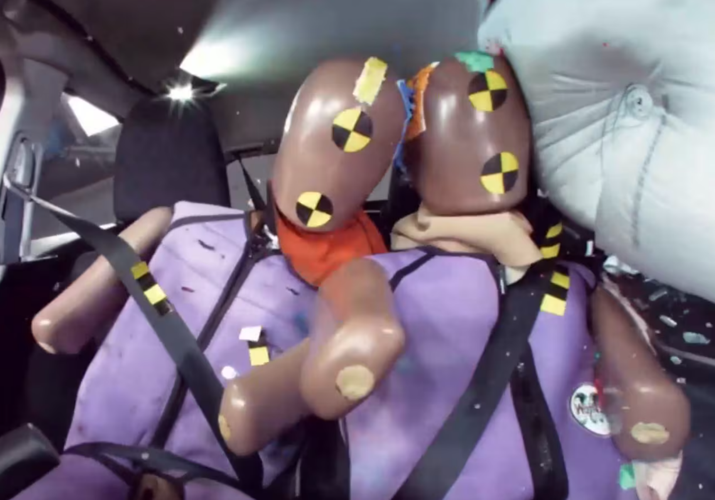
A still from a Euro NCAP crash test shows how front seat occupants can collide during a side-impact crash. The right side of the driver-side dummy's head impacts the back-left side of the passenger-side dummy — the same situation Lynsea Rohde is believed to have experienced.(Courtesy of Euro NCAP)
In a passenger vehicle crash, airbags deploy from different points throughout a car, and are, along with seatbelts, designed to help more gently decelerate occupants as the body of the vehicle crumples and absorbs the force of the impact.
For side-impact crashes like Rohde’s, most modern vehicles have side and curtain airbags that reduce the force and cushion impacts with the doors and windows.
In 2011, General Motors unveiled a new version of the technology — the front-center airbag, which deploys from the interior side of a front seat or from the console between the driver and passenger, cushioning the space between.
The European New Car Assessment Programme, which like its U.S. counterpart tests the latest vehicle models and publishes 5-Star Safety Ratings, launched an examination of side-impact crashes in 2015 as it looked to retool and improve its testing procedures.
Part of that examination included looking at injury data for far-side occupants — those sitting on the opposite side during an impact.

The European New Car Assessment Programme updated its side-impact testing procedures to better capture the injury potential from occupant-to-occupant contact, and to see how safety features in new automobiles sold in Europe account for that risk.(Courtesy of Euro NCAP)
Ellway, EuroNCAP’s technical manager, said one data point quickly caught the program’s attention: that while instances of crashes where there were two occupants in the front seats happened less frequently, "when occupant to occupant contact did occur, it was potentially life threatening."
"The surprise was how severe it was," Ellway said. "Not necessarily how often it happens — but the consequences of a head-to-head contact in a side impact. It was surprising at how severe it was in the accident data and how severe it can be."
InvestigateTV conducted a comparable analysis on 2020-2024 data from the National Highway Traffic Safety Administration’s Crash Investigation Sampling System and found a similar pattern.
Occupant-to-occupant contact was identified as a factor in only roughly 1-in-12 serious cases.
But when looking at lateral crashes with two occupants in the front seats, far-side front occupants were more than three times as likely to suffer a severe head injury when there was someone sitting next to them compared to someone riding alone.
"Three times more likely — that’s a big increase on the risk," Ellway said, commenting on InvestigateTV’s data analysis. "And it’s in line with what we found all those years ago. It’s really what does give you the justification to say, 'Hey, we can do something, we should do something about this.'"
EuroNCAP updated its testing procedures in 2020 to include an evaluation of how well new vehicles protect against occupant-to-occupant contact during side-impact collision.
As a result, Ellway said, more than 80% of the new vehicles the program has tested over the last five years have had front-center airbags — not as an add-on, but as a standard safety feature.
Ellway said that in his mind, the technology was never the obstacle.
"It’s not new technology," he said. "It just needed refinement of existing technology to put center, front-row airbags in the vehicle."
'None of them knew what I was talking about'

A still from a Euro NCAP side-impact crash test shows a front-center airbag being deployed.(Courtesy of Euro NCAP)
European auto buyers may have a large selection of vehicles with standard front-center airbags, but when she started shopping for a new car six months after her 2025 crash, Rohde said despite living in one of the nation’s automotive epicenters — it was nearly impossible to find one with the feature.
"I just started emailing every car dealership in this area and said, 'This is what I want,'" she said. "Most of them didn’t know what I was talking about. Actually, none of them knew what I was talking about."
Rohde said she was able to identify a handful of luxury vehicles that came equipped with a front-center airbag, but ultimately only one car she could actually afford — a used 2023 Nissan Rogue, which was actually a newer model of the car she was driving in the crash.
But even then, the safety feature was only available because the vehicle had a higher-priced “Platinum” trim package, which she said she finds more than a little frustrating.
"It’s not fair that you have to have more money to have standard safety," Rohde said.
InvestigateTV contacted 20 automakers that sell vehicles in the U.S. Most either did not respond or could not be reached. Of those that did respond, the answers varied widely:
- General Motors — Despite being among the first automakers to add a front-center airbag to U.S. vehicles, when asked about the current integration of front-center airbags and whether the company had plans to expand their use, a spokesperson said the company had "no details to add."
- Ford — A spokesperson declined to answer questions about front-center airbags and instead referred InvestigateTV to an industry group.
- Subaru — Subaru, which InvestigateTV found offers standard front-center airbags in European versions of models such as the Forester, responded by email saying: “We do not have center airbags on our vehicles,”in the U.S., with the spokesperson saying they could not comment on future plans.
- Honda — Honda’s spokesperson couldn’t say when or which vehicles, but in a statement acknowledged the gap directly: “New Honda vehicles sold in the European Union now feature front center airbags in response to EU regulation. While the technology is not currently required by U.S. regulation or by third-party safety ratings, guided by insights gained from our research and analysis of real-world crashes, we have a plan to add a front center airbag to our product roadmap in the near future.”
- Volkswagen / Audi — The legacy European manufacturer provided the most specific response, including a list of which U.S. models have the safety feature available, such as the model-year 2025 and newer Volkswagen Tiguan, the 2027 and newer Volkswagen Atlas and Atlas Cross Sport; the model-year 2019 and newer Audi A8; 2025 and newer Audi A5 and Q5; and Audi A6 and Q3 model-year 2026 and newer.
- Mercedes-Benz — A spokesperson said front-center airbags are “widely available” in newer models but “not universal by design,” adding that the company evaluates them as part of a broader, integrated safety system.
- Nissan — Said most of its U.S. models have front-center airbags either as standard or optional equipment, depending on the model and model-year.
Jordi Lombarte, executive vice president of Autoliv, which manufactures front-center airbags and supplies them to automakers around the world, said the technology is ready — the U.S. market has simply not caught up.
"We are a bit frustrated," Lombarte said, "because the solution is on the table."
He said Autoliv has supplied millions of front-center airbags to automakers around the globe — not just for European vehicles, but for those sold in Japan and Korea too — but vehicles destined for American streets account for just a fraction of the company’s sales despite the U.S. being the second-largest automotive market in the world.

Autoliv Executive Vice President Jordi Lombarte shows InvestigateTV reporter Anna Werner examples of front-center airbags(Owen Hornstein, InvestigateTV)
Lombarte said this pattern can play out even within the same manufacturer’s portfolio because the goal posts for safety vary market to market.
"You can find brands that they may have different equipment in Europe than they have in the U.S., this is normal practice," he said. "So they’re basically saying, 'In Europe we have to have them, in the U.S. there is no test.'"
The National Highway Traffic Safety Administration, a division of the U.S. Department of Transportation, sets the minimum safety standards for all vehicles sold in the U.S. and operates the U.S. New Car Assessment Program.
But while the federal requirements and the U.S. NCAP’s 5-Star Safety Rating procedures include side-impact testing, they don’t include the same elements the European version added in 2020 that look at occupant-to-occupant contact during a collision — such as the use of a more advanced crash test dummy.
In response to InvestigateTV’s questions about whether the agency is considering changes or additions to its safety standards that would encourage the use of front-center airbags, a spokesperson said, in part: "NHTSA’s safety standards focus on limiting intrusion into the passenger compartment and complete or partial ejection in side-impact and rollover crashes, and protecting people seated where the impact happens," but said the agency is "currently studying real-world cases of occupant-to-occupant injuries" in all types of crashes, and that the agency "will assess next steps based on this study’s findings."
The U.S. NCAP’s 5-Star-Safety Ratings aren’t the only safety metric new vehicles can be judged on, however.
The Insurance Institute for Highway Safety, a nonprofit funded by the auto insurance industry, has driven many of the most significant vehicle safety improvements in recent decades through its crash-test program and rating system.
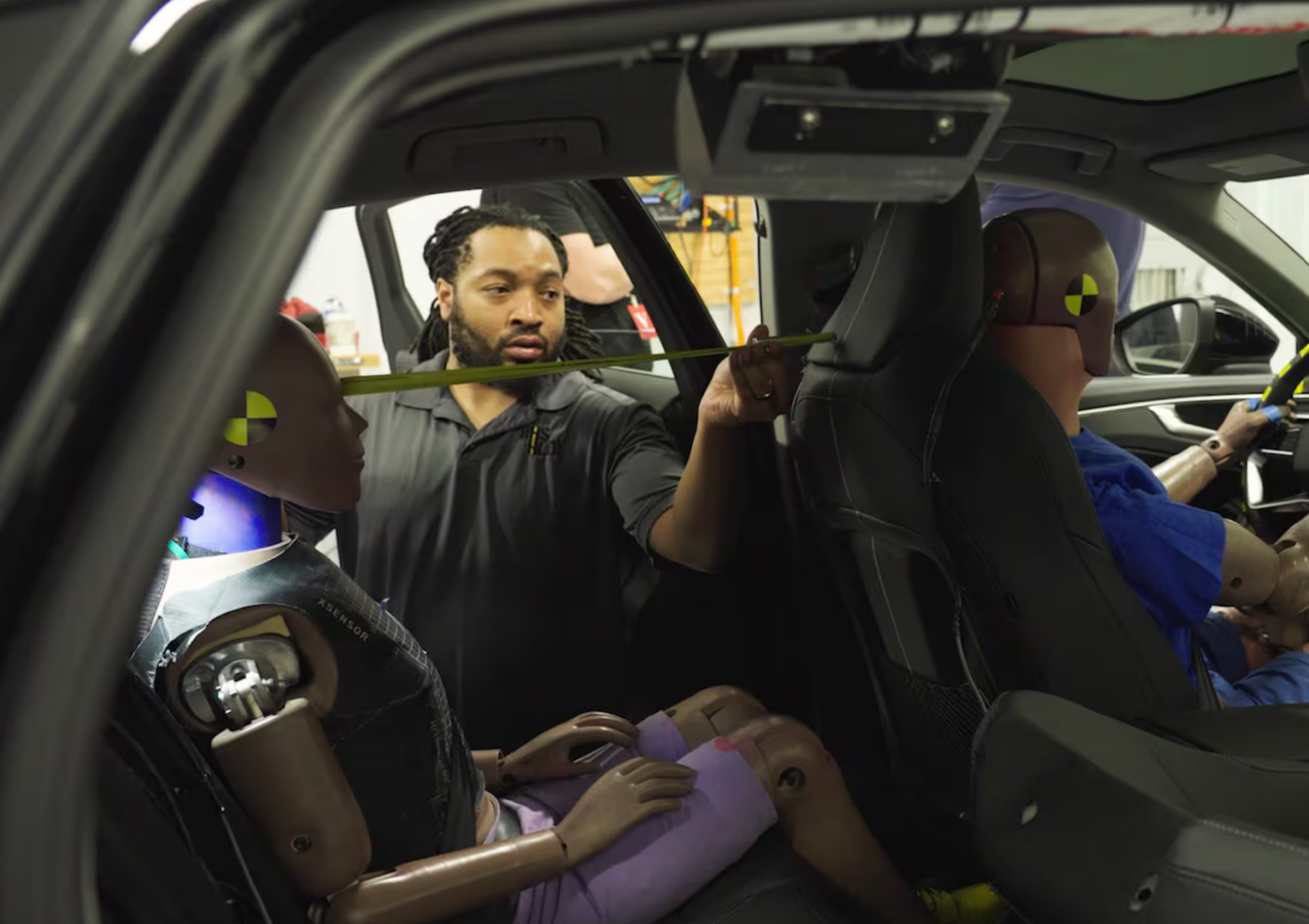
IIHS engineers and technicians prepare dozens of vehicles for crash tests each year at the organization's Virginia headquarters.(Rod Curry, InvestigateTV)
"The IIHS tests turn out to be, in some cases, de facto regulation, because all of industry wants to do well in our tests," said Raul Arbelaez, IIHS vice president of vehicle research. "Even though there’s no legal requirement for them to do well in our tests, just about every vehicle eventually earns a good rating because they all change to earn that top rating.”"
Arbelaez said that to some degree he sees many manufacturers eschewing their own safety testing and research and instead looking to metrics like those published by his organization when making design decisions.
"They’re relying on organizations like IIHS or the National Highway Traffic Safety Administration to really tell them what needs to change," he said.
That makes IIHS’s decisions about what to test — and what not to test — consequential, and like NHTSA, the institute has not made front-center airbags a priority.
Arbelaez said the data wasn’t sufficient to justify prioritizing a test when IIHS previously reviewed the issue.
"Can those airbags help? I think certainly, yes," he said. "But we didn’t see enough data to convince us that it was the right path to take at the time."
Notably, though, Arbelaez admitted that for his own vehicle, the calculus is simple.
"On my personal vehicle, if a vehicle had it as an option, I would certainly want one," he said.
'It’s heartbreaking'
Given the extent of her injuries and the extensive surgeries needed to repair her skull, Rohde said she is thankful just to be alive — but the damage and swelling in her brain caused by the impact initially left her unable to engage with the thing she loves most: music.

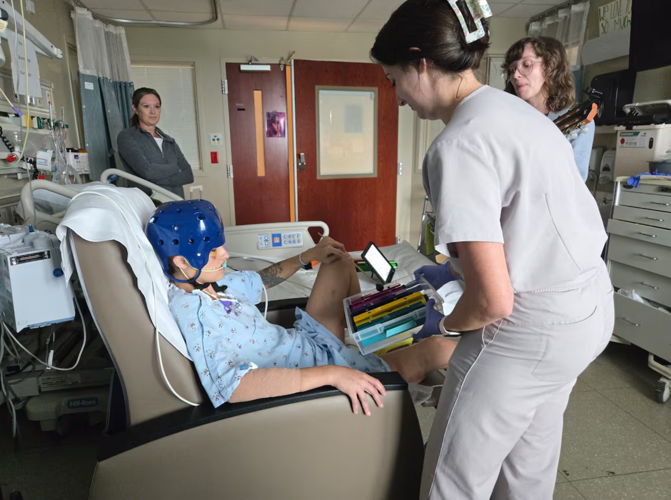
Lynsea Rohde in her hospital room attempting to play the xylophone as she recovered from the severe brain injury caused by the crash.(Courtesy of Melony Block)
In the hospital, she struggled to pick out a few notes on an instrument, and it took her months to be able to sing her own melodies.
"It’s heartbreaking," she said of having her identity as a musician torn away.
"There was a moment where I sat down and I told myself, 'We have to come up with new dreams' … because my dream was to get a publishing deal, maybe even a record deal one day, and go on tour, and those just weren’t options for me,' she said.
Now, with her musical abilities finally returning, Rohde said her original dreams no longer feel so far out of reach.
But with no federal test, no government mandate, and no consistent industry standard requiring front-center airbags in U.S. vehicles — she said being thankful to be alive and thinking of the future isn’t quite enough.
Rohde said she felt it was up to her to act. She launched an online campaign and petition, calling for the airbags to be mandated in vehicles sold in the United States.
"I felt like I got lucky. And I don’t want everyone else to have to rely on hopefully being lucky."
Copyright 2026 Gray Media Group, Inc. All Rights Reserved.


