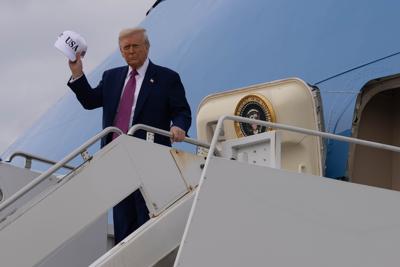
DAVOS, Switzerland (AP) — President Donald Trump was addressing the World Economic Forum — where his ambitions to wrest control of Greenland from NATO ally Denmark could tear relations with European allies and overshadow his original plan to use his appearance at the gathering of global elites to address affordability issues back home.
His arrival in in the Swiss Alps community of Davos was delayed after a minor electrical issue aboard Air Force One had forced a return to Washington to switch aircraft, but it wasn't expected to push back his scheduled keynote speech.
Billionaires and business leaders were among those seeking seats inside the forum’s Congress Hall, which had a capacity of around 1,000, to hear Trump. Michael Dell, founder of the eponymous Dell Technologies, weaved through the crowd to get toward the front of the line. Marc Benioff, the Salesforce chief and a World Economic Forum board member, wiggled his way through the press line to get inside.
Trump's planned to focus on domestic policy, but his speech may touch on Greenland as well as the U.S. military operation that led to the recent ouster of Venezuelan President Nicolás Maduro.
Foreign policy, and hemispheric domination by Washington, was expected to be more central on Thursday, when the Republican president is set to discuss the “Board of Peace” he's creating to oversee the U.S.-brokered ceasefire in Israel's war with Hamas.
That's according to a White House official who on the condition of anonymity to discuss plans that haven't been made public. Trump will also have around five bilateral meetings with foreign leaders, though further details weren't provided.
There are more than 60 other heads of state attending the forum, and the official said around 30 are expected to join the board — after invites were sent to about 50 countries late last week.
Tariff threat looms large
Trump comes to the international forum at Davos on the heels of threatening steep U.S. import taxes on Denmark and seven other allies unless they negotiate a transfer of the semi-autonomous territory — a concession the European leaders indicated they are not willing to make.
Trump said the tariffs would start at 10% next month and climb to 25% in June, rates that would be high enough to increase costs and slow growth, potentially hurting Trump’s efforts to tamp down the high cost of living.
The president in a text message that circulated among European officials this week also linked his aggressive stance on Greenland to last year’s decision not to award him the Nobel Peace Prize. In the message, he told Norway’s prime minister, Jonas Gahr Støre, that he no longer felt “an obligation to think purely of Peace.”
In the midst of an unusual stretch of testing the United States' relations with longtime allies, it seems uncertain what might transpire during Trump's two days in Switzerland. Before Trump spoke, British Prime Minister Keir Starmer vowed, “I will not yield.”
“Britain will not yield on our principles and values about the future of Greenland under threats of tariffs, and that is my clear position,” Starmer said during his weekly questioning in the House of Commons.
U.S. Commerce Secretary Howard Lutnick told a Davos panel before Trump's arrival that he and the Republican president, planned to deliver a stark message: “Globalization has failed the West and the United States of America. It’s a failed policy."
Trump promised before leaving the White House, “This will be an interesting trip" and things did indeed get off to a difficult start. There was a small electrical problem on Air Force One, leading the crew to turn around the plane about 30 minutes into the flight out of an abundance of caution.
Wall Street wobbled on Tuesday as investors weighed Trump's new tariff threats and escalating tensions with European allies. The S&P 500 fell 2.1%, its biggest drop since October. The Dow Jones Industrial Average dropped 1.8%. The Nasdaq composite slumped 2.4%.
“It’s clear that we are reaching a time of instability, of imbalances, both from the security and defense point of view, and economic point of view,” French President Emmanuel Macron said in his address to the forum. Macron made no direct mention of Trump but urged fellow leaders to reject acceptance of “the law of the strongest.”
Meanwhile, European Commission President Ursula von der Leyen warned that should Trump move forward with the tariffs, the bloc's response “will be unflinching, united and proportional." She pointedly suggested that Trump's new tariff threat could also undercut a U.S.-EU trade framework reached this summer that the Trump administration worked hard to to seal.
“The European Union and the United States have agreed to a trade deal last July,” von der Leyen said in Davos. “And in politics as in business — a deal is a deal. And when friends shake hands, it must mean something.”
Trump will talk about housing
Trump planned to use his Davos appearance to talk about making housing more attainable and other affordability issues that are top priorities for Americans.
But Trump’s Greenland tariff threat could disrupt the U.S. economy if it blows up the trade truce reached last year between the U.S. and the EU, said Scott Lincicome, a tariff critic and vice president on economic issues at the Cato Institute, a libertarian think tank.
“Significantly undermining investors' confidence in the U.S. economy in the longer term would likely increase interest rates and thus make homes less affordable,” Lincicome said.
Trump also on Tuesday warned Europe against retaliatory action for the coming new tariffs.
“Anything they do with us, I’ll just meet it,” Trump said on NewsNation’s “Katie Pavlich Tonight.” “All I have to do is meet it, and it’s going to go ricocheting backward.”
Davos — a forum known for its appeal to the global elite — is an odd backdrop for a speech on affordability. But White House officials have promoted it as a moment for Trump to try to rekindle populist support back in the U.S., where many voters who backed him in 2024 view affordability as a major problem. About six in 10 U.S. adults now say that Trump has hurt the cost of living, according to the latest survey by The Associated Press-NORC Center for Public Affairs Research.
U.S. home sales are at a 30-year low with rising prices and elevated mortgage rates keeping many prospective buyers out of the market. So far, Trump has announced plans to buy $200 billion in mortgage securities to help lower interest rates on home loans, and has called for a ban on large financial companies buying houses.
Promoting the ‘Board of Peace’
On Thursday, Trump plans talk about the Board of Peace, meant to oversee the end of the Israel-Hamas war in Gaza, and possibly take on a broader mandate, potentially rivaling the United Nations.
Fewer than 10 leaders have accepted invitations to join the group so far, including a handful of leaders considered to be anti-democratic authoritarians. Several of America’s main European partners have declined or been noncommittal, including Britain, France and Germany.
Trump on Tuesday told reporters that his peace board “might” eventually make the U.N. obsolete but insisted he wants to see the international body stick around.
“I believe you got to let the U.N. continue, because the potential is so great," he said.
Weissert and Madhani reported from Washington. Michelle L. Price contributed from Washington.
