Scientists say they're certain that a SpaceX rocket has slammed into the moon as predicted. While no one observed the actual impact, a telescope in Chile spotted what astronomers have identified as the debris plume resulting from the high-speed crash. The leftover rocket segment plowed into the moon Wednesday after drifting off course for the past year. SpaceX launched the rocket last year with a pair of lunar landers. The company says a combination of solar activity and gravity accidentally put it on a collision course with the moon. SpaceX is working with NASA to avoid any further lunar littering.
From
To
A SpaceX rocket is on a collision course with the moon after launching a pair of lunar landers last year. Space tracking experts say the upper stage will unintentionally slam into the moon on Wednesday. The high-speed impact will carve out a crater and send up a plume of dust and rubble that scientists and skygazers are eager to observe. The eastern portions of the U.S. and Canada, and much of South America, should have the best views. SpaceX's abandoned rocket stage hoisted a pair of private lunar landers in January 2025 and has been drifting ever since.
A U.S.-Russian space crew has arrived at the International Space Station for an eight-month mission. NASA astronaut Anil Menon and Russian crewmates Pyotr Dubrov and Anna Kikina lifted off Tuesday from the Russia-leased Baikonur cosmodrome in Kazakhstan and docked at the station three hours later. NASA Administrator Jared Isaacman attended the launch, marking the first visit to Baikonur by a NASA chief in eight years. This highlights ongoing cooperation between Moscow and Washington in space, despite tensions over Russia’s military actions in Ukraine.
China has successfully recaptured the first stage of a rocket after a launch, marking a breakthrough for its space program. The Long March-10B rocket's first stage separated after liftoff and returned to a platform in the sea. The achievement, reported by state media, mirrors what SpaceX has been doing for years to reduce launch costs. The rocket launched from Hainan Island, a popular beach destination. It can carry up to 25,285 pounds into low Earth orbit. In comparison, SpaceX's Falcon 9 can carry up to 50,265 pounds. The Falcon 9 transports astronauts and supplies to the International Space Station.
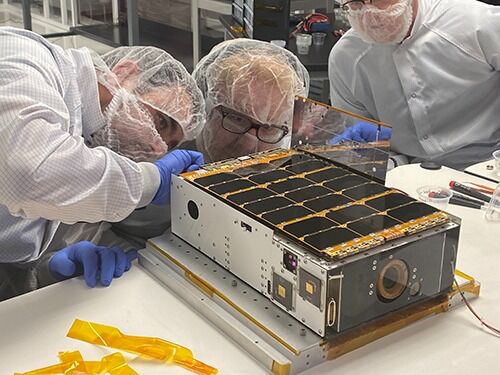
A team of scientists, as well as students and faculty, at Morehead State University in Kentucky built the Lunar IceCube Satellite.