
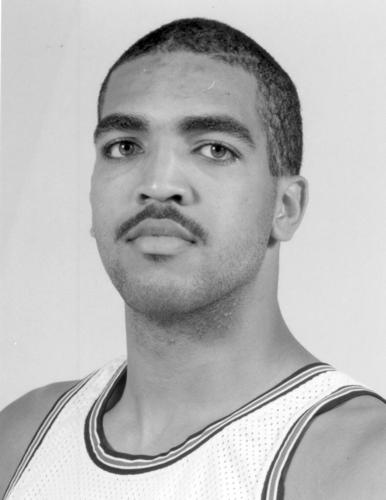
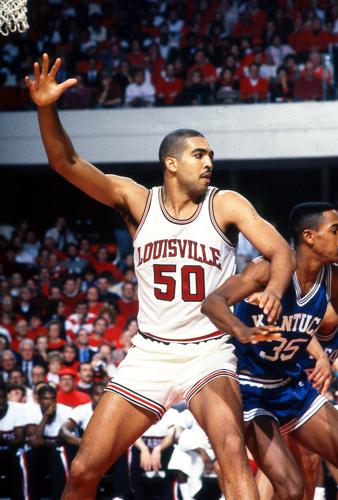
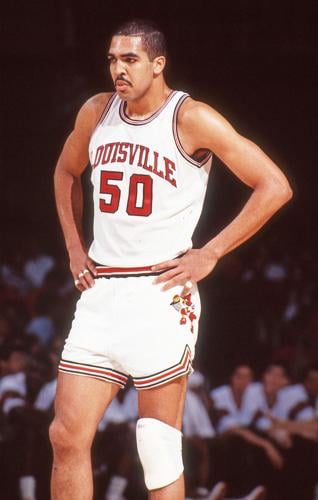


LOUISVILLE, Ky. (WDRB) -- They told Felton Spencer that he would never play a second of high school basketball after he was cut from his junior high school team.
They told Spencer that he would rarely escape the bench when he signed with the University of Louisville out of Eastern High School in 1986 and was stuck behind Pervis Ellison.
They told him to forget that crazy idea of making a living in the National Basketball Association.
From the first time Spencer picked up a basketball until day he returned home to Louisville as a retired professional, the skeptics persisted in peppering Spencer with doubts.
You're too slow. You're too weak. You're too nice. You're too limited. You're too everything.
Spencer, 55, died unexpectedly Sunday in Louisville after a short illness.
Of the many things I know about Spencer, I am most certain of this:
Felton Spencer didn't tell the critics anything. Wasn't his nature. He showed them. That absolutely was his nature. If Spencer attacked you with anything, it was kindness, his work ethic and results.
Like scoring 49 points and grabbing 27 rebounds for Eastern High School when Eastern advanced to the quarterfinals of the 1986 Kentucky Sweet Sixteen as the surprise winner of the Seventh Region.
Like scoring 1,168 points at Louisville even though he started just 41 of the 134 games he played for Denny Crum's Cardinals, 35 in his senior season. There aren't many guys on the U of L 1,000-point list who were part-time starters.
By going to the Minnesota Timberwolves and staying in the NBA for a dozen seasons, earning nearly $20 million and enjoying a longer career than 20 guys selected in the first round of that 1990 draft class.
In his prime, Spencer was 7 feet tall and 265 pounds — with 264 of those pounds in his heart. There wasn't an inch of entitlement in his body. He was a first-team all-giver who was still giving when he worked with troubled teenagers at local high schools after his pro career ended.
If you saw Spencer at Costco, the grocery store or the runway at the KFC Yum! Center, he would wrap you in a mammoth hug and ask what was happening in your life.
Felton Spencer always left you with a smile, encouragement, an uplifting word. Early in Spencer's NBA career, I was in Minneapolis on another assignment. I got word to him that I would be in town. He set up dinner reservations at his favorite spot, drove to my downtown hotel to pick me up and gave up three hours of his off day.
Craig Hawley also came to the University of Louisville in 1986. He was the other member of Denny Crum's two-player recruiting class. Those were the days before AAU basketball ruled the world.
As the son of a former U of L player, Hawley attended Cardinal basketball camps. Hawley remembered seeing Spencer as a 6-foot-6-inch eighth grader.
"He couldn't play," Hawley said. "He wasn't very good."
Four years later, they were teammates and roommates in the Derby Classic. Hawley remembers shaking his head at Spencer's size-18 shoes. And at the way Spencer filled the entire doorway when he entered the room at the downtown Hyatt Regency.
"The first time he sat on the foot of the bed at the hotel, it pushed the other end of the mattress up and knocked the head board off the wall," Hawley said. "He was big man."
Spencer earned only 11 minutes per game as a freshman. No big deal. He played behind Ellison, who was voted the 1986 Final Four Most Outstanding Player while leading the Cards to the national title.
Today, the world would scream at Spencer to enter the transfer portal. Hawley said that several weeks ago that he and Roger Burkman, another former Cardinal, had dinner with Spencer.
Felton told them that John Thompson and Georgetown recruited him out of high school. Thompson was a certified Big Man Whisperer, the guy who developed Patrick Ewing, Alonzo Mourning, Dikembe Mutombo and others.
Louisville and Crum played a high-post offense that did not play to Spencer's strengths. Ellison had the starting center position on lockdown for Spencer's freshman, sophomore and junior seasons.
Why didn't Spencer leave?
"Because I wanted to prove everybody wrong," Spencer said told Hawley and Burkman.
Consider it proven.
Spencer changed his diet. He and Hawley did track workouts. They took ballet lessons to fine-tune their footwork. They worked out in a boxing gymnasium with Greg Page, a local heavyweight.
And don't forget this: They never whined or complained or blamed the coaching staff.
"Whatever Felton needed to do to get better is what he did," Hawley said. "His work ethic was so strong."
For that, Spencer was rewarded. After Ellison graduated in 1989, Spencer finally moved into the starting spot. He averaged nearly 15 points and 8.5 rebounds for a Louisville team that beat Villanova, Notre Dame, Vanderbilt, New Mexico and Kentucky while winning the Metro Conference regular-season and tournament titles.
Their season ended with a second-round loss to Ball State in the NCAA West Regional. For the next three decades, Hawley and Spencer enjoyed teasing each other that they were the second and third players coached by Crum who failed to advance to the Final Four.
That was Felton Spencer.
He was serious about basketball without being obsessed with his personal achievements. Felton Spencer did all the things they said he would never do — and he did them with incredible joy.
Copyright 2023 WDRB Media. All Rights Reserved.


