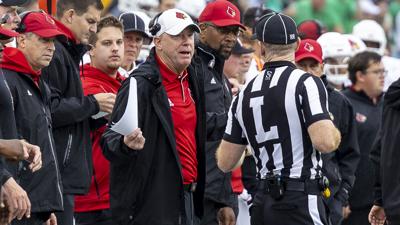

LOUISVILLE, Ky. (WDRB) -- For the first time, really, since Jeff Brohm returned to Louisville as head football coach, his Cardinals are experiencing some legitimate adversity (and the accompanying grumbling).
They fell to SMU on Saturday in L&N Stadium, and, after back-to-back losses, everyone is disgruntled. They fell out of the Top 25. Fans are frustrated. Why shouldn't they be? It's their right. Brohm seemed miffed after the 34-27 loss, as much at his staff as his team. Probably was ticked off with himself, too, if you know Brohm.
With the defense getting criticism, the mother of Ashton Gillotte took to social media to defend her son, whose numbers, while not great over the past several games, don't really tell the story of a player who is a focal point of opposing game plans.
If you look around college football after some of the carnage this past weekend, Louisville isn't the only place this is happening. Alabama dominates Georgia one week and loses at Vanderbilt the next. Tennessee has one of the nation's most potent offenses but nothing happens when it hits the gas at Arkansas.
You know all the examples. As I look at the landscape, here are some loosely associated thoughts, relating to Louisville.
1. DEFENSE NEEDS SIMPLIFICATION. This isn't a new concept. Last season, after Georgia Tech lit up the Louisville defense in the first half of the season opener, Brohm and his staff quickly paired down the defense, simplified the scheme, and saw immediate results.
As this season's defense continues to appear slow to line up, confused at times on roles, and otherwise lost on some plays, it would appear that communication from bench or booth to field may yet be an issue. Helmet communication on offense, with a defined play caller at quarterback, is a natural. It may be less so on defense, with players counted on to communicate calls – but with adjustments still happening via signal after the communication is off.
Hard to say. There have been bright spots. The continued emergence of Stanquan Clark at linebacker, for one. The play of MJ Griffin.
But you have to have your best players play their best. If Gillotte is not going to be the disruptive force Louisville needs him to be from a production standpoint, someone else needs to get home in terms of pressure. Or the scheme needs to be tweaked. Or, instead of moving him around, perhaps Louisville coaches have him focus on his strength. Louisville also needs Quincy Riley, who missed a second straight game because of injury, on the field.
Whatever the case, Louisville is giving up 390 yards and 28 points per game to Power 5 opponents. It has had one sack in three games against Power 5 competition. Its inability to pressure quarterbacks is a problem, and it's difficulty with running quarterbacks is going to be a liability if not fixed.
Also this – whatever your thoughts on Louisville, responsibility for its two losses does not lie solely on the defense. At Notre Dame, in fact, the defense was put in, well, indefensible positions on a couple of scores. Otherwise, it held a nationally ranked team on the road to an output that was clearly manageable for an offense that was delivering to its capability.
2. THE FOURTH DOWN THING. Tyler Shough, at quarterback, is the real deal. Louisville has three legitimate wideout threats in Ja'Corey Brooks, Caullin Lacy and Chris Bell. Its tight ends are pretty good. It has a star in the making with freshman running back Isaac Brown.
The offense is not far off. But on fourth down, it has had a problem. The Cards were 1-for-5 on fourth down at Notre Dame, and converted two of four against SMU. Louisville ranks dead last in the nation in fourth-down rushing yards, but only because of a negative 42 yards on a bad punt snap at Notre Dame. Even when you don't count that play, however, Louisville has rushed for seven yards on four fourth-down carries, and six of those came on the one fourth down that was successful.
The Cardinals are converting 50 percent of their fourth down passes. And they're converting 40 percent of all fourth downs against Power 5 competition. That's not terrible. The national average is around 51 percent. But they've picked some bad times to come up short, passed up on some chances to kick field goals and chosen to roll the dice.
Those are easy things to criticize in hindsight, but they matter.
Most of the offensive issues stem from offensive line-running game struggles. Against its three Power 4 opponents, Louisville is averaging 3.3 yards per carry. It has allowed six sacks in those games, and numerous other pressures or hurries.
The Cards rank No. 8 in the nation in plays of 20-plus and 30-plus yards, and they're tied for second in the nation in plays of 40-plus yards. The big plays have been good. The short yardage has been a struggle.
Brohm will need to find a solution or a workaround.
3. THE NIL EXPERIENCE. It's not about the money, but it is about the money. The abrupt departure bug hit Louisville before the SMU game, as it has hit others. This past week, safety Devin Neal left the program reportedly because he wanted to redshirt after playing his fourth game, and coaches said they needed him to keep playing.
College football's redshirt rule has to go, except in cases of injury or abuse. To play four games, then decide to pack it in and go elsewhere if you don't like the way things are going is not a good-faith option for players who presumably signed one-year deals coming into the season. When the entity paying the player isn't the same entity they are playing for, that, too, is going to lead to problems, as we've seen elsewhere.
The fact is, we have no idea what's going on behind the scenes on some of this NIL stuff. We don't know how that affects a team's dynamic, or what impact it has on player attitudes. I suspect it is more of a factor in more places than we know.
We do know it changes the player-fan dynamic. Gillotte's mother took to social media to note that her son was still playing hard, saying, "The negative comments about my son & other players is wild. I'm disappointed how quickly people turn."
No one (coaches, players, parents, and true fans) is happy w the loss. Everyone can be disappointed but the negative comments about my son & players is wild.
— Veronica Gillotte (@VGillotte) October 6, 2024
I am disappointed how quickly people turn.
I agree with her. In general, I think people are too quick to lash out and say over-the-top things on social media.
At the same time, her son is a professional athlete. We're no longer in the world of college kids just out there playing for love of school and tuition, room and board. They're making more money than many of the people in the stands rooting for their team – many of whom have parted with their hard-earned money in NIL donations, not to mention the cost of tickets and everything else.
You take the money, you take the criticism. That's part of what you're paid for. And if people knew how much a lot of these guys are paid, the criticism likely would be greater. So, they'd do well to remember — it could be worse. One other thing to remember — there are far, far more people who support these guys than those who are on social media or elsewhere criticizing them.
I covered Dewayne White and Elvis Dumervil and Michael Josiah and a lot of edge rushers at Louisville. I've been fortunate to cover seven of the school's 10 all-time sack leaders (and my WDRB partner, Rick Bozich, has covered all of them.) Gillotte is on that list. Where he differs is that he's the only one to get paid to do it. That does change the equation, as much as I sometimes wish it didn't.
White worked at Home Depot after football practice in high school to help make ends meet. He had multiple family homes burn down. He went after quarterbacks like his next meal depended on it, because growing up, it did.
We are in the early days of college football pay-for-play. Most of us can't relate to how that would've affected us in college. I can tell you, I probably wouldn't have been able to manage the same kind of dedication that a lot of these players do, whatever the money.
But it has created a really difficult to manage situation for coaches. Until guardrails go up, we have little to no idea the stuff going on behind the scenes (and I have no notion what it's like at Louisville). I only suspect that it is a factor everywhere.
4. BROHM WILL MANAGE. When you lose, everybody grumbles. One thing I've noticed about Jeff Brohm is that he is an honest evaluator of everybody, including himself. He'll stay after it, stay after his staff, stay after his players and keep pushing himself.
I do view his coaching tenure at Louisville as different from others. He's from here. He came back here knowing the landscape. Knowing that there is more NIL money elsewhere. Knowing that the conference situation is better elsewhere (including the school he left).
He took on the challenge here — and there are challenges here — and is the one coach in America who feels more desire (and pressure) to make it work than any other.
That doesn't mean fans aren't going to gripe about you when you lose. It also means that even when they gripe, they're in your corner.
I can't tell you how many people I've heard say, even complaining about this or that aspect of the loss, "I love Jeff, but ..." or "Jeff is my coach, but ..."
When the fans aren't with you, there's no disclaimer. This fan base is what it is. It isn't going to be a big, traditional fan base that shows up 60,000 strong no matter the time of game or the opponent. Howard Schnellenberger worked his pipe off to create a football culture here, and it's still growing.
But fans here, at least any with any kind of perspective, realize what they have in Brohm, and will take the lumps on the way to seeing where this program winds up under his leadership.
Copyright 2024 WDRB Media. All Rights Reserved.


