
LOUISVILLE, Ky. (WDRB) -- College football is on the brink, we're being told, with various and trusted college football reporters speculating that Power 5 conferences are on the verge of pulling the plug on all sports this fall in order to regroup and hope for a spring launch.
Here's my question, and the question of many around the nation: What pushed things to the brink? Why now? What has changed from when athletes reported to campus?
As May turned to June, conferences couldn't wait to get players back to campus, despite the presence of COVID-19. They wanted to do it safely, yes, but over the course of a month, they brought them back in stages, tested them, educated them, housed them, took all the precautions.
The goal was an on-time start to college football, or close to it. Don't let them tell you anything else. Look at when the leagues are set to start play, even with their COVID-19 adjusted schedules. Louisville's original start was Sept. 5. Its new schedule begins a week later. A single week. Indiana will keep its originally scheduled opening date. Despite everything, even at 1,000-plus cases the past three days, around 3,000 deaths in the state, the Big Ten didn't delay Indiana's start by a single day. In fact, Power 5 conferences were looking at adding television inventory, with extra league games.
So don't tell me they weren't pressing on, virus or no virus. Players want to play, coaches want to coach.
Now, issues did crop up. Some coaches, as you might expect, were doing it wrong. Some staffs were pressuring players. A few high-profile players opted out. Rondale Moore, a Louisville native, was one of the highest profile, leaving Purdue to focus on the NFL Draft, "given the unprecedented circumstances we are currently living in."
But essentially, college football had pressed on through what looked like the worst of it in a good many places. And where it hadn't, short-sighted and obstinate political leaders were slowly being brought to a position of reality so that those places had to begin to deal with it, or try to. Dr. Anthony Fauci said it, other experts said it, with the virus waning in the spring. They said May and June could be months where people feel comfortable and start getting back to life and grow careless. Andy Slavitt, a former White House public health official, called them "months of bliss."
People laughed at the notion. Some scoffed. Some right-leaning media members made fun of the whole crowd. But of course, that crowd was right. Ask them in Florida, or Arizona, or anywhere else trying to re-fight a battle that the president and everyone of similar thinking said had already been won.
A quick lesson: Anyone who tells you that the media is "fear mongering" is himself -- or herself -- afraid. They may not be afraid of whatever the subject of the story is, but they're afraid of the influence it might have, or they're afraid themselves of the possible outcome of the subject. They are tipping their hand. They are scared, and they, in fact, are the ones about to take advantage of fear.
Here's the reality: Whether the American media reports on COVID-19 or not, it is still there. You stop publishing the statistics every day, the cases still keep coming. You stop reporting on the deaths, they still happen, perhaps in greater number, because the public lets down its guard.
And here's the problem in American life: There is more money at the moment in telling people what they want to hear rather than the actual truth. There are people who have been wrong about this virus and its consequences at every, single, stop, who keep selling their trash analysis and gaining large followings because it is what people want to hear, it makes them feel like they have some kind of power or gives voice to their own fear.
They mix in a good portion of media bashing, because that sells, too. But if people are afraid of simply reporting an analysis, that's on them. I could go on, but that's veering off into another column.
The virus is still among us, that's a fact, has always been a fact.
So what the heck has changed? Did college administrators realize that fans at games were a longshot for September and do the math? Did the cost of testing and other precautions finally begin to hit home? Have, unbeknownst to the public, large numbers of players tested positive?
Or did player demands shake leadership into realizing that its plan had a major flaw -- it had not included player concerns enough from the start?
This last point might be the closest to the mark. Until Saturday, the prevailing player viewpoint in public discourse was that players were A). Opting out and B). Demanding money and other concessions from administrators.
The latter has been the case for a while, but during a pandemic, became more pronounced, focused, and, from the standpoint of players, more organized.
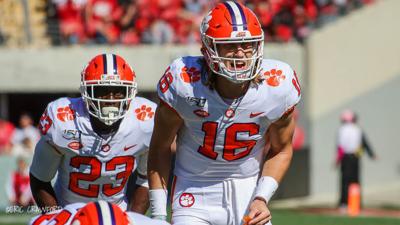
In 24 hours, however, the prevailing message of players changed from one of threatening to sit to one of "wanting to play." Trevor Lawrence, Clemson quarterback, has done a masterful job of trying to wed the two, but it's an uphill battle.
The problem? The revenues players want a share of are evaporating. As we speak. As the virus refuses to abate and administrators see the financial writing on the wall, the pie is shrinking. If there are no games, if millions of Americans remain out of work, if the economy is contracting or not rebounding as quickly as hoped, who has extra income to spend on jerseys? And if they can't buy tickets, TV revenue alone isn't enough.
Players, perhaps too late, perhaps not, have had the slow yet certain realization that without games, they're just regular students. And let me tell you, life as a regular student is no picnic.
Players not only want to play, they need to play. And the threat of losing the opportunity to play has brought them out in huge numbers as advocates for -- wait for it -- exactly what was happening before all this "shutdown" discussion started.
#WeWantToPlay pic.twitter.com/jvQhE7noGB
— Trevor Lawrence (@Trevorlawrencee) August 10, 2020
To say that college football's leadership orchestrated this is, I feel like, giving it more credit than it deserves. But for the life of me, the only thing I can find that changed from the month players returned to campus to the day the sports world woke up to talk of cancellation is this awkward relationship between athletes and administrations.
If the concern had been COVID, administrations would've listened to the (non-sports affiliated) experts from the start.
So we'll wait, not for health reasons, so much, but for athletes and administrators to look each other in the eyes and decide whether they really want to do this or not.
Meanwhile, the Mid-American Conference became the first non-Power 5 FBS conference to realize that without guaranteed games its members would be irresponsible to continue. They can't afford the weekly testing. Most of them are using university money already. Best to button up and weather the storm. They did the math, and blamed COVID, which is a legitimate concern if you can't afford the protective measures, and may be a legitimate concern even if you an..
But I'm not going to believe that universities who believe it is safe to bring students back to campus by the thousands think they can't manage having players play football.
There are two realities here. There is a coronavirus reality, and a financial reality. College football was prepared to move forward in the former, but the latter has it taking a hard look at whether it is truly realistic, or even worth it.
That's what has changed.
Copyright 2020 WDRB Media. All Rights Reserved.


