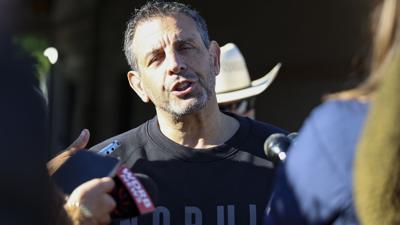

LOUISVILLE, Ky. (WDRB) — Mike Repole came to Churchill Downs this week with the Kentucky Derby favorite, an Oaks contender, 75 guests and a warning.
The party, he will tell you, is beautiful.
The business behind it, he says, is not.
"This is the beautiful part about racing," Repole said, standing on the backside this week, surrounded by friends, family and the kind of Derby-week energy that sells the sport to the world. "This is the part that made me want to get into it."
But that's the tension he keeps coming back to.
Because what the Kentucky Derby shows you — the crowds, the color, the 20 million people watching — is not what he believes horse racing really is anymore.
"This is not what it was five years ago," he said. "This is not what it was 10 years ago. This is not what it was 20 years ago."
Repole is one of the sport's most successful owners. He is also, by most measures, its most outspoken.
And what he has been saying — louder, more often, and with less patience — is that the sport everyone sees on Derby weekend is masking something else entirely. Something smaller. Something shrinking.
"Foal crop has shrunk from 50,000 beautiful horses 30 years ago being born to now under 16,000," Repole said. "You go from 50 to 16, soon you're going to be at 10."
Fewer horses. Fewer owners. Fewer bettors.
He doesn't dress it up.
"This game is not as bad as I'm telling you," he said. "It's worse than I'm telling you. It's a house of cards right now."
And yet, for one weekend every spring, the sport looks bulletproof.
That's the paradox Repole can't shake. Horse racing has its biggest stage, its biggest audience, its most compelling product — and, in his view, no real plan for what comes next.
"Once you get that big hit, once you get that big spark, you now have to have a plan and a strategy to have that momentum to build off of this," he said. "Okay, what's after the Derby? Okay, what's the next one?"
He pauses.
"This sport does nothing."
Or at least, nothing long-term.
"A long-term plan in horse racing is next Friday," he said.
And when Repole talks about why, he doesn't speak in generalities. He points directly at the people in charge.
"The Jockey Club is the root," he said. "They're the root of every issue."
His argument is not subtle. He believes the sport's leadership structure — from the Jockey Club to other governing bodies — is too insular, too overlapping, and too slow to change. He questions why a nonprofit entity tied to the sport also controls key pieces of its business infrastructure, including data.
"They own the data," Repole said. "In every sport, the data is free."
That matters because computer-assisted wagering — high-volume, data-driven betting that can flood pools late and shift odds — has become one of racing’s hottest issues. To many smaller bettors, it can feel as if some players are operating with a different set of tools.
He goes further. Repole argues that the same small group of decision-makers holds influence across multiple governing bodies — a structure he believes creates conflicts of interest and limits accountability.
"When you look at the boards ... the overlap," he said. "Everything's a conflict of interest. Everything."
That, in his view, is why change is so difficult.
"When you don't want to sit down and talk, that means you don't want change," he said.
Repole doesn't just think the sport is shrinking. He thinks it is resisting the changes that might save it.
"If you did a secret poll ... and ask people who are industry participants ... how do you feel today versus 15 years ago?" he said. "They'd all say it's a shell of itself. It's not as fun."
That's not the version of horse racing you see on Derby Day — the packed grandstand, the national spotlight, the feeling that for two minutes the entire sport still matters in a way few others can match.
That version is real. Repole believes it's just incomplete.
"If you want to come back to this Derby in 2036," he said, "it has to change."
That's the warning. And the question that follows isn't whether Repole is right about every detail, every solution, every target.
It's whether the sport he's talking about — the one beneath the spectacle — is strong enough to ignore him.
Because Repole is still here. Still investing. Still entering horses. Still chasing the same race everyone else is chasing this week.
The sport, Repole said, has resisted the road to relevance. He now fears it is resisting routes to survival.
He hasn't given up on horse racing.
He’s just not convinced the people running it will change it in time.
Copyright 2026 WDRB Media. All Rights Reserved.


