


LOUISVILLE, Ky. (WDRB) — Chris Redman was on his way to a Christmas Eve church service when his phone rang.
Eric Wood was calling.
The former Louisville offensive lineman, now an ambassador and analyst for the city's new UFL franchise, had a question for Redman.
Would he be interested in becoming the Louisville Kings' first head coach?
Redman listened. The more Wood explained, the more intrigued he became. By the time he pulled into the church parking lot, something had shifted.
He said yes.
It was, in some ways, the most unlikely phone call of his football life. Not because the job was beneath him or beyond him, but because coaching hadn't been part of the plan. Not anymore. For the past year, his attention had been somewhere else entirely.
His son, Britt, had been diagnosed with testicular cancer in 2023, during his senior year at Christian Academy of Louisville. Redman stepped away from coaching to be present for what mattered most. Britt went into remission. Graduated. Enrolled at Ole Miss.
And Chris Redman, for the first time in a long time, had time on his hands.
Football found him again.
It had found him before.
When Redman’s NFL career ended, the Jacksonville Jaguars offered him a coaching job. He turned it down. He wanted to stay in Louisville, stay close to his family and his city. He tried other things. Eventually, football found him again through his son, through the sidelines of high school games, assisting at Christian Academy, through six years of coaching and three state championships.
Then Britt got sick, and Redman stepped away again.

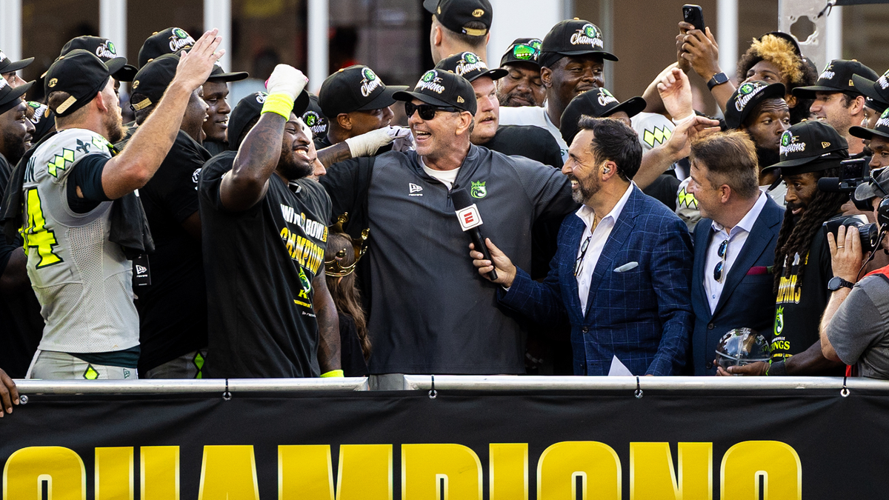
Chris Redman and the Louisville Kings celebrate their UFL United Bowl championship win on the podium after the game.
Now here was Wood on the phone, on Christmas Eve, with an offer that hadn't been on Redman's radar.
The difference this time was that nobody was asking him to coach quarterbacks or support someone else's program. They were asking him to lead. To be the one people looked at when things went wrong. To represent a city that hadn't had a professional football team in years.
That's a different job.
He'd find out just how different soon enough.
Three games into the season, the record was not encouraging.
The Kings had lost by a yard. Lost in overtime. Lost to a rule that sounded made up until it wasn't.
The standings said 0-3.
The critics had ammunition.
The pressure was specific in a way it wouldn't have been for anyone else. Other coaches in the UFL represented their cities. Redman was from his. Born here. Raised here. The kind of person who, if things went badly, would still have to go to the grocery store and the gas station and the kids' games and look his neighbors in the eye.
"There's a lot of pressure," he said. "If things go bad, I'm still going to live in Louisville. You’ve got to live with that."
What nobody knew was that Redman was already facing the first truly difficult decisions of his coaching career.
The Jason Bean situation had been building for a while.
Redman had noticed things. Small things. The kind coaches notice and players often don't.
"He was sitting there in between meetings playing video games," Redman said. “I call his agent, I was like, ‘Hey, man, like, you know, we need to get serious about this. We want to win a championship here, and we need to take it serious.”
The agent’s response surprised him.
“Well, no, this is the new age,” Redman remembered him saying. “’If you want to be a coach in this age, you need to be able to handle these guts.’ I'm like, ‘I don't know about that.’”
Redman sat with the agent’s words.
Maybe he was right. Maybe this was how things worked now. Maybe a rookie head coach with an 0-3 record wasn't in a position to push back.
Then Redman called his father.
Bob Redman had spent decades as a Hall of Fame high school coach in Kentucky. He had made difficult personnel decisions.
The son explained the situation. The father didn't need long.
"My dad said, ‘Go with your gut,’” Redman said. “That's kind of where he really helped me. How it was just like, ‘If you feel something, then go with it,”

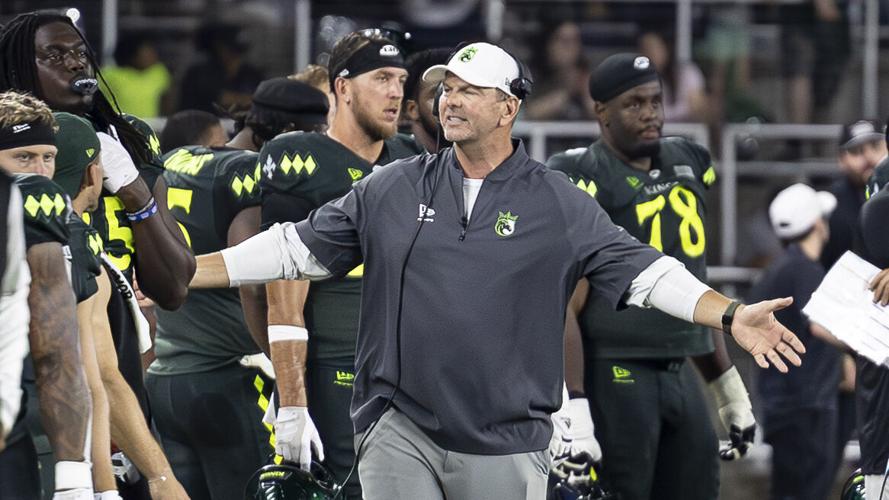
Louisville Kings coach Chris Redman during his team's overtime loss to Orlando on April 10, 2026 in Lynn Family Stadium.
Simple advice. Hard to follow. Especially when your season feels like it's hanging by a thread and everyone is already questioning whether you belong.
But the call clarified something. Chris Redman already knew what he wanted his team to look like. The question was whether he was willing to act on it.
He was. The day after Louisville’s first win of the season, Redman traded Bean. The quarterback had not necessarily done anything wrong. He wound up in the UFL Championship game himself. But it wasn't Redman's way.
Benny Snell was gone soon after.
A University of Kentucky grad and former Pittsburgh Steeler, Snell had been a respected name when the Kings brought him in. He was good to Redman personally. But his knee wasn't right, and Redman had some concerns about how he was treating other staffers.
"I'm more about how you treat other people," he said.
Neither move was universally popular. Neither looked particularly safe for a rookie head coach already absorbing criticism. But Redman wasn't trying to win an argument.
He was trying to build something.
And somewhere in the process of building it, he realized he understood how. He had watched his father make decisions exactly like these, standing on sidelines, in coaches' offices, doing the things that don't show up in the box score but determine what a team becomes. He hadn't fully understood it then. He did now.
Before the season, looking to bridge the gap between high school coaching and professional football, Redman had sought advice from Scott Davenport, the longtime Bellarmine men's basketball coach who had navigated the transition from high school to college to Division II head coach, then Division I. The conversation stuck with him. Different sport, same principle: the game doesn't change as much as people think. The people do.
The Kings responded.
Louisville won six of its next seven games. The defense became the identity of the team. Redman compared it, without much hesitation, to the 2000 Baltimore Ravens defense he'd witnessed up close as a backup quarterback, one of the greatest in NFL history. The running game became relentless. The locker room tightened around the right people. The city embraced the franchise.
A season that looked wobbly in April looked inevitable by June.
At least from the outside.
Redman, characteristically, doesn't see it that way. Even at 0-3, he said, he never believed the record reflected the team. He'd watched the film. He knew how close the losses were.
"We were not an 0-3 team," he said. "I knew that."
The city caught up to what he already understood.
For most of his football life, people knew Chris Redman as a quarterback.
The kid from Male High. The star at Louisville. The NFL player who came back from two years away from the game and played five more seasons because he refused to let the door close without walking back through it.

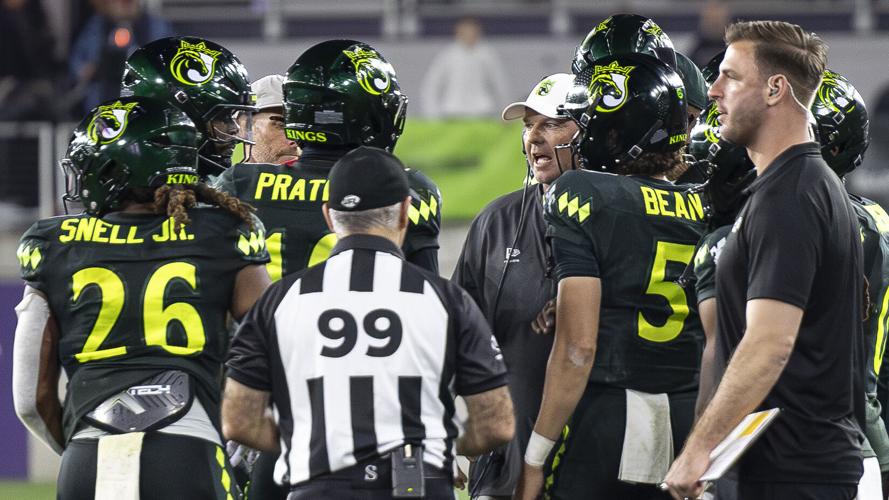
Chris Redman talk to his team during the Louisville Kings' overtime loss to Orlando in Lynn Family Stadium.
What they missed was the part underneath, the willingness to make decisions, the comfort with responsibility, the understanding that leadership isn't about certainty. It's about accountability.
"Everybody's like, 'Well, you don't have any experience,'" Redman said. "My answer is, either you're a leader or you're not."
The championship validated that belief. It didn't create it.
What changed this spring wasn't Redman's understanding of football. It was his understanding of himself. He hadn't known, when he turned down Jacksonville, what he was postponing. He hadn't known, when he stepped away to care for his son, that the game would be waiting when he came back. He hadn't known, when Wood called on Christmas Eve, that the thing he'd been circling his whole adult life was finally ready to be claimed.
"It turns out I love coaching even more than I thought," he said.
That may be the most important thing he learned all season.
On Christmas Eve, a phone rang.
A man on his way to church answered it.
He said yes to a job he hadn't been looking for, in a city he'd never really left, representing people he'd have to face either way.
The game had found him one more time.
He started the season as a former quarterback. He ended it as a championship coach.
Copyright 2026 WDRB Media. All Rights Reserved.


