
LOUISVILLE, Ky. (WDRB) — There are two kinds of people. Those who stay in their seats and watch the credits roll at the end of movies, and those who do not.
For the University of Louisville men’s basketball team, the credits are rolling. By now, most people have left their popcorn buckets in the aisle and headed to the car.
Imagine, then, if you will, having a job that requires you to keep writing about what is happening, even with the credits rolling, without even any comic relief, like at the end of Ferris Bueller’s Day Off.
What, you’re still here? Go home? It’s over.
Louisville lost to Syracuse Saturday night, 82-76, a score which fails to convey the depth of frustration the game entailed for the Louisville basketball program and the fans still hardy enough to stick with it. My thoughts on the game, which you might as well roll over a few highlights (lowlights) as they pass by.
DIRECTOR: KENNY PAYNE
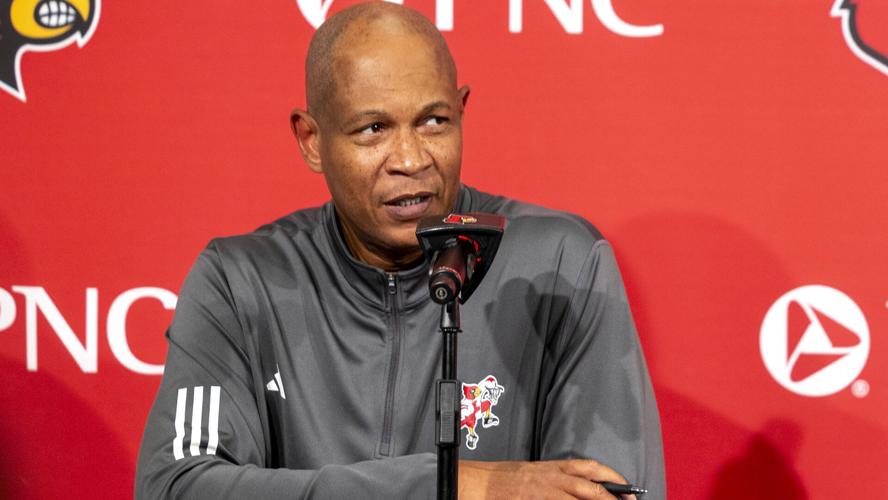
The Louisville coach sounded genuinely frustrated in his opening comments after the loss. While they centered around a well-worn theme — the players aren’t getting it, aren’t grasping how hard they need to work, fight, etc. (Payne used the word “fight” or some form of it six times in his nine-minute news conference.), the coach openly questioned why he hasn’t been able to land the right messages with his players.
“Very disappointed that I, we as a staff, myself, couldn't get these guys to come out with the energy, the effort, the fight that it takes to get a win,” Payne said. “For me, personally, I look at this and I say, ‘All right, am I giving the message the wrong way? Am I asking you to sacrifice something that you’re not able to do? Am I saying something that's not translating?”

Louisville coach Kenny Payne speaks at a press conference on Dec. 17, 2023.
I do take Payne at his word that coaches are telling players a lot of the right things to do. They’re not telling players to break down on defense or to take bad shots. At the same time, it’s the job of the coach to land those messages, to find ways to drive those points home. With every team, there is game slippage. There are mistakes and failures. Even for the best teams — but much less often for the best teams.
But the essence of coaching is to be able to implement plans and systems and see them replicated at game speed in real-time competition. There are many different ways to achieve that. Payne has yet to find his way, it sounds like.
When my WDRB colleague, Rick Bozich, asked him why he thinks that is, Payne had few answers. And in fact, he bemoaned the approach of players, not his own approach to coaching at all.
“I want players that when it’s tough, they fight, and they love their teammates and they’re doing it together and they’re doing what they’re supposed to do on the court, and they’re overcoming their barriers,” Payne said.
Great, but how do you get them to do that. I know it’s not easy. They do pay a lot of money for coaches to do that, though.
CINEMATOGRAPHY: TY-LAUR JOHNSON AND CAST
With 5.1 seconds left in the first half and Syracuse having to go the length of the court to try to score, the Orange set up a press-break and Louisville set up its press. Turns out, Syracuse didn’t have to run much of a break. They inbounded the ball to near midcourt. One backward pass went to a streaking Judah Mintz, who caught it on a dead sprint, split two Louisville defenders at midcourt and drove unchallenged for a dunk before the buzzer.
It was one of two times that ACC Network commentator Terrence Oglesby said, “That just can’t happen.”
Oh, it can happen, my friend.

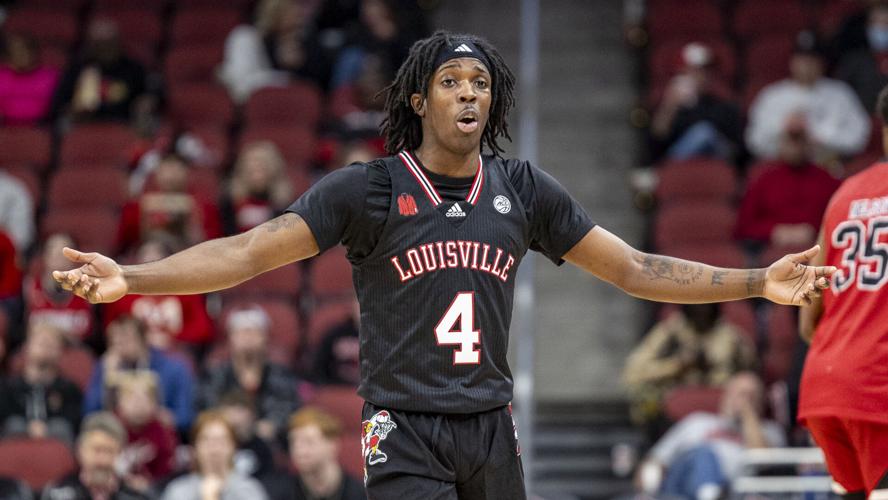
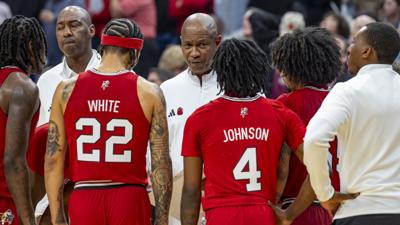
Ty-Laur Johnson gestures toward the bench during a loss to Arkansas State.
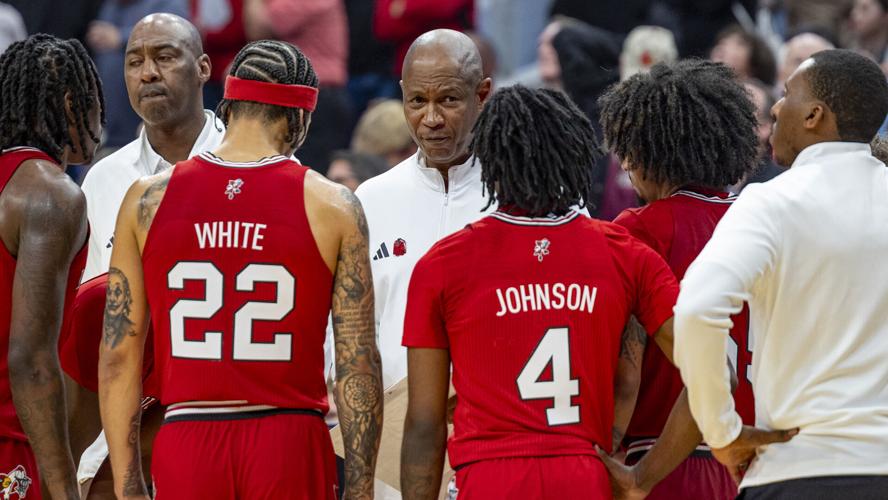
The key to Louisville’s defense on that play, according to Payne after the game, was the initial defense on Mintz. He had Brandon Huntley-Hatfield in front of Mintz to deny the inbounds pass, and Ty-Laur Johnson behind him to deny his break to get the ball once it was inbounded. The problem, according to Payne, was that instead of lining up behind Mintz to block his break for the ball, Johnson lined up beside him, and when the ball was inbounded, Mintz sprinted right by him, got the ball, and was gone.
“Attention to detail. Little things mean a lot,” Payne said. “I’m not blaming Ty-Laur, but the attention to detail is what it takes to prevent a nothing play to end up in a dunk.”
A couple of things. First, it kind of sounds like he is blaming Ty-Laur, and that’s OK. Yes, he’s a freshman and isn’t going to be perfect. But he’s also making money to play the game. Players and fans may not like it, but these guys are basically pros. They’re not professional from an age standpoint, but a good many of them are making more money than the fans watching them.
Second, these are situations where you usually see assistant coaches up screaming at players to position them. You see it on almost every inbounds play. May have happened in this case, I don’t know.
Third, even if Huntley-Hatfield and Johnson are taken out of the play after one pass, there are three other defenders on the court and they only have to defend for four seconds. Somebody has to stop the ball. Why Emmanuel Okorafor was positioned where he was, I don’t know. You need somebody to protect the rim, somebody to pick up the ball. None of that happened.
And Louisville’s coaches are making a lot of money to take care of that stuff, too, so there is blame to be spread around.
And look, it’s just one play. But it was a demoralizing play. Louisville looked flat-footed, because it was flat-footed.
It was a bad scene.
ONE MORE SNAPSHOT
Remember the credits for The Hangover, when they rolled through pictures from the lost night? If we rolled through snapshots of this season for Louisville, this unfortunately would be one of mine.
Typical free throw. Syracuse’s Maliq Brown had driven for a layup and was fouled just under four minutes into the second half. Brown is at the line for one free throw; every other Syracuse player is back on defense at the other end of the court. Louisville has the only rebounders in the lane. Brown misses his free throw, follows it, and outfights the Cardinals for the rebound and is fouled again. Syracuse winds up scoring moments later on a spinning drive by Quadir Copeland for a four-point possession, pushing its lead from seven to 11.
“That just can’t happen,” Oglesby said of the offensive rebound.
Oh, it happened.
In a situation where there was only one guy to block out, he didn’t get blocked out.
Quick story. Back in my days of covering Division II basketball, I had the good fortune to be able to watch practice at the University of Southern Indiana every day. And I remember a free-throw during scrimmage play. Free throws are practice, for the shooter, for the guys blocking out, for the guys trying to get on offensive rebound. On the shot, the player on the left side was supposed to slip around and try to get around the block-out along the baseline for rebounding position. But he didn’t. He went the other way toward the middle of the lane, and the defensive team rebounded. Play was about to go on when the whistle blew, and the coach went to the court and corrected the player. Then play went on.
I think I remember it because the coach came over to me after doing that and said, “Championship teams, that guy makes that move on the offensive rebound every time. Not most of the time, every time. Always. Disciplined. Consistent. Championship teams care, even about that one little thing.”
He didn’t say that to the team, but said it to me. Bruce Pearl eventually would win a national championship, though not that year. I remember that little comment almost every time I see a guy slip around for an offensive rebound on a free throw.
It's more than just a challenge to players, though it very much is, in the end, a challenge to players. But it’s also a challenge for coaches, to get players to do that, whether it is through fear or pleading or inspiration.
That attention is more than half the battle.
ROLL THE CREDITS
It's easy to forget, this Louisville team has seven top-100 recruits. At some point along the line, all of these guys have been judged to have a pretty high talent level. The beauty (and frustration) of basketball is that sheer talent is rarely enough. You have to play together, have to play with intensity.
People got mad when Payne said that Louisville couldn’t beat people with talent. He wasn't wrong. The fact is, Louisville is more talented, at least as the evaluators judge it, than a moderate number of teams it plays. But it is missing that urgency, intensity and discipline.
Unfortunately for Payne, that also means it is missing coaching.
Look, this kind of column makes me feel like I’m beating a dead horse. And there’s no point in doing that. Much of this season has been about trying to figure out creative ways to present the same old problems.
I guess, in the end, the value in this is less for basketball purposes than for the rest of us to remember. I find myself asking whether I do those little things every time? Do I attend to those little details in my life and work? Do I communicate clearly enough?
No coach, or player, or team, athletic director or even sports writer is going to get it right every time, though I have seen some come pretty close.
But we’ve been watching a bad movie in these parts for quite some time, and it’s no surprise that a good many people have long since walked out. For the rest of you, my apologies for talking as the credits roll.
Copyright 2024 WDRB Media. All Rights Reserved.