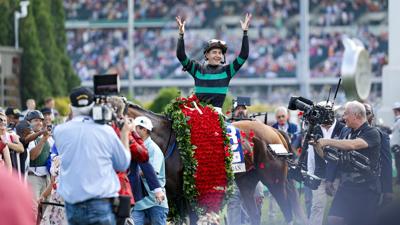

LOUISVILLE, Ky. (WDRB) — Every Kentucky Derby winner inherits a problem. It arrives while the roses are still fresh and the photographs are still being taken.
What's next?
For more than a century, there was only one answer. The Preakness. Lately, as training methods have changed, there have been two. Hustle back in two weeks to run the Preakness in the Triple Crown chase, or stick to the modern conventional schedule and go on to the Belmont.
Nothing that happened in horse racing this week changed that, and that's a problem for the Triple Crown. One of the oldest challenges in American sports isn't dead. But it is being slowly abandoned.
Churchill Downs and the New York Racing Association on Monday unveiled a six-race championship series that stretches from the Kentucky Derby through the Belmont, ending in a championship race in September. The Preakness was not included in the series.
On Wednesday, Maryland announced the Preakness would move back eight days in an effort to give the Derby winner a little more room to breathe.
Both ideas make sense on their own.
Together, they expose the same uncomfortable truth.
Horse racing still can't decide whether its greatest championship lasts five weeks or six months.
The next Derby winner will. That may not be a good thing for the Preakness.
Imagine standing in that barn the morning after the Derby.
You can wheel your horse back toward Baltimore 22 days later, chasing one of the most revered prizes in sports. But that decision will all but assure that you won't run again 13 days after that in the longest race most elite American thoroughbreds will ever attempt.
So maybe you decide right there to skip the Preakness, head to New York and stay on the six-race course that will make you part of a summerlong horse racing narrative and take you right to the Breeders' Cup.
One path is history. The other follows the direction the sport has been moving for years.
The sport has decided both should exist. But this week it failed to find a way for them to coexist.
That's why I don't think Maryland's move changes much.
Eight extra days may help the Preakness. It doesn't solve the Triple Crown. And if you're not going to win the Triple Crown, why run back in the Preakness?
Modern thoroughbreds simply aren't campaigned the way they were when the Triple Crown became racing's defining achievement. Trainers space races farther apart. Every start is weighed against the next one.
You don't have to like that reality.
You do have to acknowledge it.
Because every spring, common sense keeps running into tradition. And lately, common sense has been winning. Three of the last five Derby winners have passed on the Preakness altogether. Eric Reed skipped it with Rich Strike. Bill Mott skipped it with Sovereignty. Cherie DeVaux skipped it with Golden Tempo. This isn't an outlier decision anymore. It's becoming the default one.
If the Preakness has a prayer, it may be in the length of the races. It's possible some Derby winners may prefer their chances at 1 3/16 miles more than they do at 1.5 in the Belmont. Regardless, it's still an either-or proposition. And the Triple Crown loses no matter what the choice is.
Maryland's bigger mistake may not have been moving the Preakness too little. It may have been moving too late.
For years, Pimlico deteriorated while the rest of the sport evolved. By the time Maryland committed to rebuilding the track and rethinking the calendar, Churchill Downs and New York had already begun imagining a different future, one that doesn't end in June.
There was a moment when this might have gone differently. Churchill Downs agreed to acquire the brand rights to the Preakness, before Maryland exercised its option to buy them back and keep the race under state control. Had Churchill kept those rights, it would have had an even stronger commercial reason to fold the Preakness into whatever comes next. Instead, Maryland got its race back, and Churchill got a free hand to build a future that doesn’t rely on Maryland’s inconsistent commitment.
There is another possibility. New York could decide the Triple Crown is worth preserving and move the Belmont to a date that allows horses to compete in all three races.
If horse racing had a commissioner, that conversation would probably begin tomorrow. Someone could sit Churchill Downs, NYRA and the Maryland Jockey Club in the same room and make them solve this together.
It doesn't have that. It has two private racing operators building a series on their own timeline, a state-run track trying to catch up, and no one with the authority to make any of them coordinate.
That's precisely the problem.
That's not an indictment of the Derby. Or the Preakness. Or the Belmont. It's an indictment of a sport that can’t keep its biggest players from pulling in different directions.
The Kentucky Derby still needs the Preakness. The Preakness still needs the Belmont. Those three races became legends together.
Today, each operator is looking out for its own track.
Everybody is protecting a jewel. Nobody is protecting the crown.
Copyright 2026 WDRB Media. All Rights Reserved.


