

LOUISVILLE, Ky. (WDRB) -- While many are focused on spiders as Halloween decorations this time of year, others are busy studying them for research.
"For me, I think anything related to ecology, it's all important and it's all tied together," said Sarah Fortner, a Ph.D. student at the University of Louisville. "Any little change in an ecosystem is going to have big effects that we might not even be able to foresee."

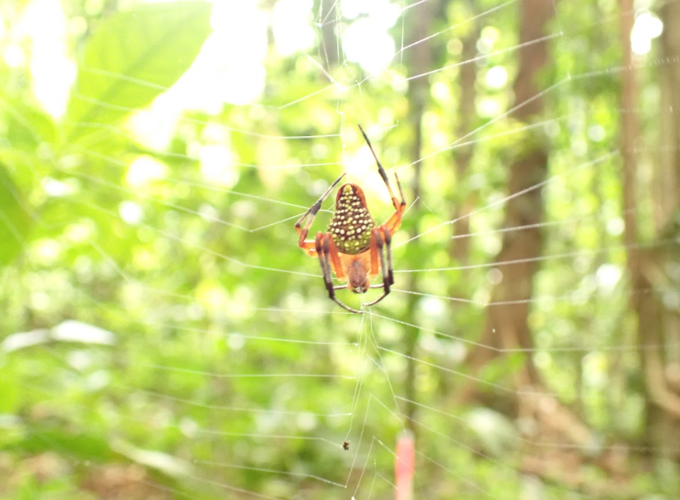
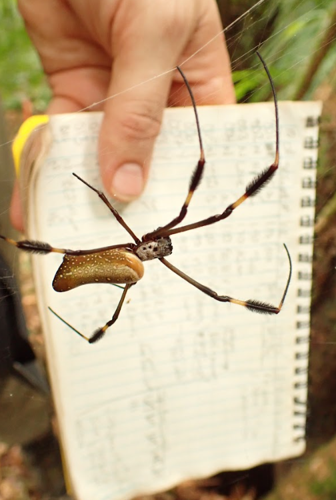
Spider image submitted by Sarah Fortner
Fortner is taking her research to the forests of Panama, studying on an island in the middle of the canal in Central America. This work will take years and many trips back and forth from Kentucky, but she's dedicated to the project. The work she's doing specifically looks at spider webs, taking into account changes in the structure of the rainforest.
"So far we're finding that the horizontal traps are catching larger prey but that the vertical traps are catching more prey, but we're still looking at that data and analyzing that. In Panama, so far what I've seen is that there are more adult spiders in the gaps of the canopy -- in the disturbed areas -- and there's more juvenile or spiderlings, little, tiny spiders in the understory."
Fortner is also measuring the webs to see if there are any trends.
"They build their webs all different angles, different shapes, different sizes and I'm just interested in what it is ecologically that's causing this variation," she explained.
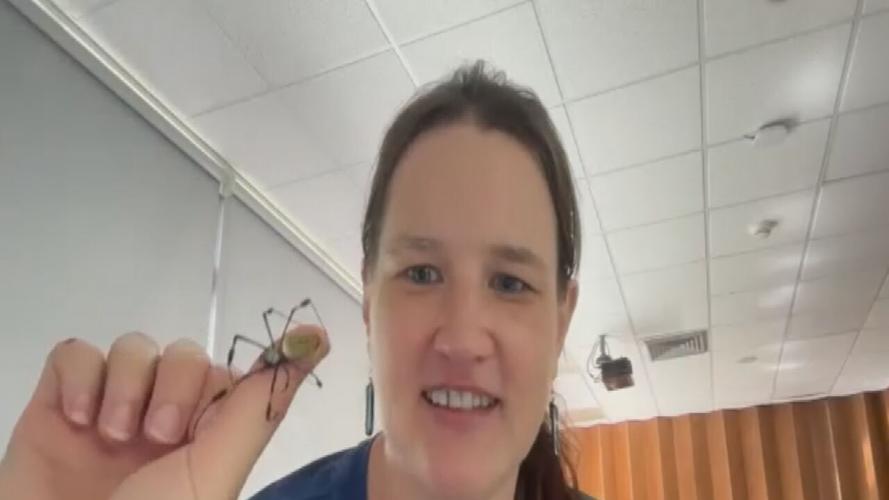
During a virtual interview with WDRB News, Fortner brought out a golden silk orb weaver spider. Handling it with ease, she admitted she used to be terrified of spiders as a child, but after learning more about them, conquered that fear.
"... once you get to know something more, you become more comfortable with it. And I think a lot of the reason that people are scared of insects and spiders is just that they don't, they don't know a lot about them," she said.

Sarah Fortner holds up a spider during an interview with WDRB News as she discusses her research. (WDRB image from Oct. 7, 2024)
Steve Yanoviak, a biology professor at the University of Louisville, helped put together some of the ideas for Fortner's research.
"The goal of her work is to try and figure out why some spiders build their webs in certain orientations relative to the ground," he explained. "Basically our working hypothesis is that there's a trade-off between getting damaged from things like acorns falling on the web and the number of prey that they capture."
He said while some people may not be too fond of spiders, they're actually very beneficial and catch things like gnats, flies, and mosquitoes in their webs. Aside from Fortner's research focused on these webs, Yanoviak said others are looking into things like the grip of spiders as they crawl through areas of different terrain such as leaves.
"We're looking at the biomechanics of that potentially to develop future adhesives that are better for human use," he said.
Fortner believes her research and others like it are important and can help provide answers, even if it takes a lifetime.
"Knowledge is always good," she said. "You might learn something in your research that while you're alive nobody, you know, isn't really used but later on somebody might find something really spectacular."
She went on to add that small findings can help lead to larger discoveries.
"There's no reason not to learn new things and find out new information about nature. It can lead you down so many different paths and it can build a nice groundwork for things -- big things -- to come in the future. But if you don't have the little foundational building blocks first you can't learn those big things," Fortner said.
Fortner plans to return home to Kentucky from Panama this November and continue taking trips back and forth for the next two or three years while she continues this research.
More STEAM Stories:
- UofL professor researching the effects of lightning on trees in tropical rainforests
- Portable and Affordable | A Louisville teen's mission to improve healthcare access
- Safe Room Program can help Indiana residents who need extra protection from strong storms
- Cruise into Learning | S.T.E.A.M. adventures for children on the Ohio River
- Free summer program in Louisville teaching architecture, engineering and construction
Copyright 2024 WDRB Media. All Rights Reserved.


