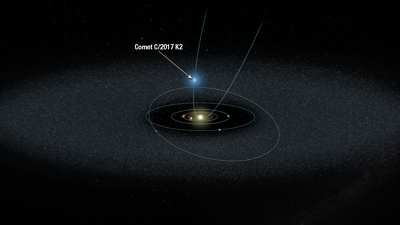
Comet C/2017 K2 (PanSTARRS) is making its closest pass by Earth today on its way toward the sun, but it will still be roughly 168 million miles away from us at its closest point.
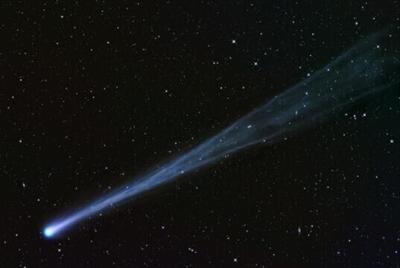
This comet was first spotted in 2017 by astronomers using the Pan-STARRS survey instrument in Hawaii, which is why that is part of its name. According to NASA, in May 2017 "it was the most distant active inbound comet ever found, discovered when it was some 2.4 billion kilometers from the Sun. That put it between the orbital distances of Uranus and Saturn." Those astronomers were able to see it from so far away because Comet K2 is either very large or very active. The size has been up for debate since, "initial observations from the Canada–France–Hawaii Telescope suggest a nucleus with a diameter of about 18 to 100 miles (30 to 160 km). But observations with the Hubble Space Telescope indicate the nucleus should be smaller, at some 11 miles (18 km) or less," according to EarthSky. If it's not large, then it's very active which can be judged based on the size of the coma around it. Comet K2's coma has a diameter of roughly 81,000 miles which is about 10 times larger than Earth's diameter. Early observations also suggest Comet K2 has a tail roughly 500,000 miles long!

If you want to look for Comet K2 in the sky tonight, you will need a dark viewing place and a telescope. Comet K2 isn't bright enough to be seen with just your eyes, but even a small telescope should be able to pick it up. The full moon is also adding a lot of light to the night sky making this already dim object even harder to spot. You should be able to see Comet K2 in your telescope through early September, but today it will be at its closest point to the Earth giving you the best chance to locate it.


