
Brush up on your meteorology with these tasty, try-this-at-home activities. We’re headed to the kitchen to answer your burning questions: What’s the dew point of your leftovers? Why do some seasonings appear to defy gravy — uh — gravity? From convection to condensation, these kitchen science demos are sure to give you some food for thought.
Nothing but pepper in the wind
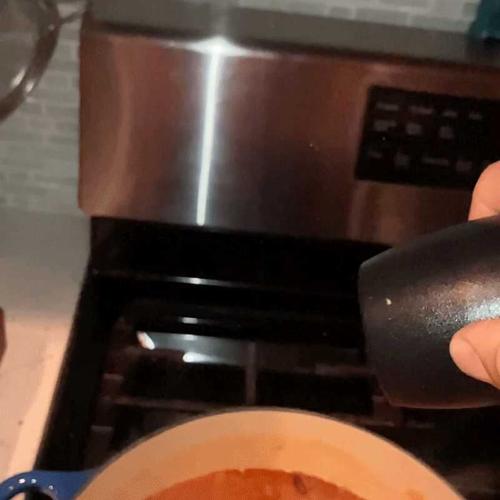
Have you ever ground pepper over a simmering pot of soup only to find that some of the pepper floats up into the air first rather than falling down right away? Like paragliders catching a lift on invisible air currents, those small flecks of pepper are riding an updraft, caught up in warm air rising from the heating soup. This stovetop marvel is caused by convection, which is a driving force behind wind and weather as well as atmospheric circulation. Warm air rises, creating an area of low pressure and generating wind. Convection is also one of the major ways that heat transfers on our planet, as radiation from the sun warms up the land, which heats the air around it.

Image Credit: Going up? Ground pepper catches a lift on an updraft. (NOAA)
Try this at home
- Adult supervision is needed for this experiment. Please be careful when using the stove.
- Try different seasonings! Do dried herbs, red pepper flakes, or other ingredients show the same effect?
- For more kitchen fun, check out the toaster wind experiment from NWS JetStream, the online school for weather.
Cloudy with a chance of mashed potatoes
Thought experiment: You have a pot of water gently boiling on the stove (perhaps, like us, getting ready to boil potatoes for your favorite mashed potato recipe — yum!). You turn the heat on the stove up. Will you see more steam, or less? What about when you turn the heat down?
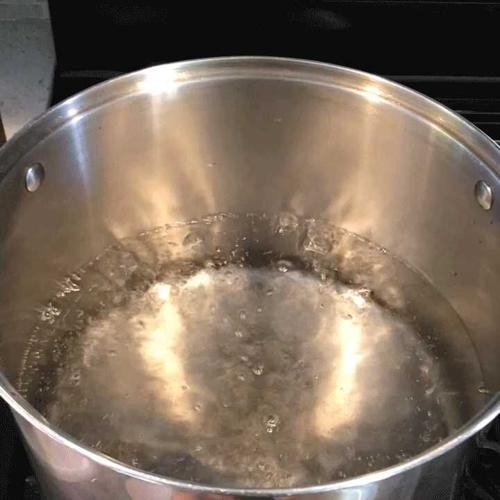
Although it might seem counterintuitive, you’ll usually see more “steam” when you turn the heat down. That’s because steam is water vapor — water in the form of a gas — which is not visible. Rapidly boiling water is generating more steam, but we can’t see it until we drop the temperature and water vapor condenses into liquid droplets. Likewise, there’s always water vapor in the atmosphere, but we can only see it when it condenses — to form clouds!

As we turn the heat on the stove up and down, we can change how much water vapor is visible above the pot. (NOAA)
Try this at home
- Adult supervision is needed for this experiment. Please be careful when using the stove, and keep your hands and face clear of the steam.
- The temperature of your kitchen will also play a role in how much condensation you see.
‘Dew’ we have any leftovers?
Why do water droplets sometimes form on the inside of containers in the refrigerator? Once again, we can look to meteorology, and condensation, for an answer. Think of a warm, humid day followed by a chilly night — you’ll wake up to dewy grass. Likewise, if you take your warm leftovers and pop them in the fridge, you’re taking it below the dew point. The warm water vapor trapped in the container will condense into droplets. Put your leftovers into the freezer instead, and voilà: frost!
Bonus: Water condenses more easily in the presence of small particles called “cloud condensation nuclei” (see more on cloud formation) or other surfaces to cling to before it will transform from gas to liquid. We wondered whether we could use our knowledge of cloud condensation nuclei to leave a secret message in dew on our container. We painted our favorite shape onto the inside of the lid using a solution of sugar and water, then let it dry. When we topped our container of warm leftovers and put it in the fridge, the sugar molecules gave the cooling water vapor something extra to cling to compared to the smooth surface of the lid. As a result, the droplets were larger in those areas, and our pattern was revealed! Can you tell what it is?
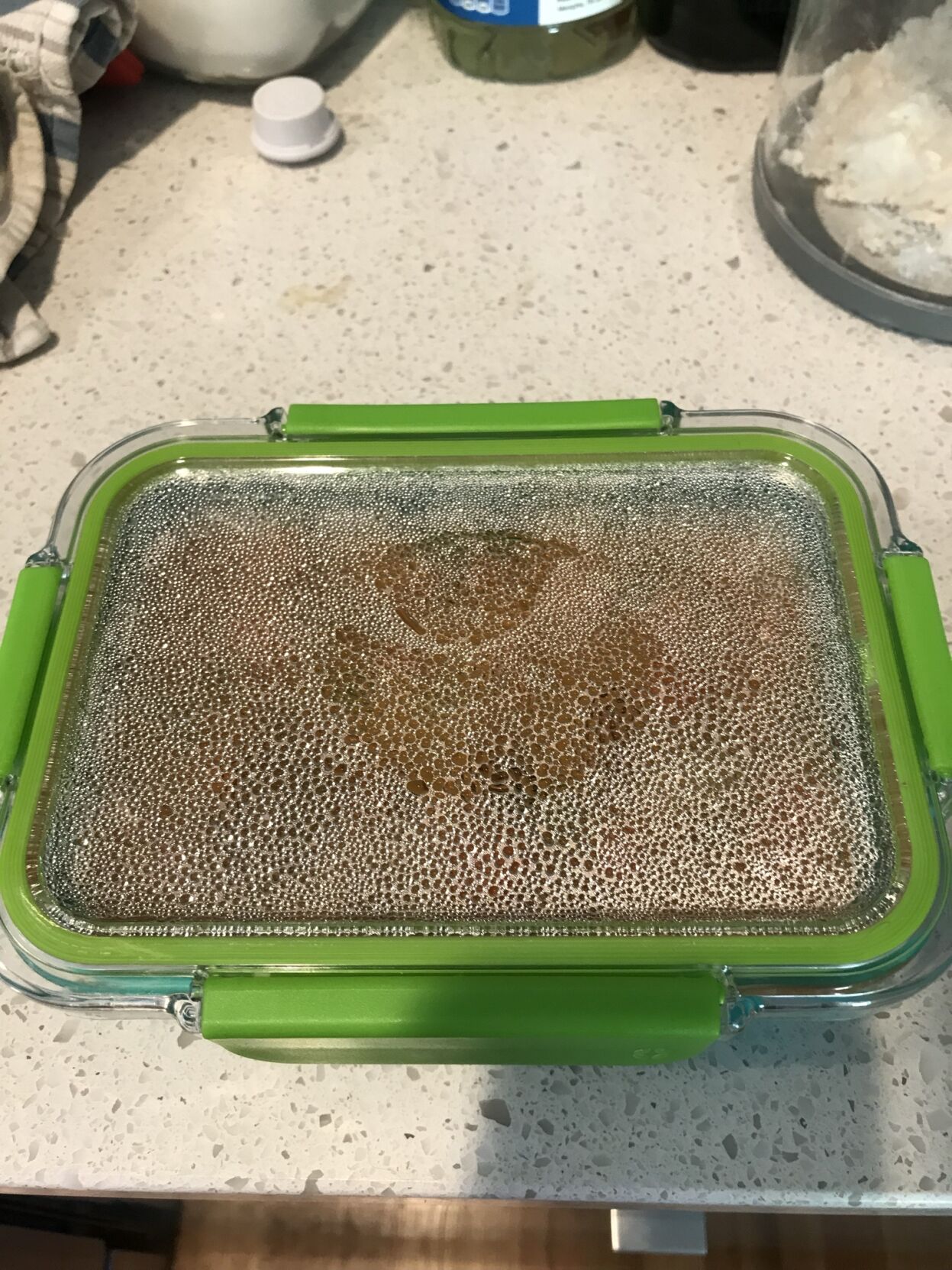
We used our knowledge of "condensation nuclei" to make our favorite shape, the NOAA logo, appear in condensation inside this container of leftovers. (NOAA)
Try this at home
- For this to work, your leftovers need to be warm when you put the lid on the container. But be careful: if they’re too hot and your container makes a complete seal, you could damage the lid. Also be sure to follow food safety guidelines for chilling food.
- To make a pattern in condensation on the lid, try dissolving 1 teaspoon of sugar into 2 teaspoons of warm water. Use a paintbrush or your finger to paint a pattern on the lid (and remember that the image will be reversed when you turn the lid over!). We found it helpful to go over the pattern with a dry paintbrush when the sugar water was nearly dry.