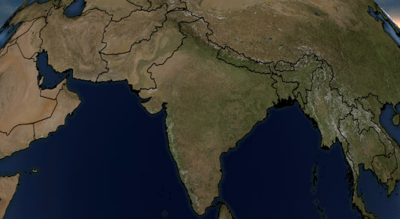
India placed a strict lockdown on citizens and businesses at the end of March to stop the spread of COVID-19. Now NASA is releasing satellite images from the area showing how large an impact that is having on pollution levels.
A couple weeks ago we showed you regions in northern India where the Himalayan mountains were once again visible after decades of being obscured by pollution. India restricted travel and activity so pollution from buses, cars, planes, factories, etc. dropped significantly by early April. According to NASA Earth Observatory, "after just a week of reduced human activities, NASA satellite sensors observed aerosol levels at a 20-year low for this time of year in northern India." In fact one NASA scientist said he has never seen levels so low in this region at this time of year.
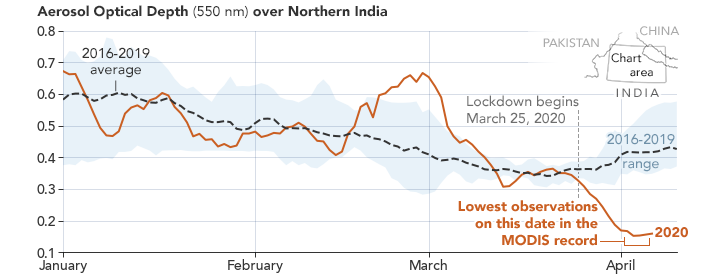
Image Credit: Joshua Stevens, using Terra MODIS analysis courtesy of Pawan Gupta/USRA/NASA
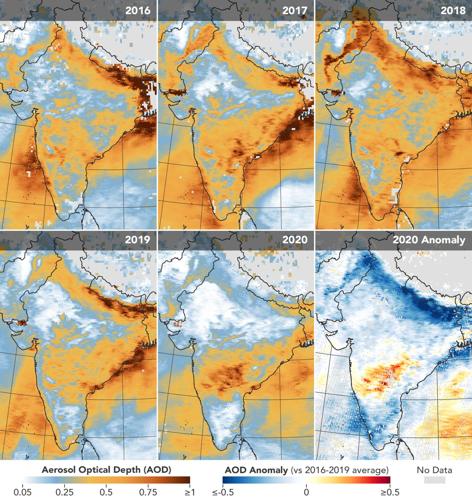
This particular instrument on the satellite measures aerosol optical depth, and that's what you see in the first five images in the collage below. A number near one means the sky is very hazy and there are many aerosols in the air. A number less than 0.1 is considered clean air. Aerosols are any particle that hangs in the air - anything from dust and dirt to manmade pollutants. What we are seeing drop here are those manmade pollutants or other aerosols stirred up by human activity. The sixth image shows the anomaly from this year to help put this in perspective.

Image Credit: Joshua Stevens, using Terra MODIS analysis courtesy of Pawan Gupta/USRA/NASA
While it is clear aerosol levels have dropped in northern India, the same is not true in south central India. This is giving scientists a chance to understand how certain industries and pollutants contribute to the overall picture.