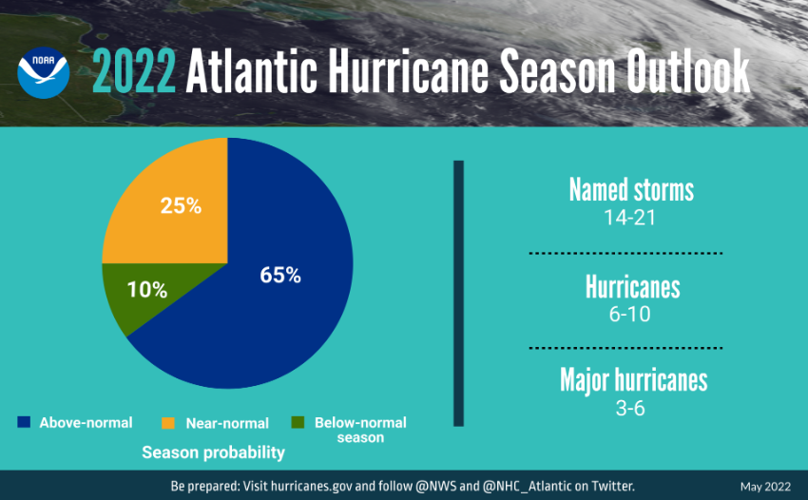

The National Oceanic and Atmospheric Administration released it's official outlook for the 2022 hurricane season today. They are expecting 14-21 named storms this year. A tropical cyclone gets a name once its winds have exceeded 39mph, which makes it a Tropical Storm.
Also for the Atlantic, NOAA is predicting 6-10 hurricanes forming this season (74mph or greater), and 3-6 of those hurricanes to strengthen into major hurricanes (Category 3, 4, or 5).

Courtesy: NOAA
This means that another above-average hurricane year is expected once again. Specifically, NOAA is expected a 65% chance of an above-normal season, a 25% chance of an average season, and only a 10% chance of a below-average season.
NOAA says that they have around 70% confidence with these predictions which is pretty high confidence.
Here's more reasoning behind the forecast from NOAA:
"The increased activity anticipated this hurricane season is attributed to several climate factors, including the ongoing La Niña that is likely to persist throughout the hurricane season, warmer-than-average sea surface temperatures in the Atlantic Ocean and Caribbean Sea, weaker tropical Atlantic trade winds and an enhanced west African monsoon. An enhanced west African monsoon supports stronger African Easterly Waves, which seed many of the strongest and longest lived hurricanes during most seasons. The way in which climate change impacts the strength and frequency of tropical cyclones is a continuous area of study for NOAA scientists."
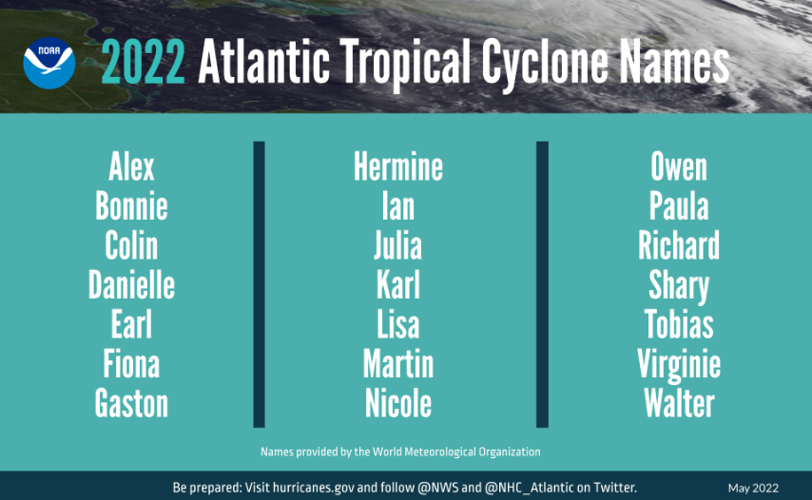
Here are the names that are going to be used for this year's Atlantic Hurricane Season

Courtesy: NOAA
Hurricane season officially runs from June 1st through November 30th.
As the climate changes, we have to update what "normal" weather looks like and that process happens every 10 years when we get a new decade of weather information. With the new climate normals that were implemented this month, hurricane averages have also been updated.
| Old Normals: | New Normals: |
| 12 Named Storms | 14 Named Storms |
| 6 Hurricanes | 7 Hurricanes |
| 3 Major Hurricanes | 3 Major Hurricanes |
Why Are We Expecting An Above-Average Season?
According to NOAA:
The increased activity anticipated this hurricane season is attributed to several climate factors, including the ongoing La Niña that is likely to persist throughout the hurricane season, warmer-than-average sea surface temperatures in the Atlantic Ocean and Caribbean Sea, weaker tropical Atlantic trade winds and an enhanced west African monsoon. An enhanced west African monsoon supports stronger African Easterly Waves, which seed many of the strongest and longest lived hurricanes during most seasons. The way in which climate change impacts the strength and frequency of tropical cyclones is a continuous area of study for NOAA scientists. “As we reflect on another potentially busy hurricane season, past storms — such as Superstorm Sandy, which devastated the New York metro area ten years ago — remind us that the impact of one storm can be felt for years,” said NOAA Administrator Rick Spinrad, Ph.D. “Since Sandy, NOAA’s forecasting accuracy has continued to improve, allowing us to better predict the impacts of major hurricanes to lives and livelihoods.”