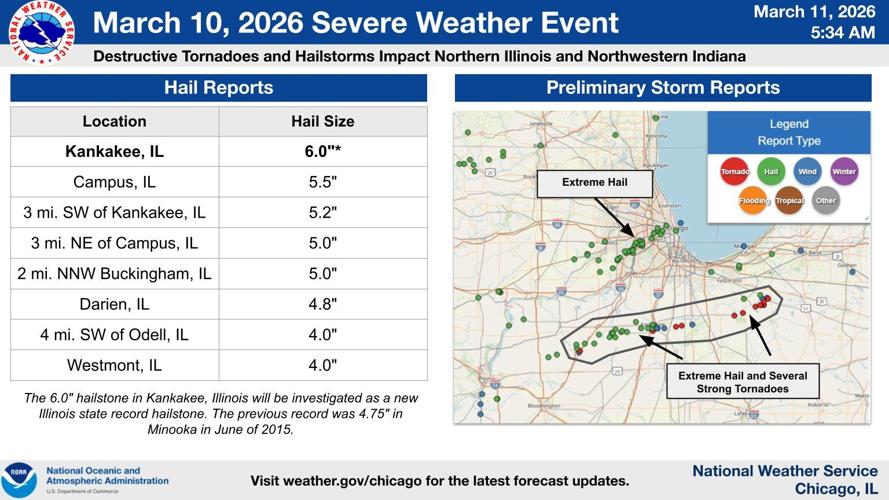
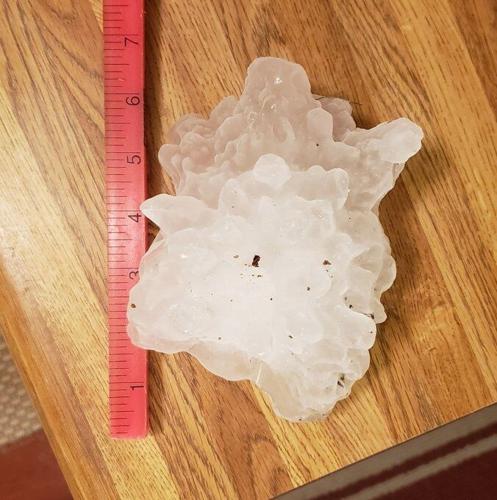

A supercell thunderstorms south of Chicago produced exceptionally large hail on Tuesday, March 10th. A hailstone with a diameter of 6.0" was measured in Kankakee, IL. This giant 6.0" hailstone may be considered for a new Illinois state record hailstone. The previous record was a hailstone measuring 4.75" in diameter that fell in Minooka in June of 2015. There is a process to verify the hailstone, so this report is considered unofficial at this time.

Credit: NWS Chicago
Another supercell moved across the southern and western Chicago metropolitan area and dropped hail ranging in size from 2 to locally 4 inches in diameter across Bolingbrook, Woodridge, Downers Grove, Westmont, and Darien. The largest hailstone measured in this area was 4.8" in diameter and occurred in Darien, IL.

Credit: The Denault Family
Hailstones are formed when raindrops are carried upward by thunderstorm updrafts into extremely cold areas of the atmosphere and freeze. Hailstones then grow by colliding with liquid water drops that freeze onto the hailstone’s surface. If the water freezes instantaneously when colliding with the hailstone, cloudy ice will form as air bubbles will be trapped in the newly formed ice. However, if the water freezes slowly, the air bubbles can escape and the new ice will be clear. The hail falls when the thunderstorm's updraft can no longer support the weight of the hailstone, which can occur if the stone becomes large enough or the updraft weakens.
The largest hailstone recovered in the United States fell in Vivian, South Dakota, on June 23, 2010, with a diameter of 8 inches and a circumference of 18.62 inches. It weighed 1 lb 15 oz.
Hail size is often estimated by comparing it to a known object. Most hailstorms are made up of a mix of different sizes, and only the very largest hail stones pose serious risk to people caught in the open. When reporting hail, estimates comparing the hail to a known object with definite size are good, but measurements using a ruler, calipers, or a tape measure are best.
- Pea = 1/4 inch diameter
- Mothball = 1/2 inch diameter
- Penny = 3/4 inch diameter
- Nickel = 7/8 inch
- Quarter = 1 inch — hail quarter size or larger is considered severe
- Ping-Pong Ball = 1 1/2 inch
- Golf Ball = 1 3/4 inches
- Tennis Ball = 2 1/2 inches
- Baseball = 2 3/4 inches
- Tea cup = 3 inches
- Softball = 4 inches
- Grapefruit = 4 1/2 inches


