A study published at the end of February in Nature Communications has found the existence of a "space hurricane" in our atmosphere. Before this study was conducted, scientists didn't even know these space hurricanes existed!
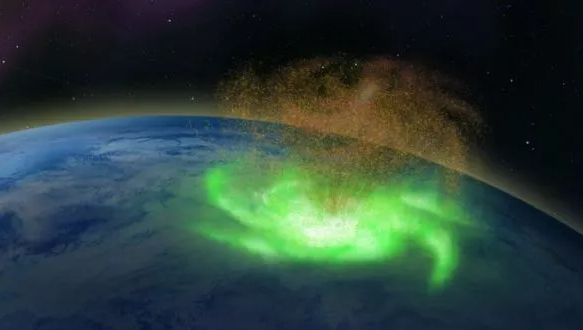
Image Credit: Qing-He Zhang, Shandong University, via Space.com
The phenomenon the scientists were studying actually happened in August 2014 and lasted for nearly 8 hours before "gradually breaking down." It's being called a "space hurricane" because it has elements that resemble the hurricanes we have down here in the bottom of the Troposphere. That's the lowest layer of the atmosphere where we live and most of our planets weather happens. This space hurricane happened in the ionosphere and magnetosphere, hundreds of kilometers above the Earth's surface according to the research published in Nature Communications.

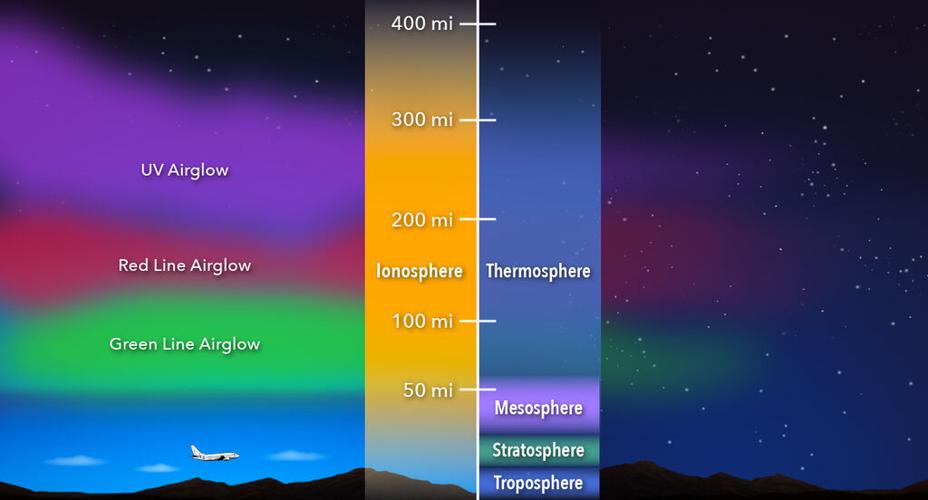
Credit: NASA's Goddard Space Flight Center/Mary Pat Hrybyk-Keith
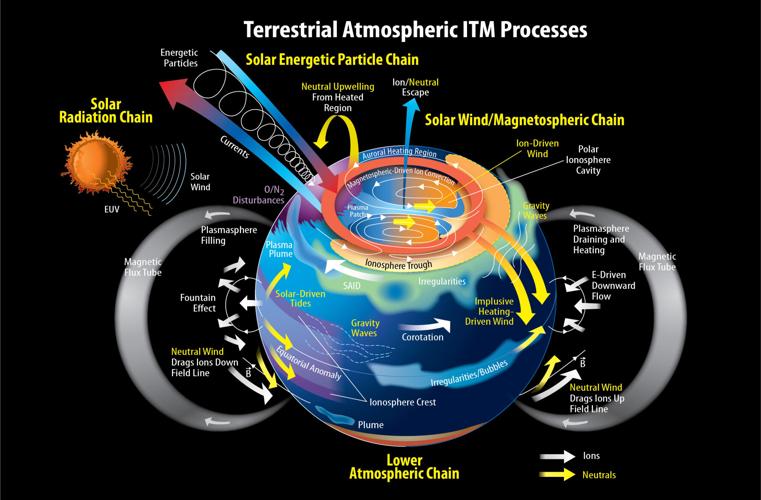
The image above gives you a sense of how far up the ionosphere is, and the image below shows the ionosphere-thermosphere-mesosphere (ITM) and how complicated all those interactions are! No need to get too bogged down in everything on this image; this is just to help understand how high above our heads this region of the atmosphere is.

Credit: NASA's Goddard Space Flight Center/Mary Pat Hrybyk-Keith
Getting back to the space hurricanes, they have elements that look like our surface-based hurricanes. In August 2014 four different satellites passed over this disturbance above the Earth's magnetic north pole. Scientists from China, the United States, Norway, and the United Kingdom analyzed the data from those satellites to study this disturbance. They saw a "clear" center from which spiral bands rotated outward spanning roughly 1000 km across the whole thing. This "hurricane" doesn't drop rain like the surface-based ones do; it drops electrons. Instead of spiral bands of clouds, the spiral bands are made of plasma. Both space and surface-based hurricanes move large amounts of energy using wind or solar wind.
You can't see these with your eyeballs, and you are in no danger of plasma raining down on your head. But these space hurricanes might have similar impacts to other space weather phenomena we already study such as disruptions to radio and satellite communication systems. There are many other planets that have magnetic fields and plasma in the atmosphere, so these space hurricanes might be more common than we realize. This space hurricane also happened during a very quiet geomagnetic period, meaning the activity it created wasn't picked up by geomagnetic index observations. That may require slight adjustments to how or where we monitor for that activity.
Also did you know there are tornadoes on our Sun? While these phenomena don't form the same way our tornadoes and hurricanes do down here on Earth's surface, their structures look familiar so they get familiar names to help describe them.