

Today marks day 9 in a row of cloudy conditions in our area. A few peeks of sunshine here or there really aren't enough to lift our moods.
The cloudiness of winter seems to be a yearly occurrence, affecting our mood, weather, and some even say how slowly the months of winter go by. So, is it normal for us to see this much cloud cover this time of year? Let's dive into some records provided by the National Weather Service in Louisville.
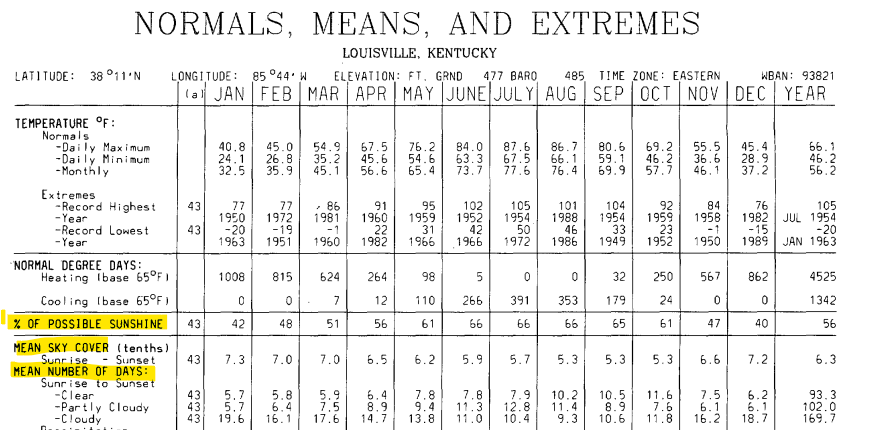
As mentioned before, this is our 9th consecutive day with cloudy conditions in our area. You may be wondering, how many cloudy days do we usually have in January? What about the rest of the winter season? The year? This chart shows how many we normally see each month and the percentage of sunshine we experience the entire month:
Courtesy of NWS Louisville
(Note: These are older climate normals from 1961-1980)
According to that chart, the month of January in Louisville averages around 19.6 cloudy days, making it the cloudiest month of the entire year. This also means that we typically only see about 42% of our possible sunshine in January!
So far this January, according to the NWS observations in Louisville, we have experienced 19 cloudy days (not including January 31st) this month.
Other Winter Months
December: According to the chart, December averages around 18.7 cloudy days, making it the second cloudiest month of the year. Louisville only sees about 40% of possible sunshine throughout December.
February: In February, Louisville sees some slight improvement and averages around 16.1 cloudy days. This makes February the fifth cloudiest month. We also see a little bit more of our possible sunshine for the month at 48%.
While we're on the topic, in case you're curious, the month with the least amount of cloud cover is August, with just 9.3 cloudy days, and Louisville is able to see 66% of available sunshine for the month.

Part of the reason why this happens often during the winter comes down to what is called a temperature inversion. Now, this isn't always the case, but on many days when it's not even raining, and we're still stuck with overcast skies, this is the reason.
During the winter, temperatures at the surface tend to be pretty cold, while there is milder air further up in the atmosphere. Colder air will sink to the ground due to its greater density, and the milder air will rise. Right along that boundary layer is where we often see the thick stratus clouds that we've witnessed frequently over our area recently.


