LOUISVILLE, Ky. (WDRB) – Four elected Kentucky jailers and their statewide association have sued the Kentucky Department of Corrections, claiming it routinely fails to move inmates in county jails to state facilities.
The lawsuit, filed last Friday in Franklin Circuit Court, alleges that the corrections department relies on county jails to keep its prisons below capacity and has created a “backlog” in local jails that is used to cite counties for having more inmates than beds.
The suit also says the state agency has “consistently failed to adequately pay those counties for the housing, medical, and other costs they incur in housing state inmates and regularly violates state statute to facilitate its failure to do so.”
The legal action was brought by two jailers in northern Kentucky -- Campbell County Jailer Jim Daley and Kenton County Jailer Marc Fields – along with jailers Bill Hensley of Boyd County in northeastern Kentucky and J. Barry Brady of Marion County, about 65 miles southeast of Louisville. Their county governments and the Kentucky Jailers Association also are plaintiffs in the case.
A key issue in the lawsuit is a 45-day period in which the jailers say state law requires officials to transfer inmates to state prisons once they are sentenced on state charges, except in several cases that let the sentences be served in county jails.
Katherine Williams, a spokeswoman for the Kentucky Department of Corrections, said in a statement that House Bill 1 approved in the 2022 legislative session gives the department 90 days to transfer state inmates.
“The statute does not provide any exceptions to the length of time, but it is not physically possible (due to available bed space, limited staffing and COVID exposures) to meet this requirement,” she said.
“Once an individual has been sentenced to serve their sentence at a state prison, DOC must transfer the individual to the state assessment center for intake, booking and medical evaluation. DOC has approximately 2,000 inmates waiting to be transferred and the assessment center has 730 beds.”
The state corrections commissioner, Cookie Crews, and the department are named as defendants in the suit. Williams said the department has not yet been served with the complaint.
Daley, who also is president of the jailers association, referred comment to attorney Jeffrey Mando, who is representing the jails.
Mando did not immediately return a phone message.
The jailers also claim the state corrections department is failing to “adequately compensate county jails” for housing state inmates and providing other services, such as medical care and medicine.
Among other things, they are asking a judge to rule that the state must follow Kentucky law and make certain payments to local jails. The suit claims state law requires the corrections department to pay counties at least $24,000 per year to care for inmates charged with or convicted of breaking state law.
The state has “regularly failed to make sufficient payments,” and it also has not entered into contracts with counties detailing how state inmates will be housed in country jails, according to the lawsuit. Instead, the suit claims the state pays a daily amount of $33.43 per inmate, even though it costs more than $50 per day to house in inmate in most Kentucky counties, including the ones that filed suit.
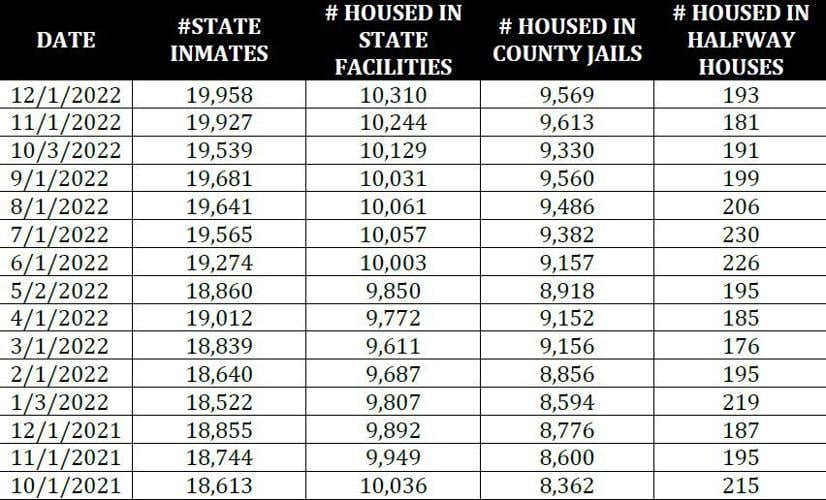
There were 9,569 state inmates in county jails as of December 1, 2022, according to corrections department data included in the lawsuit. That was up from 8,776 at the same time in 2021, or about a 9 percent increase.
The data show that the number of state inmates in county jails was higher in 2022 – reaching a peak of 9,613 on November 1 – than during the previous year, when that census didn’t reach 9,000 during any of the months included in the lawsuit. The suit only showed jail populations for the final three months of 2021.

State inmates in county jails (source: Kentucky Department of Corrections data included in jailers' lawsuit)
The suit alleges state officials aren’t following state law that requires them to classify inmates and transfer certain inmates to state prisons within 45 days after they are sentenced. The delay in classifying inmates has not only resulted in more beds than inmates in some county jails, but it “adversely affects the inmates themselves,” the lawsuit claims.
That’s because many state inmates can or must participate in health, education, job or other skills programs, as well as work programs, allowing them to earn credit towards their sentences or parole, according to the suit.
“However, since eligibility to participate in such programs is dependent on a state inmate’s classification, any delay in classifying a state inmate also delays his ability to participate in these programs and, in turn, delays his ability to become parole-eligible, to finish his sentence, and /or to earn money,” the suit says.
This story may be updated.
Copyright 2023 WDRB Media. All rights reserved.


