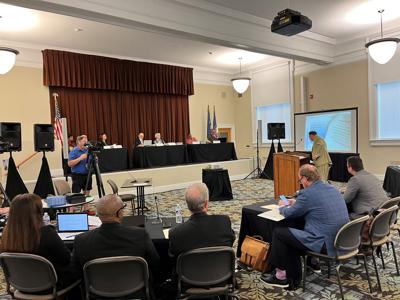


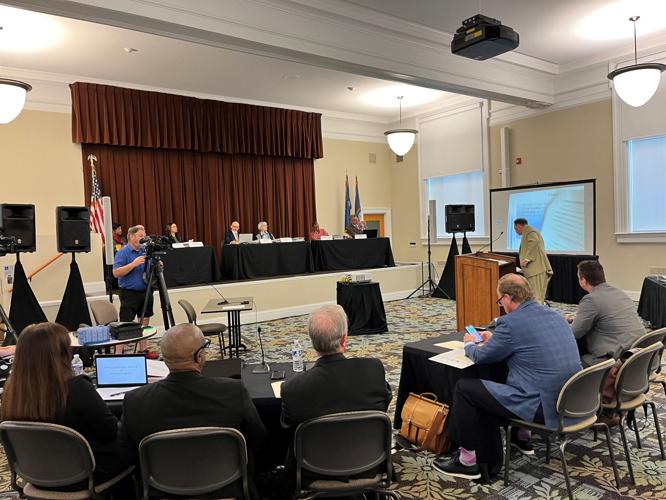
LOUISVILLE, Ky. (WDRB) -- There is no proof supporting ethics charges against Anthony Piagentini, his attorney argued on the final day of the Metro Council member's trial for alleged violations of financial disclosure and other rules.
J. Brooken Smith, Piagentini's lead lawyer, told the Louisville Metro Ethics Commission on Thursday that nothing presented during this week's trial amounted to "clear and convincing evidence" that Piagentini ran afoul of city law in his role in a $40 million grant that benefitted his future employer.
Piagentini began a one-year, $240,000 consulting job a day after the measure passed the council. He was a co-sponsor until minutes before the final vote.
"I find it extraordinarily interesting that every attempt has been made to confuse the issues, rather than bring clarity," Smith said in his closing statement at the Louisville Free Public Library downtown. "Ordinarily, the prosecution brings clarity to the issues while the defendant tries to obfuscate. It's the opposite in this case."
The case against Piagentini involves seven alleged violations of Metro government's ethics code, including charges that he didn't to disqualify himself from a matter before the Metro Council in which he had a financial or personal interest; failing to disclose that interest and improperly soliciting or accepting a job.
The ethics complaint was brought by Kevin Fields Sr., CEO of Louisville Central Community Centers, which unsuccessfully vied for American Rescue Plan funding appropriated by the Metro Council. Fields signed the complaint after Louisville Public Media reported earlier this year on Piagentini's new job.
Piagentini, a Republican who represents Middletown and surrounding areas in eastern Jefferson County, co-sponsored an ordinance directing the federal pandemic relief money to the Louisville Healthcare CEO Council. The measure passed the Metro Council on Dec. 1; he took a consulting job with the group the next day, according to evidence shown at trial.
Fields' attorney, Kent Wicker, argued in his final remarks that he did in fact prove his case. He claimed certain facts didn't pass the "smell test" and that Piagentini used his council position to get "unwarranted privileges or advantages."
Wicker urged the ethics commission to recommend harsh discipline. If the commission finds that Piagentini committed intentional violations of the ethics code, he then could face sanctions from the Metro Council up to and including his ouster.
"Piagentini has to be removed from office. His conduct is beneath the office of Metro Council," Wicker said. "If there is any penalty less than that, than this proceeding hasn't done anything but prove that cheating wins. He's gotten $240,000 out of what he did. You should apply a penalty that makes him wish he hadn't done it and that tells everyone watching that they shouldn't do it either."
Also giving closing remarks was the ethics commission's prosecutor, Robert Boyd, who also serves as a member of the mayoral-appointed body.
Boyd, a Republican, told his colleagues he agreed with Wicker's statements and took aim at comments made by Smith on the trial's first day that injected politics into the case.
On Monday, Smith raised concerns that Boyd's role as investigating officer meant that one of the two GOP members on the commission wouldn't be able to deliberate. Boyd shot back Thursday, saying that politics hasn't ever factored into any cases before the board during his five-year tenure.
"It was alluded to that my role as investigating officer would somehow deny Councilman Piagentini a presumably friendly Republican vote," Boyd said. "I can assure Councilman Piagentini that he would not want me voting, because at this point I would urge the commission to find Councilman Piagentini guilty on all seven counts as described in Mr. Wicker's closing."
The commission has 60 days to deliberate and issue its decision, said its counsel, Todd Lewis.
The timeline
Much of the arguments centered around the timeline of Piagentini's discussions and relationship with Tammy York Day, the CEO council's president and CEO.
The healthcare council includes the leaders of 16 hospitals, medical systems and other providers in Louisville, including Norton Healthcare, Baptist Health, Humana and the University of Louisville. The grant was for one of the council's initiatives called the Healthcare Workforce Innovation Coalition.
The coalition's proposal that landed the public funding involves making Louisville "a national epicenter of healthcare aging innovation" through increasing and diversifying healthcare jobs.
The key dates presented as evidence were:
Piagentini met York Day in November 2021 through a mutual friend. He testified it was a "networking" introduction because they both worked in the healthcare industry and he was considering leaving his job with Wellcare Health Plans.
Piagentini said he sent his resume to York Day in January 2022, but "she was very clear that there was no opportunity" at the CEO council.
That same month, York Day testified, she met with Piagentini and Democratic Metro Council members Markus Winkler and David James — now a deputy mayor for Mayor Craig Greenberg — at the urging of lobbyist Tim Corrigan to get "on the radar of the council."
Winkler, now the Metro Council's president, and Piagentini led a legislative working group that in 2022 decided which projects to back for American Rescue Plan funds.
York Day testified that he wasn't sure if the Metro Council could help them with their workforce efforts.
In March 2022, she testified she connected Piagentini to an official at Delta Dental, a company where she used to work. Piagentini did not get a job there.
Around the same time, the CEO council also was responding to the Metro government's request for applications for federal coronavirus funding designed to stimulate the economy.
In April, Winkler and Piagentini were shown the ranking of various projects that had applied for the federal funds. The CEO council had ranked 29th out of the 30 projects scored.
Fields, who filed the complaint against Piagentini, testified that his organization's proposal ranked ninth
Over time, the CEO council's plan morphed from a $9.2 million project to the one that eventually needed $40 million to execute.
In September 2022, York Day testified that she offered Piagentini, Winkler and James tickets to a Louisville Healthcare CEO Council conference at Churchill Downs. Only Piagentini accepted and attended.
Piagentini acknowledged not paying for the ticket — valued between $199 and $499 — but insisted it wasn't a violation of city ethics rules for public officials.
York Day said she didn't know Piagentini's employment status at the time and didn't have a job available, but told him at a rooftop cocktail reception at the racetrack that, if the CEO council pursued a government affairs position, she wanted to talk with him.
Piagentini testified he didn't recall that conversation.
On Oct. 21, York Day and Piagentini spoke three times on the phone. Piagentini said he "very vaguely" remembered those phone calls, but they did "absolutely not" discuss the government affairs position he would ultimately accept.
On Oct. 25, Piagentini and Winkler issued a press release announcing that $40 million in American Rescue Plan funding was being earmarked for the CEO council.
Piagentini and York Day spoke again by phone on Nov. 1, but the council member said they did "absolutely not" discuss the position during that call.
York Day said the CEO council had a board meeting on Nov. 7. At that time, she said, the board approved a government affairs position. That led to the nondisclosure agreement, or NDA, she sent on Nov. 17.
Piagentini, who was sponsoring the spending ordinance with Winkler and James, said he didn't recall checking his emails that day. He spoke in favor of the measure and voted for it at the budget committee meeting that same evening.
He signed the NDA — which came in an email with no further description — the next morning and emailed it back. He then called York Day.
She said Piagentini told her during that November 18 phone call that he would have to recuse himself from future advocacy on the grant, meaning he wouldn't be able to vote on the ordinance. He remained as a sponsor of the ordinance until the final Metro Council vote on Dec. 1, when he asked to be removed as a sponsor because of a "potential conflict of interest."
He did not elaborate, nor did anyone on the council ask for a detailed explanation.
Piagentini, a Republican who was first elected in 2019, said under oath before the Louisville Metro Ethics Commission that he did "nothing" to advocate for the ordinance between the committee and the full council vote.
On Dec. 2, he signed a "statement of work" with the CEO council and began his work there.
Piagentini's defense
In a closing argument that lasted more than one hour, Piagentini's lawyer Smith laid out all seven charges and meticulously went into detail on each one. He frequently wrote large Xs to cross out the allegations shown on a projector screen.
He repeatedly said the case against Piagentini didn't show evidence of ethics violations, including that the council member "concocted and masterminded a plan to leverage the ARP funds to get a job."
Smith said there's no evidence Piagentini "solicited" a job from the CEO council – as he said York Day and the councilman testified.
"The testimony from Ms. York Day was crystal clear that there was no actual job that was in existence, which could even be possibly presented to Councilman Piagentini until Nov. 17, 2022," he said. "That was the first time she actually reached out to Councilman Piagentini and said, 'Let's have a discussion now about an actual job.' Everything else—there's no evidence there was a job offer."
Smith noted that Piagentini didn't accept the job until Dec. 2.
Smith said it is "undisputed" that Piagentini first learned from Winkler in early 2022 of the CEO council's effort to secure the federal grant funding from Winkler. "All of this predates by six months the extension of the nondisclosure agreement by Ms. York Day to Councilman Piagentini," he said.
"And over the period of that time he had supported it, he had confirmed his support in September, he had moved forward with preparing the ordinance, filing the ordinance, issued a press release -- all of it before a job lands on his desk," Smith said.
Smith reminded the ethics commission of Piagentini's testimony about why he supported the grant.
"He testified that the reason why he supported the grant was because it was in the best interest of the community, because it solved a key challenge with public policy that was impacting the quality of health care in this community: the healthcare workforce crisis," Smith said. "That's the sole reason why he supported the proposal. There is no connection whatsoever to any job possibility with" the CEO council.
When Piagentini read the nondisclosure agreement, Smith said, "Councilman Piagentini was clear upfront in stating, 'Look, I got to know something. Is this related in any way to the grant? Is it funded by the grant? Is it dependent on the grant being approved by Metro Council?'"
He continued: "Ms. York Day testified in clear and unequivocal testimony: 'No, it's not related in any way.'"
Smith argued that Piagentini wasn't trying to conceal the job, which he mentioned in Christmas cards sent to fellow council members, among others.
"That's not evidence of a guilty mind," Smith said. "It's evidence of somebody who made a mistake."
Fields' argument
In his closing argument, Fields said two of the seven charges are "easy" to prove. Piagentini clearly didn't update his financial disclosure form showing his work with the CEO council until February 2023, missing the required 30-day deadline after he began his work in early December 2022.
Piagentini acknowledged the error; Wicker noted that the councilman only made the change after he had been interviewed by Louisville Public Media.
"He doesn't even do it until he's contacted by the media and he finds out that it's all going to come up," Wicker said. "It's not unintentional."
Wicker also said Piagentini accepting the ticket for the conference at Churchill Downs was a clear violation. Council members aren't allowed to do so unless all 26 members are invited, he added.
Only Piagentini, Winkler and James were invited by York Day, according to the testimony.
"She saw these three members as the ones she needed to convince," Wicker said. "So she offered the free tickets to get access to talk."
Wicker argued that Piagentini violated ethics rules by having a "private interest" in the job he ultimately took well before he signed a formal agreement to take it.
"You have an even greater incentive to try to please a potential employer than when you actually become an employee," he said. "We all dress better for the job interview."
Wicker centered on part of the ethics code that bans council members from accepting any "thing of value" in a situation in which it could "reasonably be inferred" that the offer is meant to gain access to the elected official.
"So the question is this," Wicker said. "Could it reasonably be inferred that the job was extended to Piagentini because of his position?"
Wicker cited three things to argue it was.
First, he said, the CEO council hadn't before offered Piagentini a job before it sent a nondisclosure agreement hours before the funding ordinance was to get a Metro Council committee vote.
"The only time that they saw fit to offer a job to this world-renowned healthcare executive was when he was controlling a $40 million grant that they wanted," Wicker said.
Second, he said, there was no mention during the trial of renewing the one-year contact with Piagentini. Third, Wicker said, the CEO council didn't need Piagentini in the first place because York Day is a registered lobbyist and the organization also has a lobbying firm under contract.
Wicker noted that Piagentini isn't registered to lobby fellow Republicans in the GOP-controlled state legislature but rather the executive branch controlled by Democratic Gov. Andy Beshear's administration.
"He's lobbying the executive branch where the Democrats are," Wicker said. So how are his political connections, his political expertise, his Republican credentials -- how are they effective in lobbying the Beshear administration? That doesn't make any sense."
What's next
The ethics commission met in closed session Thursday before recessing, its counsel, Lewis, said in an email. It will reconvene at 9 a.m. Friday, Sept. 1 to resume deliberations.
Copyright 2023 WDRB Media. All Rights Reserved.


