
LOUISVILLE, Ky. (WDRB) -- When Susan Rademacher lived in Jeffersonville, Indiana, years ago, she would sometimes walk down Riverside Drive to the Falls of the Ohio and wonder what lay beyond.
“It was a real no-man's land. It was a place you didn't want to go,” she recalled recently. “And so now to have this opened up in this grand scale is really exciting.”
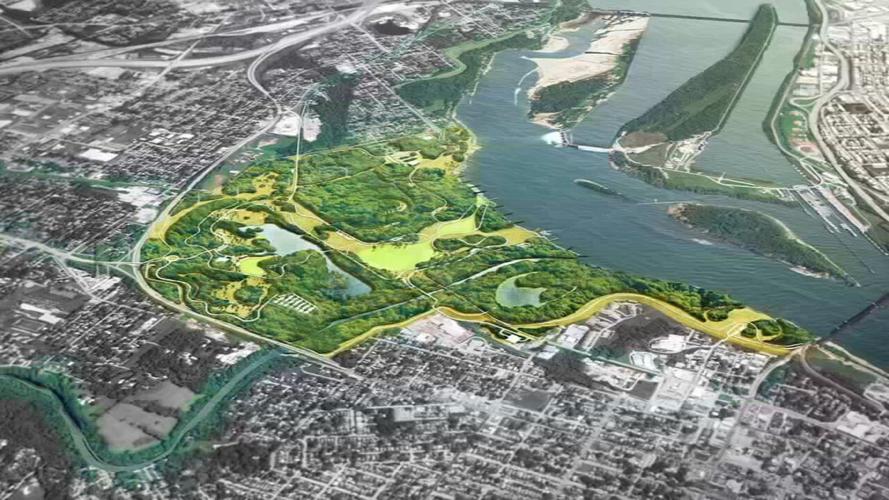
Long home to a landfill, industrial sites and flood-prone woods, the area now is the heart of the proposed Origin Park, an expanse of green space, meadows, paths and water access planned along the Ohio River around Clarksville.
After a career in parks in Louisville and Pittsburgh, Rademacher is returning to southern Indiana to become executive director of the River Heritage Conservancy, the nonprofit group developing the plan. Starting Monday, she will succeed Scott Martin, who last week was confirmed as the new administrator of Chattanooga’s Department of Parks & Outdoors.
The change in leadership comes as the park project now controls more than 300 acres, about half of the land in its master plan. In December, it was awarded American Rescue Plan funds estimated at $17.3 million from a state-run grant program that would help pay for the park’s 110-acre, $42 million first phase.
“Origin Park is at a real important transition or inflection point, moving from early land acquisition and master planning now into project development,” Rademacher said. “And that has been the focus of the latter part of my career.”

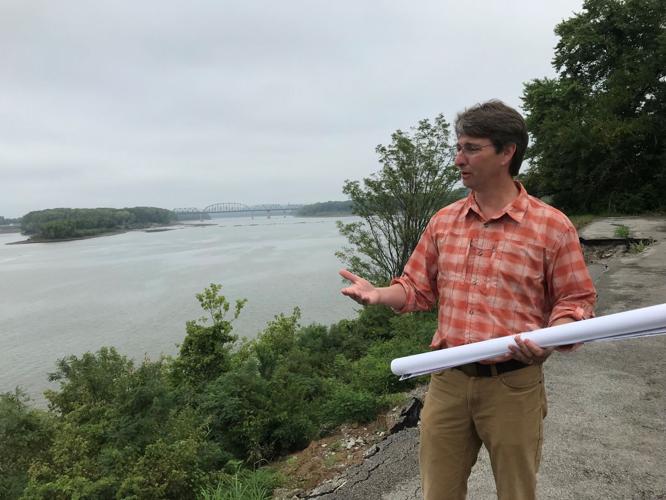
Susan Rademacher, the incoming executive director of the River Heritage Conservancy (photo provided).
Rademacher was president of Louisville’s Olmsted Parks Conservancy from 1991 to 2007, when she left to become parks curator at the Pittsburgh Parks Conservancy. She retired from there in 2020.
Last week, the Garden Club of America announced that Rademacher will receive its 2022 medal for historic preservation, citing her work leading the development of and fundraising for a master plan for Louisville’s Olmsted parks in the early 1990s. It also noted her work overseeing the planning, design and fundraising for a restoration of Mellon Park in Pittsburgh.
In more than 30 years in parks, Rademacher has directed 35 capital projects and developed 10 parks master plans, according to the conservancy.
Rademacher told WDRB News that besides getting to know the areas proposed for Origin Park, she will be focused on several initiatives. They include establishing the conservancy’s office in the park, continuing to acquire land for the project and working with the U.S. Army Corps of Engineers’ Louisville district to address worsening erosion on the Indiana shoreline.
One solution to that problem, Rademacher said, is to install a series of damlike weirs to stabilize the riverbank.
“We've got to protect what we've got,” she said. “And then we have to move forward with things that really bring value to the community.”
Corps officials said in emails to WDRB that they’re aware of the erosion concerns, but the exact method for stabilizing the shoreline hasn’t been selected. Once a project is funded, “we will determine the exact nature of the fix.”
Kent Lanum, the conservancy’s board chair, said Rademacher’s experience dealing with the Corps on similar issues in Pittsburgh was an added benefit, as was her work with architects, engineers and designers on past projects.
Rademacher also had advised River Heritage Conservancy when it selected Philadelphia-based OLIN to design the park and when planners settled on the Origin Park name. OLIN’s master plan was released in 2020.
“We could have been stalled for 12 months or more,” Lanum said. “In this case, we're just going to slow down for a month as we transition and do a data dump.”
Martin joined the conservancy in 2017 after serving as parks director for the Parklands of Floyds Fork and holding previous parks positions in Idaho and Virginia. He is the North American co-chair and an executive board member of the World Urban Parks organization.
“Parks are always bigger than people,” he said. “If you do a park right, it goes through generations of people. And so the big goal for our great parks is that the park is the boss. The plan is the boss.”
The plan for Origin Park envisions 600 acres of sprawling fields, walking and bike trails, an event center and an “outdoor adventure center” with whitewater paddling, among other features. The first phase would include the event center, six miles of trails, three miles of roads, trailheads, parking areas and restrooms.
It's unlikely that the entire scope of the park would be developed, since it includes land that New Albany has earmarked for its own parks expansion.

Scott Martin, executive director of the River Heritage Conservancy, speaks about an Ohio River park plan in Clarksville in August 2019. (WDRB photo)
Origin Park officials also are planning a “blueway” on the lower stretch of Silver Creek for paddlers. It was supposed to have opened last year, but New Albany challenged the removal of a lowhead dam near East Spring Street on the Clark-Floyd county border.
While the conservancy maintains the dam is a safety hazard, New Albany raised concerns about the possible impacts of removing it. Martin said the issue is working through an administrative hearing process.
But he believes that with the recent grant award, “I can see a pathway forward with permitting and construction and funding having this first phase opened in late 2024 or sometime in 2025.”
Documents included in the grant request indicate that the total cost of the project now stands at $200 million, up from previous estimates of about $155 million.
The conservancy also will announce Monday that it is hiring a full-time employee to oversee fundraising, a move Lanum said will let it “hit the ground running” once the grant is approved.
“My goal is to build this thing sooner rather than later,” he said. “I don't want to wait 20 years. I’d love to get it done in 10 or less.”
Reach reporter Marcus Green at mgreen@wdrb.com.
Copyright 2022 WDRB Media. All Rights Reserved.


