
LOUISVILLE, Ky. (WDRB) — Most students at the University of Louisville will pay 1.2% more for their education next academic year, as the university is holding tuition flat but raising mandatory student fees by $150 a year.
The 1.2% increase for fulltime Kentucky resident undergraduate students approved by the school’s board of trustees on Thursday is the second smallest year-to-year hike in 21 years. In 2017-18, the university kept total tuition and mandatory fees flat from the year before.

The cost of higher education in Kentucky has generally far outpaced inflation the last two decades, but this year that dynamic has flipped at the state’s two research universities thanks to federal COVID-19 dollars and the biggest increase in state funding in years.
The University of Kentucky this month approved a 2% hike in tuition and mandatory fees.
U of L chief financial officer Dan Durbin acknowledged that U.S. inflation of about 8% raises costs for the university, but he said school officials wanted to give students a relative break on tuition as they deal with other surging costs.
“We’ve just come off a really bad time with COVID. We’re in a high-inflation cycle. And we’re trying to manage costs as much as we can to make sure that we don’t pass that cost onto students,” Durbin said Thursday. “It’s all about student affordability.”
Durbin said the $75 per semester in new student fees consists of $65 that the school will use to match new state funding for deferred maintenance on campus facilities and $10 supported by the school’s student government association.
Durbin said some of the main factors allowing the school not to pursue a tuition increase include about $15 million in additional support from the state and $10 million in additional investment earnings from the school’s endowment, which is on a firmer financial footing five years after the governance of U of L’s foundation was overhauled.
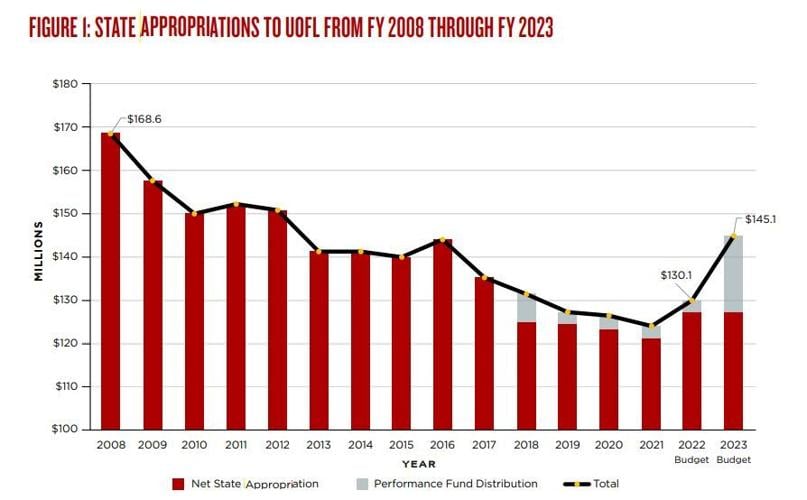
The $145 million U of L expects to receive from the state in the upcoming fiscal year is still far below pre-Great Recession levels of funding, even before accounting for inflation. But state funding has been increasing in nominal dollars for the last three years.

State funding to the University of Louisville has rebounded in recent years but is still well below pre-Great Recession levels in nominal and inflation-adjusted terms. This graphic from U of L presents figures that are not adjusted for inflation.
“The General Assembly was very good in recognizing the importance of higher ed(ucation),” Durbin said.


