
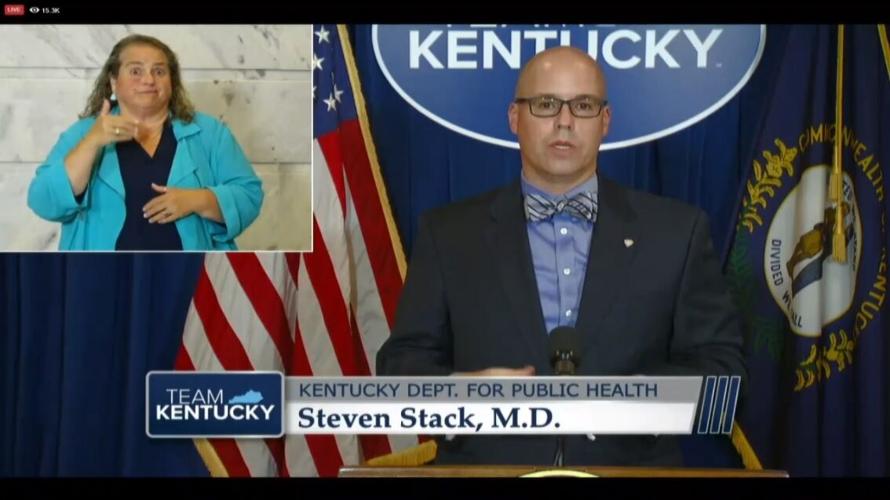

LOUISVILLE, Ky. (WDRB) -- As COVID-19 infections continue to rise in Kentucky, Gov. Andy Beshear is again limiting how many people can get together and is recommending that people who travel to nine hot spot states quarantine themselves for 14 days.
“We are in a war against this virus,” Beshear said in a news conference Monday.
“We are in an escalation — but we know how to beat it,” he said.
Beating the virus includes wearing masks and staying at least 6 feet from others in public, the governor said.
The governor said that private gatherings from now on have to be limited to no more than 10 people — which is down from 50. Restaurants, weddings and other venues are exempt from the rule.
Beshear said that large backyard barbecues, block parties and other such gatherings with up to 50 people recently have been the No. 1 cause of COVID-19 spikes.
In addition, Beshear said that people who travel to Alabama, Arizona, Florida, Georgia, idaho, Mississippi, Nevada, South Carolina and Texas should self-quarantine for 14 days. Each of those states has at least a 14% positivity rate.
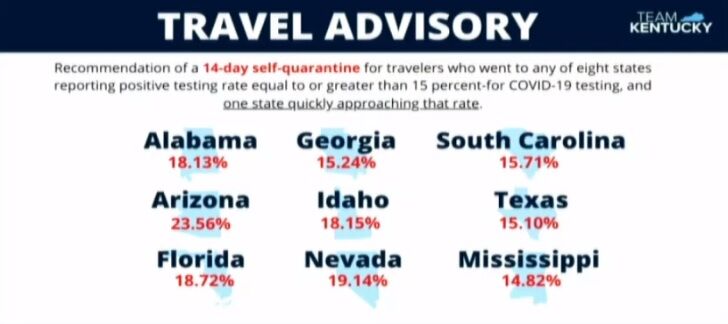
Courtesy of the state of Kentucky.
Beshear said that’s a recommendation, not a requirement.
The governor said other clusters in Kentucky have originated in people who have traveled to states with high rates of infection.
Beshear and Kentucky Health Commissioner Dr. Steven Stack also warned that if cases continue to rise, they may be forced to take more drastic steps. The governor said that the White House in a call Monday morning recommended that states that are hit especially hard institute mask mandates, reduce restaurant capacity to 25% and close bars.
Beshear said he does not want to have to take those steps in Kentucky, but he said Health and Family Services Secretary Eric Friedlander was “really concerned” by behavior he saw from Kentuckians this weekend on Bardstown Road.
People may be able to avoid more stringent restrictions if they take the steps that are necessary to stop the spread of the virus, Beshear said.
New cases
Beshear on Monday also announced 258 new cases of COVID-19, which was down significantly from the 979 the state reported Sunday and in line with numbers from the prior two Mondays.
However, the governor said Monday's number should not be compared to other days because most labs are closed on Sundays. He said he expects the number to rise again by Wednesday and Thursday.
Since the pandemic began, the state has had seven days with more than 400 cases. Six of those days were in the last week.
Beshear also said a 94-year-old woman from Casey County died from COVID-19 complications. That brings the total number of virus-related deaths in Kentucky to 671.
The governor also asked Kentuckians to stop spreading misinformation on social media, especially the falsehood that cases in Kentucky are rising because of the state's higher testing capacity. That notion, Beshear said, is "absolutely and categorically false."
When the virus peaked in April, the state lacked testing capacity and tested only people who had symptoms. Now the state is testing more widely, which means people without symptoms are being tested. And still, the number of positive tests now is higher than it was in April, Beshear said.
In addition, he said, the share of people who are testing positive has gone up, which means the infection appears to be spreading faster than before.
According to Johns Hopkins University, the seven-day average share of tests that came back positive in Kentucky peaked at 17.4% in mid-April. It fell as low as 1.6% in late May, but in early July, the share rose again above 5%, and has remained above that level since then.
Stack said, "All the indications are that we are in that accelerating phase."
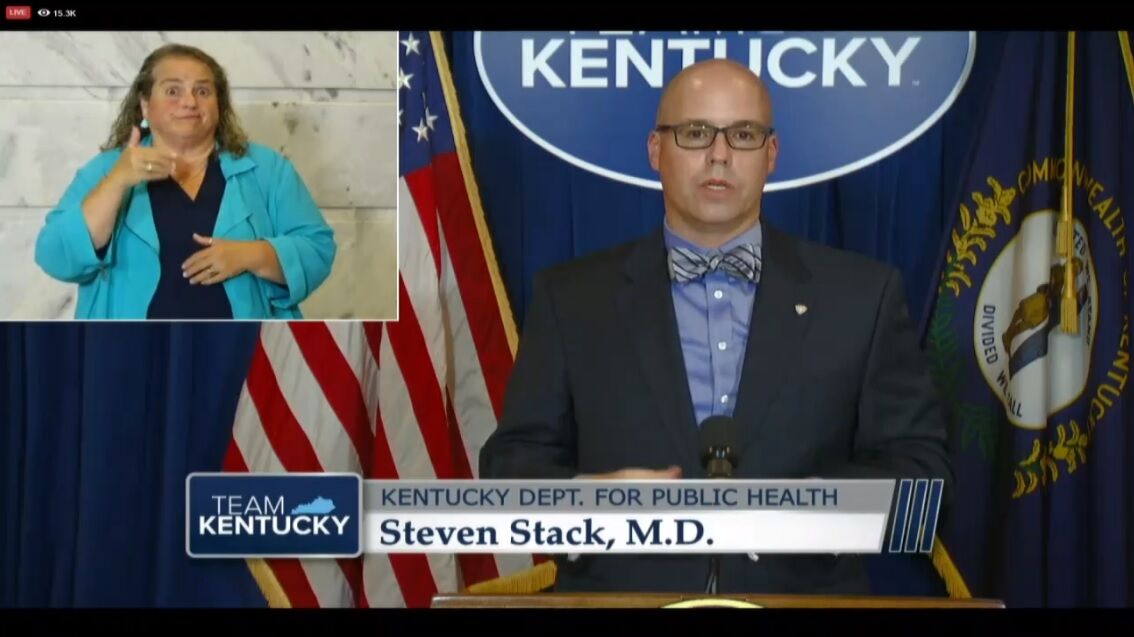
Kentucky Health Commissioner Dr. Steven Stack.
Sunday was a "shot across the bow," he said.
"Our fate is collectively in Team Kentucky's hands," Stack said.
The seven-day average of daily deaths also has increased recently. It was at six Monday, up from a low of three in late June — though it was above eight in late May.
While Beshear said that use of ventilators and intensive care beds also has increased, data from the Institute for Health Metrics and Evaluation at the University of Washington still shows significant capacity for both.
However, the governor warned that hospitalizations and deaths from COVID are lagging indicators, meaning the number of infections rise weeks before the number of hospitalizations and deaths.
Nationwide, more than 3.8 million people have become infected with COVID-19, and nearly 141,000 have died, according to Johns Hopkins. Globally, more than 14.6 million have become infected, and more than 608,000 have died.
For most people, the virus causes only mild or moderate symptoms, such as fever and cough. For some, especially older adults and people with existing health problems, it can cause more severe illness, including pneumonia. The vast majority of people recover.
To protect yourself and others, the Centers for Disease Control and Prevention recommend that you:
- Wash your hands often, especially before eating or preparing food, touching your face, using a restroom, leaving a public place, after blowing your nose, coughing or sneezing, after handling your cloth face covering, after changing a diaper, after caring for someone sick and after touching animals or pets.
- Avoid close contact and stay at least 6 feet away from others outside your home.
- Cover your mouth and nose with a cloth face cover when around others.
- Cover coughs and sneezes.
- Clean and disinfect frequently touched surfaces daily.
- Monitor your health daily by being alert for symptoms such as fever, caught and shortness of breath and by taking your temperature if symptoms develop.
Copyright 2020 WDRB Media. All Rights Reserved.