




LOUISVILLE, Ky. (WDRB) — Last year, Louisville Metro government began offering companies cash to lease office space downtown — an incentive meant to reduce historically high office vacancies in the city’s central business district.
With few takers so far, Mayor Craig Greenberg’s administration has lowered the bar to qualify for the taxpayer money.
“We got halfway through the (fiscal) year, and we’ve not moved this money yet. And I want to move the money in the next six months,” said Pat Mulloy, Greenberg’s deputy mayor for economic development.
Effective Feb. 1, new-to-downtown office tenants can qualify for the incentive by leasing as little as 5,000 square feet, down from the previous minimum of 50,000. The money can be applied to related costs such as furniture, moving expenses and renovations.
The lower bar means companies leasing as little as a third of a floor in one of the city’s main office towers could qualify, down from the previous commitment of at least 2-4 floors.
The change coincides with more bad news for the city’s office landscape. On Monday, Louisville-based Humana announced it would vacate its iconic headquarters building at 500 W. Main Street, a building that alone represents about 6% of the office space downtown, though Humana’s space isn’t on the market today.
Meanwhile, Fifth Third Bank, the namesake tenant of the tower at 401 S. 4th Street, will vacate its space for a new building in NuLu, Business First reported Tuesday. Fifth Third confirmed the move, though it released few details. The bank has four floors in the downtown tower, according to a source with knowledge of the building.
Believing in the importance of a strong downtown, Greenberg’s administration last year secured $3 million in the Metro budget that can be used to lure office tenants to the CBD — even companies already contributing to the Louisville Metro taxbase with locations in the Jefferson County suburbs.
The program launched in October, but none of the money has been claimed. Mulloy said he believes the city’s economic development staff received its first application this week. He declined to identify the applicant before the city processes the application.
‘Tremendous amount of activity’

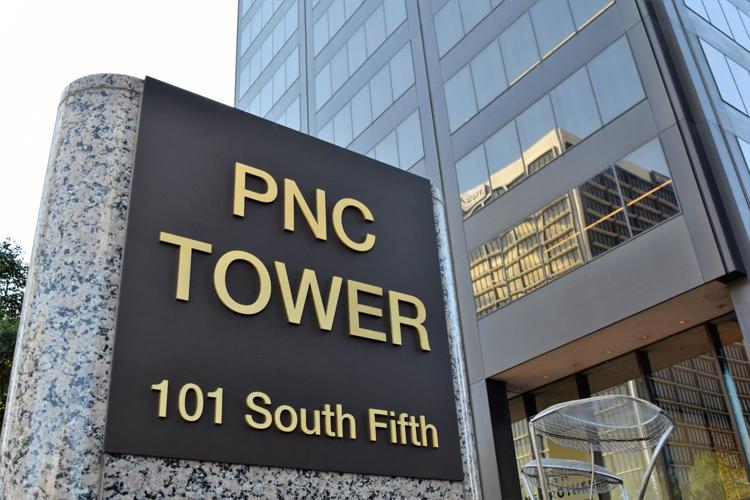
Doug Owen, an office broker with JLL, in the lobby of PNC Tower on Feb. 8, 2024.
The city money has generated interest even if no deals have been struck, according to Doug Owen, an office broker for JLL and advocate of the city incentives.
“We have seen a tremendous amount of activity since the incentives were offered and it’s really picked up since they were lowered,” said Owen, who represents the owners of big office buildings such as PNC Tower and 401 S. 4th Street in leasing negotiations. “Right now, we’re tracking anywhere from 150,000 to 250,000 square feet of new-to-downtown leasing interest. We’re hoping that will play out.”
He said office leases take several months from initial tours to final paperwork, so it may be until summer before tenants claiming incentives are publicly announced.
Nearly 25% of Louisville’s prime “Class A” office space in the central business district is vacant, according to JLL, which is about three-times higher than what brokers consider a healthy market.
Based on current rents for prime office space downtown, the Metro cash could fully offset up to 20 months of rent for a tenant leasing the minimum 5,000 square feet, Owen said.
While the taxpayer money effectively makes the cost of leasing downtown space cheaper, office tower landlords have already lowered rents drastically.
According to brokerage CBRE, advertised asking rates for Class A space in the CBD reached a 15-year low in 2023. Adjusted for inflation, office landlords are asking about 32% less for rent than during the Great Recession in 2009.
While seeking to restock office buildings, Greenberg’s administration also wants to help developers convert them to residential units and hotels.
The mayor, a Democrat, asked for $30 million in state funds from the Republican-controlled state legislature to help developers flip office space to new uses.
Mulloy said Louisville officials are still working to secure that money as the legislature finalizes the state’s two-year budget over the next month or two.
“There are a lot of moving parts to this, and I think it will coalesce late in the (legislative) session,” he said.


