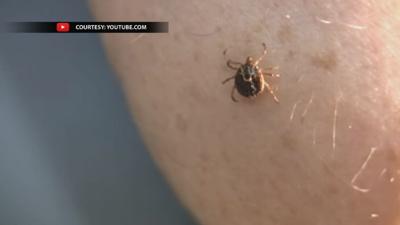
CLARKSVILLE, Ind. (WDRB) -- Indiana health officials are tracking ticks that test positive for the bacteria that causes Lyme disease, and they are encouraging people to be aware with increased tick activity as it warms up.
Bryan Price, the Entomology Director for the Indiana State Department of Health, said there is no reason to avoid the great outdoors for the fear of getting bitten by a tick. But the department sent out a state-wide warning in order to remind people to stay alert, because “the bottom line is there are these creatures out there that could potentially make you sick,” Price said.
There are three types of ticks commonly found in Indiana, including the Blacklegged deer tick, the American dog tick and the Lone Star tick. The deer tick is the type that carries the bacteria which causes Lyme disease, and this is the type the department has been tracking.
The department started tracking and testing deer ticks in late-2017. The data collected through 2018 can be found by clicking here. It shows ticks have tested positive in several southern Indiana counties, including Clark, Floyd, Crawford, Jackson and Jennings Counties.
Price said experts have gone out already this year to test ticks in certain counties. The hope is that over time, the data will help show what counties or areas might be more susceptible to Lyme disease.
But even if you don’t see statistics in your county, that doesn’t mean you should let your guard down, Price said.
“You don’t want to look at a map and see nothing much going on in your county and then make the assumption that you don’t need to worry about it," he said. "That’s the wrong way to look at it."
The best way to avoid any tick-borne disease is to avoid ticks. To help prevent them from latching onto your skin, wear appropriate clothing when outside in tall brush or the woods. Doctors and state health experts recommend using bug repellent while outside.
Carly Oliver, a nurse practitioner with Norton Children’s Medical Associates, said this is the time of year that parents need to be extra vigilant.
“We’re starting to see an increase in the number of tick bites,” she said. “And, of course, the concern for Lyme disease definitely goes up with that.”
The best way to avoid tick bites is to check over your entire body once you get inside. Ticks like to try to crawl under clothing along sleeves, necks, sock lines or waist bands. Oliver said a tick needs to latch on for 24 to 48 hours in order to infect a person with the bacteria. So if you check yourself right away and you find a tick, immediately pluck the entire thing off your body. If you’re not sure the entire head of the tick came out, you need to go to your doctor.
Symptoms for Lyme disease can feel much like regular flu symptoms. But there typically is a circular rash that comes with Lyme disease that gives it away. Symptoms will usually start within seven days of the bite, and they can last for weeks. So Price said it’s crucial to diagnose Lyme disease as soon as possible.
The longer a disease goes undiagnosed, the longer your pain and symptoms could last. If untreated, Price said you can feel tired and weak years afterward, “because you’re still suffering from that bacteria that was in your skin.” So doctors recommend if you feel any symptoms and you’ve been in the woods or know you were bitten by a tick, you should make an appointment.
Price said a good way to help doctors determine which tick-borne disease you might have is to keep the tick. If you pulled the tick off of yourself, you can put the tick in a jar of alcohol. If doctors can see which kind of tick bit you, it will help determine which disease to possibly treat you for.
Copyright 2019 WDRB Media. All Rights Reserved.