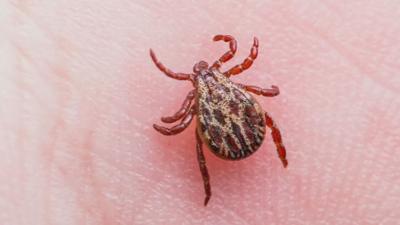

LOUISVILLE, Ky. (WDRB) — Indiana's health department reminded Hoosiers to protect themselves from tick bites as the weather gets warmer.
Health officials said tick activity increases as temperatures rise, posing increased risk for those who work outside or spend time outdoors.
"Whether you're on the job or on the trail it's important to take simple precautions to protect yourself when ticks are active from now through late fall," Dr. Jen Brown, veterinarian for the Indiana Department of Health, said in a news release Monday.
According to state health officials, prevention is the best way to avoid tick-borne diseases, such as Lyme disease and alpha-gal syndrome — which can trigger an allergic reaction to red meat.
Experts offer the following tips:
- Know where ticks are likely to be present: Close to the ground in grassy, brushy or wooded areas
- Treat boots, clothing and outdoor gear with 0.5% permethrin (which should not be used on bare skin)
- Use EPA-registered insect repellants with active ingredients such as DEET, picaridin, IR3535, oil of lemon eucalyptus, para-methane-dio or two-undecanone
- Treat pets for ticks in consultation with a veterinarian
- When going inside after being outdoors, thoroughly check clothing, gear, pets and skin for ticks
- Tumble clothes in the dryer on high heat for 30 minutes — this can kill ticks
- Shower to remove any unattached ticks
- Attached ticks can be removed by using tweezers to grasp the tick close to the skin and pulling outward with steady, even pressure before washing the area thoroughly
- Do not use fingernails to crush ticks
Entomologists found a new tick-borne disease in Indiana last year called the Heartland virus, which can cause fever, fatigue, decreased appetite, headache, nausea and diarrhea. Health officials said that while many tick-borne diseases are treatable with antibiotics, the Heartland virus is not.
Besides Lyme disease, alpha-gal syndrome and Heartland virus, other tick-borne illnesses to watch out for include ehrlichiosis and Rocky Mountain Spotted Fever.
If you become sick after finding an attached tick, see a health care provider immediately and alert them to the exposure. Health experts say early diagnosis of a tick-borne disease can help prevent complications.
For more information about prevention and step-by-step instructions on how to safely remove an attached tick, click here.
Copyright 2026 WDRB Media. All Rights Reserved.