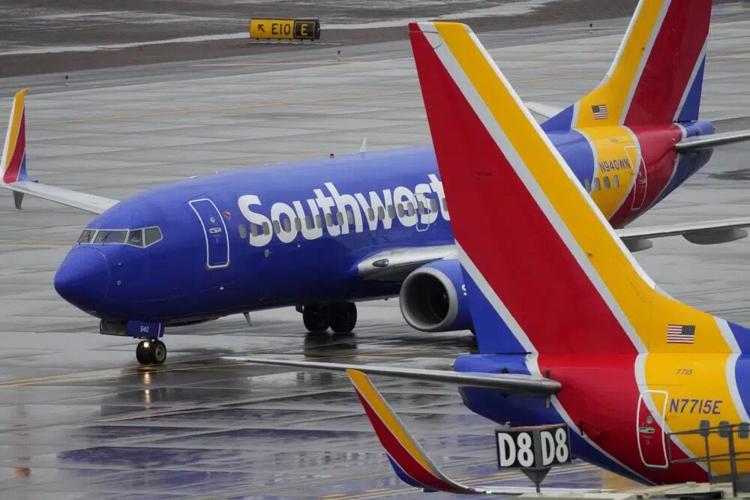


LOUISVILLE, Ky. (WDRB) -- The cancellations continue to pile up for Southwest Airlines.
There have been 4,500 cancellations on Wednesday and Thursday, and more than 1,500 since problems started last week. By early afternoon on the East Coast, about 90% of all canceled flights Wednesday in the U.S. were on Southwest, according to the FlightAware tracking service.
Other airlines recovered from ferocious winter storms that hit large swaths of the country over the weekend, but not Southwest, which scrubbed 2,500 flights Wednesday and 2,300 more on Thursday.
Bonnie Marshall Atkinson, from Mt. Washington, Kentucky, planned to fly back home from Washington D.C. on Wednesday, but she can't get back now until Saturday on another airline.
"I'm on quite a bit of medication and since I only packed enough for eight days, I ran out, so it's been a nightmare to try to get enough medication refills to last the extended stay," Marshall Atkinson said.
Southwest Airlines' CEO Robert Jordan apologized Tuesday, saying "I am truly sorry."
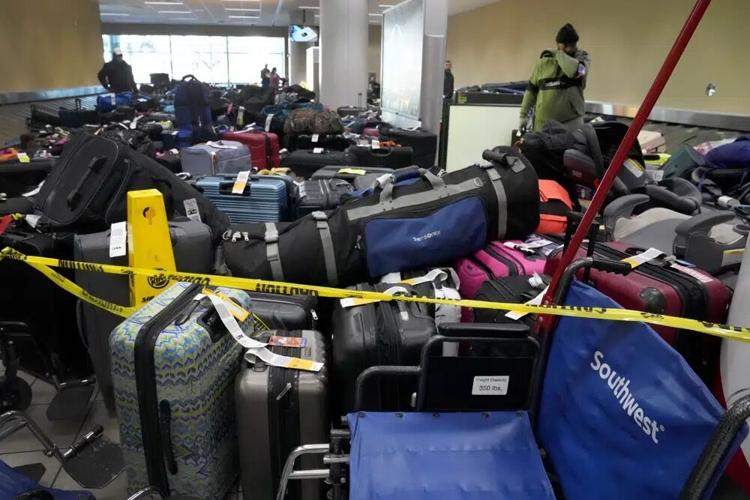
Exhausted Southwest travelers tried finding seats on other airlines or renting cars to get to their destination, but many remained stranded. The airline’s CEO said it could be next week before the flight schedule returns to normal.
The Dallas airline was undone by a combination of factors including an antiquated crew-scheduling system and a network design that allows cancellations in one region to cascade throughout the country rapidly. Those weaknesses are not new — they helped cause a similar failure by Southwest in October 2021.
"It's hard to understand, when other airlines are flying the same places, why Southwest is such a mess," Marshall Atkinson said.
The U.S. Transportation Department is now investigating what happened at Southwest, which carries more passengers within the United States than any other airline. A Senate committee promises to investigate too.
In a video that Southwest posted late Tuesday, CEO Robert Jordan said Southwest would operate on a reduced schedule for several days, but hoped to be “back on track before next week.”
“We have some real work to do in making this right,” said Jordan, a 34-year Southwest veteran who became CEO in February. “For now, I want you to know that we are committed to that.”
Transportation Secretary Pete Buttigieg, who has criticized airlines for previous disruptions, said that “meltdown” was the only word he could think of to describe this week’s events at Southwest. He noted that while cancellations across the rest of the industry declined to about 4% of scheduled flights, they remained above 60% at Southwest.
From the high rate of cancellations to customers’ inability to reach Southwest on the phone, the airline’s performance has been unacceptable, Buttigieg said. He vowed to hold the airline accountable and push it to reimburse travelers.
“They need to make sure that those stranded passengers get to where they need to go and that they are provided adequate compensation,” including for missed flights, hotels and meals, he said Wednesday on ABC’s “Good Morning America.”
Robert Mann, an aviation consultant and former airline executive, said the Transportation Department could force Southwest to pay refunds for all flights that were canceled for reasons within the airline’s control, such as lack of crews. He estimated that could total 6,000 cancellations affecting 1 million customers and adding up to $300 million.
Since Southwest plans to pay $428 million in shareholder dividends next month, “the numbers are not life-threatening, although brand damage has been done,” Mann said.
Some consumer advocates are skeptical the government will punish Southwest.
William McGee, a travel expert at the American Economic Liberties Project, noted that the Transportation Department fined Frontier Airlines and several foreign carriers for slow refunds early in the pandemic but didn’t touch the four biggest U.S. airlines.
“What Pete Buttigieg should do and what he will do are probably two different things,” McGee said. His group wants a change in federal law that would make it easier for states and private parties to sue airlines for harming consumers.
On its website, Southwest told customers affected by canceled or delayed flights between Dec. 24 and Jan. 2 to submit receipts. The airline said, “We will honor reasonable requests for reimbursement for meals, hotel, and alternate transportation.”
Leaders of Southwest labor unions have warned for years that the airline’s crew-scheduling system, which dates to the 1990s, was not keeping up as the route map grew more complicated.
“The fact is this is not the same airline that (Southwest co-founder) Herb Kelleher built where planes went point-to-point,” Randy Barnes, president of the union that represents Southwest ground workers, said Wednesday. “If airline managers had planned better, the meltdown we’ve witnessed in recent days could have been lessened or averted.”
The other large U.S. airlines use “hub and spoke” networks in which flights radiate out from a few major or hub airports. That helps limit the reach of disruptions caused by bad weather in part of the country.
Southwest, however, has a “point-to-point” network in which planes crisscross the country during the day. This can increase the utilization and efficiency of each plane, but problems in one place can ripple across the country and leave crews trapped out of position. (Crews can be stranded at hub-and-spoke airlines too.)
Those issues don’t explain all the complaints that stranded travelers made about Southwest, including no ability to reach the airline on the phone and a lack of help with hotels and meals.
Copyright 2022 WDRB Media. The Associated Press contributed to this report. All Rights Reserved.