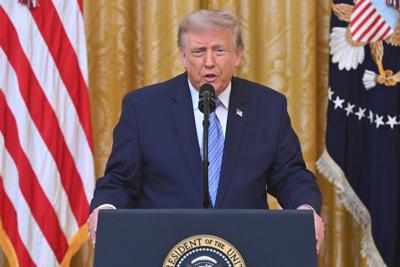
WASHINGTON (AP) — President Donald Trump used a primetime address to the nation Thursday to elevate his yearslong push to raise doubts about the legitimacy of U.S. elections and dispute his 2020 loss in an appeal for more restrictive voting laws ahead of the midterms.
Trump's amplification of debunked theories about the election six years ago and his inability to accept his loss led to one of the darker moments in American history when a mob of his supporters led a violent attack on the U.S. Capitol on Jan. 6, 2021, in the final days of his first term.
Now back in power, Trump opted to revisit the subject, despite persistent voter concerns about the cost of living, American forces escalating strikes on Iran in a conflict for which there is no end in sight, and an immigration crackdown facing bipartisan scrutiny for its sometimes deadly tactics.
His address Thursday hinged on contradictions.
A twice-elected president complained about his one personal defeat, alleged a cover-up by officials in his own first administration and surfaced claims about countries attempting to harm his own prospects while staying silent on steps taken by other nations to boost him.
Trump used the remarks to justify his push to pass a strict voter ID bill in Congress that has not advanced because it lacks enough support from Republicans.
“America is back and doing really well, but we still have a major challenge that must be urgently addressed, because no country can be great without fair and honest elections,” he said.
Trump doesn't raise doubts about his election wins
Trump began Thursday night with a stark warning about what he described as flaws in the voting system and said he was releasing previously classified documents related to the 2020 and 2018 elections, when he lost the presidential election and his party suffered losses.
Trump’s speech presented allegations of interference and influence in ways that lacked key context, and did not produce evidence that votes had been manipulated or that the election outcome had been altered.
Notably, Trump focused on China but glossed over Russia, a country that intelligence officials have said favored Trump in 2016 and 2020 and engaged in wide-ranging influence campaigns aimed at boosting him over Democrat Joe Biden in the latter campaign.
Despite focusing on China in his speech, Trump did not criticize or issue a warning to Chinese President Xi Jinping, whom he has long praised.
Election security experts say America’s decentralized voting system, with the power over elections residing with the states instead of the federal government, is a strength. Americans vote in more than 10,000 different jurisdictions with different rules, making the nations’ elections extraordinarily complicated but safe from widespread fraud.
No credible intelligence has emerged showing that the vote count in 2020 was manipulated by foreign actors. Repeated audits and reviews -- manyrun by Republicans, including Trump’s own then-attorney general -- have found no significant fraud occurred in 2020.
Even if substantiated, Trump’s claims did not amount to conduct that would have altered the outcome of any race, let alone the 2020 race for the White House.
He also did not raise doubts about his election wins in 2016 or 2024.
As Trump spoke, the White House unveiled a website containing documents that were presented without context and included selectively released pieces of investigation files, intelligence analysis and correspondence.
Former intelligence official calls address ‘dangerous’
Sue Gordon, principal deputy director of national intelligence in Trump’s first term, called the president’s address “a dangerous speech about an incredibly important topic.” She said the intelligence community throughout Trump’s first term was alarmed about foreign interference in elections, but Trump scoffed at them, angered at the investigation of his campaign’s relationship with Russia.
“He had an entire term to deal with it and I don’t know how you can believe how the same community that told him about it, that was excoriated about it” wouldn’t warn him in 2020, Gordon said on CNN.
Conservative commentator John Solomon, who joined the White House staff last month and was seated in the East Room for Trump’s speech, later told MS NOW that “the intelligence community has zero evidence that someone has flipped – that a foreign power flipped -- a vote in 2020, ‘22 or ’24.”
But, he added, “We’re not through all the documents.”
Trump urged the Justice Department to conduct investigations and prosecutions, though it was unclear from his speech what sort of criminal conduct — if any — could be identified, proven and charged.
In a contrast with his concerns about foreign interference in elections, Trump in his new budget proposes a $707 million cut in the U.S. Cybsersecurity and Infrastructure Agency, the group charged with protecting American election systems from overseas cyberattacks. Trump and other conservatives have been frustrated that the organization pushed back on election claims in 2020 and beyond.
Some networks did not air it live
In past presidencies, primetime addresses have typically been reserved for major milestones or nationally significant events.
Trump last spoke to the nation in April, giving an address on the Iran war a month after it started. He said then that the U.S. would accomplish its objectives “very shortly” and that “the hard part is done, so it should be easy.” The war, however, has dragged on and strikes between the U.S. and Iran have intensified this week.
Trump also delivered a politically charged primetime speech in December in which he sought to blame the challenging economic climate on Democrats.
ABC, NBC and CNN did not air Thursday's remarks live but carried them in full on their streaming services.
CBS and MS NOW both cut away from Trump’s speech before he finished, while Fox News continued to carry his address.
Trump called out the media outlets for not carrying it live, accused them of being “part of a plot" and suggested their broadcast licenses be revoked.
Networks typically — but not always — carry presidential addresses to the nation live. In 2022, when Biden delivered a primetime address full of warnings about Trump and his adherents’ “extreme ideology,” the networks did not carry it live.
In 2014, the major networks chose to stick with their primetime programming instead of airing an address by President Barack Obama on his plans for immigration reform.
Democrats accuse Trump of seeking to discredit next election
Democrats warned that Trump was trying to revive false claims of past stolen elections in order to delegitimize the 2026 midterm elections, in which Trump’s Republican Party is facing headwinds.
Democratic Sen. Mark Warner of Virginia called Trump’s claims “totally bogus.”
“The fact is our intelligence agencies unanimously agreed that China did not even try to change a single vote in the 2020 election,” Warner said in a statement on X. “A single concurring opinion suggested China may have tried to sway voters’ opinions … but that’s been public knowledge since 2021."
Rep. Joseph Morelle of New York, the ranking Democrat on the administration committee that handles federal voting issues and elections, said Trump is trying to sow confusion before the midterm elections.
“This is a pretext for the president, I think, calling into dispute the 2026 elections,” Morelle said on C-SPAN, adding that “we have secure elections.”
“I heard no concrete allegations that foreign actors actually changed the results of an American election,” Democratic Sen. Chris Coons of Delaware said on CNN.
Associated Press writers Mary Clare Jalonick, Lisa Mascaro and Will Weissert in Washington, Ali Swenson and Jocelyn Noveck in New York and Nicholas Riccardi in Denver contributed to this report.


