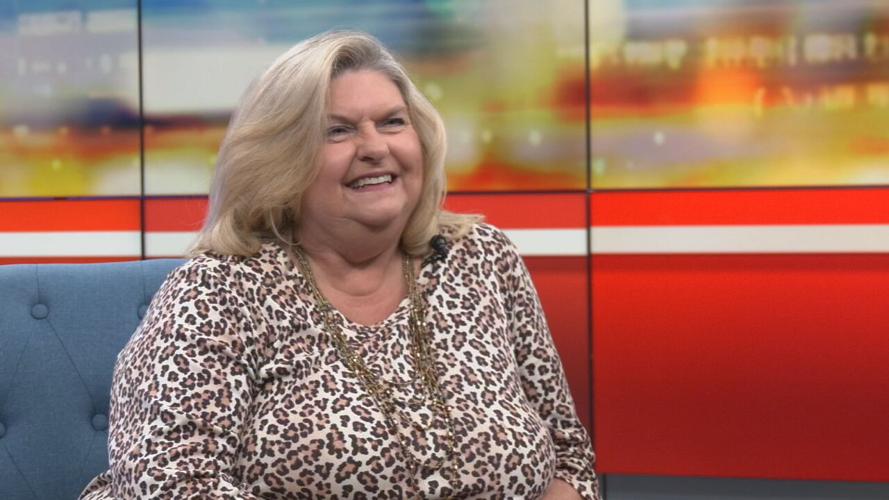


LOUISVILLE, Ky. (WDRB) -- Janice Hughey said she first started experiencing pain in April.
"One afternoon I coughed and it felt like somebody was stabbing me in the back," she said.
At first she ignored it, but then the pain progressed. She eventually went to her doctor to find out what the tingling and frequent numbness could be.
"My physician sent me for an MRI," Hughey said. "I left going to Florida that next day; that was on Friday. On Monday, she called me and told me there was a mass on my spine."
When she got the call, Hughey said it was an "almost drop to your knees" sinking feeling.
"I knew I had to be strong, my son was with us. I kind of took it with a grain of salt I guess," Hughey said.
The mom rushed to get back to Kentucky to follow up with more doctors at Norton Healthcare.
That's when she met Dr. Mahan Ghiassi, who's the director of endovascular neurosurgery at the Norton Neuroscience Institute.
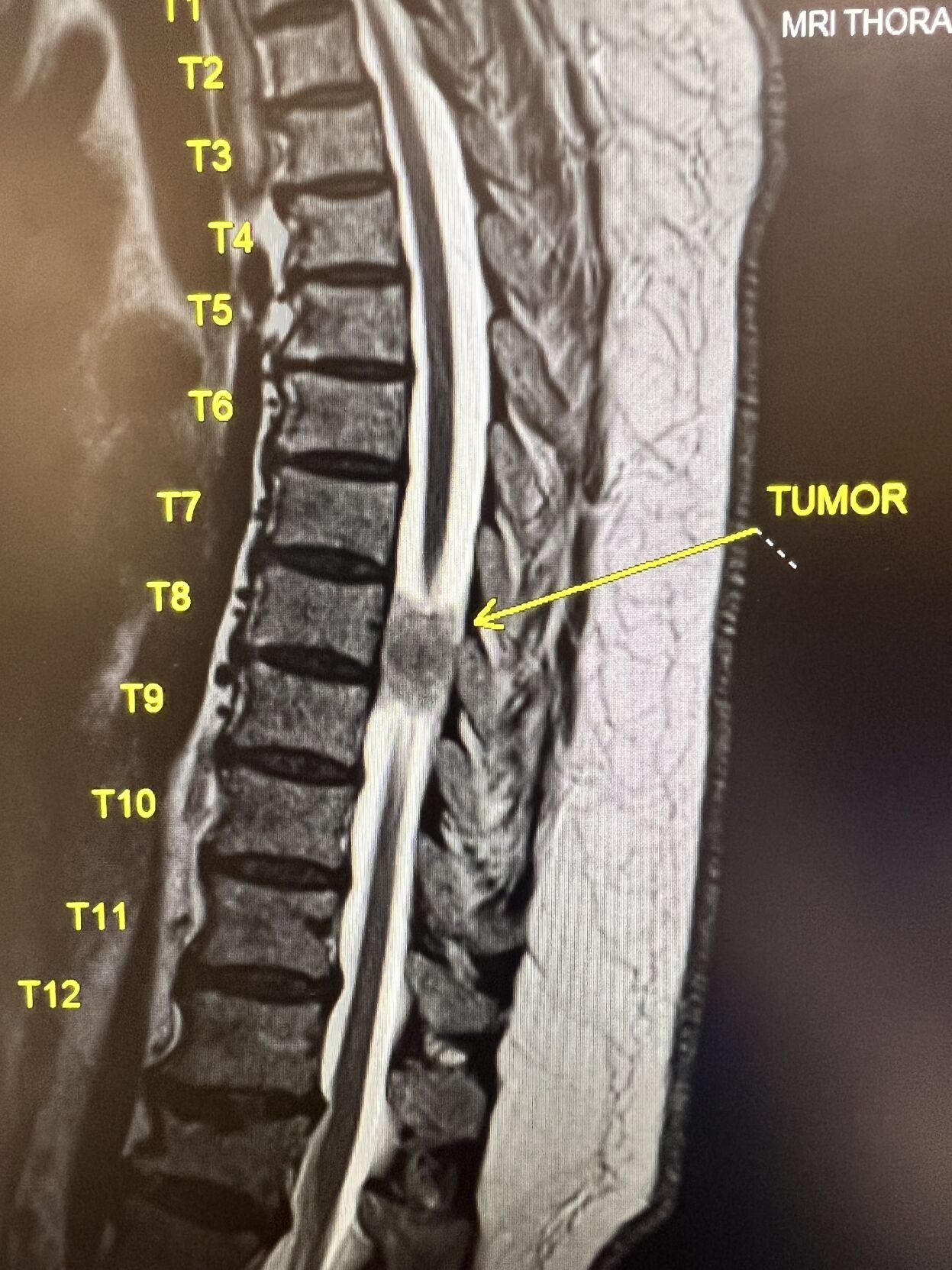
"It was in her thoracic spinal region, which is kind of your mid-torso area," he said. "The rate of progression and severity of symptoms is what kind of triggers our spider senses to say, 'There's something going on there.'"
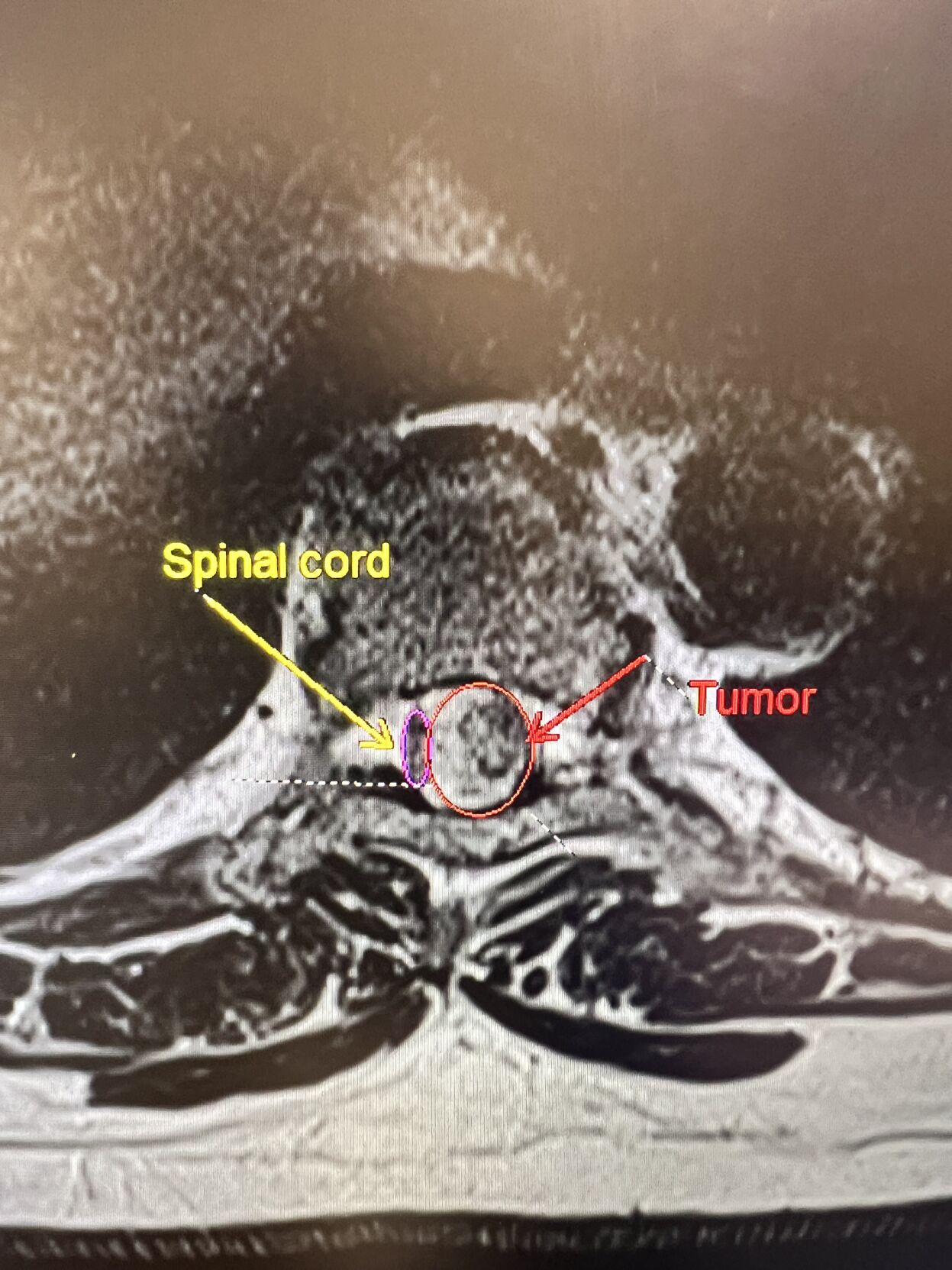
Ghiassi said scans revealed a massive tumor encompassing 90% of her spinal canal.
Janice Hughey began experiencing symptoms from her spinal tumor in April. (Image Courtesy Dr. Ghiassi)
"Your spinal cord is encased in a leathery sac and inside that leathery sac is the spinal chord and the spinal fluid that the spinal chord kind of bathes inside. Surrounding that sac of fluid is bone essentially, your spinal column, and that bone doesn't really move," he said. "Where the spinal chord usually lives and resides had basically no room left and was getting squeezed and pressed against the bone."
The surgeon said the pinching of the spinal cord into the bone was what caused Hughey's symptoms.
"These types of tumors are probably less than 10% of tumors we see in the neurosurgery field and the degree to which her tumor had grown, I'd say less than 1% of tumors get to this size," said Ghiassi.
The tumor wasn't cancerous but it did put Hughey at risk of paralysis or serious loss of motor function.
"It was fortunate we did find it when we did because ultimately at a certain point, the spinal cord can't compensate anymore and people start experiencing permanent loss of function, even paralysis," Ghiassi said. "When we do find tumors that are that compressive on the spinal chord, we want to get them out as quickly as possible."
The doctor said, "Once paralysis starts, the likelihood of reversal diminishes with every day that goes by essentially."
The team at Norton Healthcare knew time was of the essence and within two months of finding her tumor, Hughey was on the operating table.
"I was very nervous," Hughey said. "There was no guarantee I'd be able to walk again, if he slipped... that was the chance I had to take."
Before every surgery, Ghiassi said he visualizes what needs to happen.
"I essentially play the entirety of the surgery in my head before I even step into the OR. That kind of gives me confidence when I walk into the OR, I've already played a movie of how that surgery is going to progress. It kind of calms you," he said.
Hughey's surgery ended up being successful and took Ghiassi and the team about five hours.

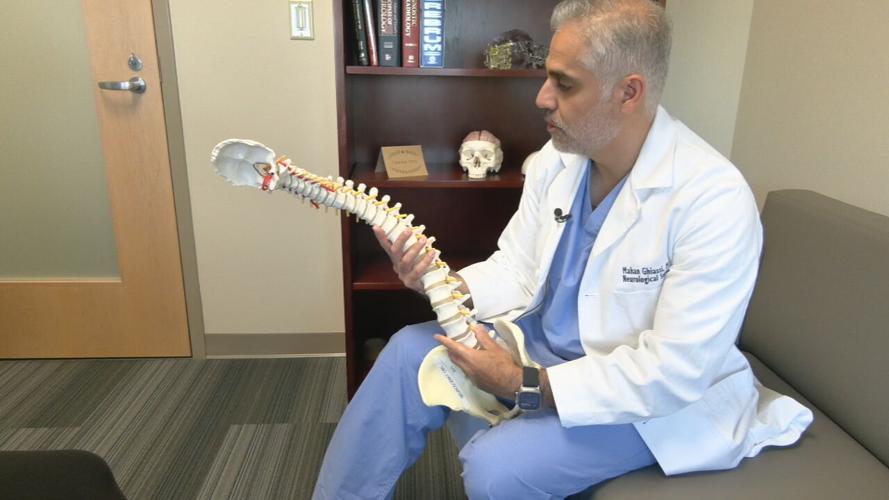
Dr. Mahan Ghiassi works as the director of endovascular neurosurgery at the Norton Neuroscience Institute. (WDRB Image)
"It's by far the best part of my job," said Ghiassi. "Having a patient come in with significant problems, potentially an even paralyzing disease process, and and being able to take her and perform an operation that will dramatically change the course of her life, it doesn't get better than that. It's so rewarding."
"I am tremendously thankful," Hughey said about her doctors. "Anybody can say, 'Oh I can do surgery' but there was just something there that we trusted."
Hughey thought she'd be out of work for about three months, but was able to return to the office in just two after a short stay in the hospital and some physical therapy.
"I'm pretty much back to normal," she said. "I'm a little slow, but not like I was before. It was so bad that if I walked in my office, if I walked down the hallway, I was bouncing from one side to the other. I couldn't go up the stairs at home hardly at home, I had to hold both hands to the rail and kind of pull myself up. Now I go up and down just fine."
Hughey said she feels lucky to have her independence back, knowing the outcome could have been much worse.
"I guess the most scary thing was the thought that maybe I could be paralyzed. There are people that live with that every day, but I'm just thankful I didn't not have to. It changes your perspective on everything," she said.
The patient and doctor both said they hope her story can be a reminder of how quickly something can progress and the importance of seeing a doctor if something feels off.
"I just feel if I hadn't done something at that point, I'd have probably been paralyzed or in a wheelchair in a matter of weeks because that was just a couple months from beginning to end," Hughey said. "Please, if there's something you feel or there's tingling in your legs or feet, go and have it checked out because who knows. I never in a million years dreamt it was a tumor on my spine."
"Everyone can have symptoms every now and then," Ghiassi said. "Everyone can have a headache or back pain every now and them, but if a symptom persists more than a few days and it's not going away and certainly if it's getting worse, you should seek counsel of your physician."
For more information on signs and symptoms of spinal tumors, click here.
Copyright 2023 WDRB Media. All Rights Reserved.


