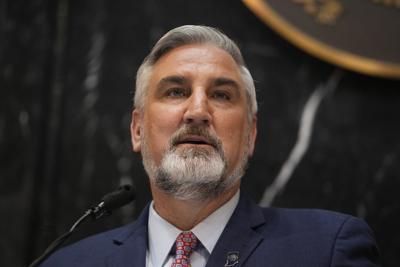


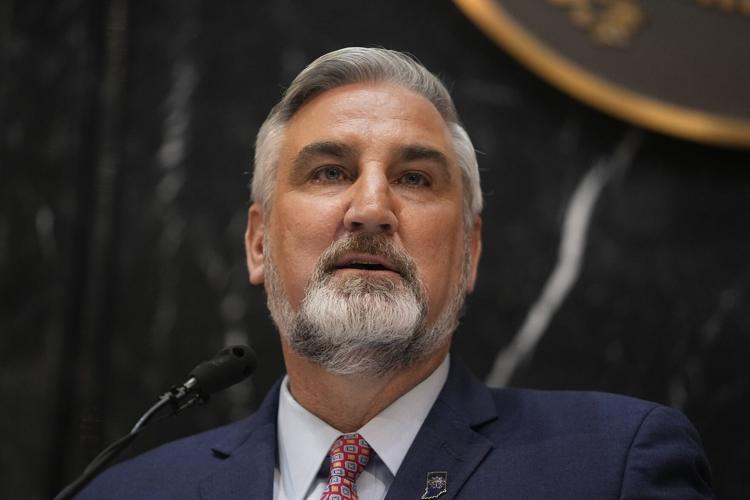
LOUISVILLE, Ky. (WDRB/AP) -- In his eighth and final year as Indiana's governor, Eric Holcomb said his focus will be on improving the state's child care and education systems.
Holcomb presented his agenda on Monday, Jan. 8 ahead of the state's 2024 legislative session, asking lawmakers to make improvements to child care and education from preschool through college a priority.
The Republican governor wants lawmakers to require administering the state's reading test to second graders as an early indicator of where they stand and how they can improve.
Holcomb said he supports holding back third graders who did not pass the test in the third grade. According to the Department of Education, about 18% of third graders did not pass Indiana's reading test last year.
But critics have said that if more students are held back, class sizes could become unmanageable and schools won't have enough staff or resources to keep up.
Current Indiana policy is to keep these students from being promoted, but GOP lawmakers said the exemptions are too widely applied: Department of Education data show more than 96% of students who did not pass the reading test were advanced to the fourth grade.
Many of Holcomb's goals surrounding education were echoed by top Republican lawmakers, who have also said they want to focus on education with policies to improve elementary students' literacy rates and make child care more available and affordable.
In a written statement, Senate President Pro Tem Rodric Bray said Senate Republicans share several of Holcomb's priorities, especially when it comes to literacy among elementary school students.
Holcomb said retention and attraction in Indiana's workforce will be improved by increasing access and affordability to child care. He would also reduce child care regulations, lowering the minimum caregiver age to 18 for infant and toddler rooms at day care/child care centers and 16 for school-age classrooms. Holcomb also wants to increase the eligibility requirements for free or reduced child care for employees of child care facilities through a voucher program that already exists.
He also said the second phase of his Employer-Sponsored Child Care Fund will be launched soon, awarding the remaining $6.9 million to help employers and communities in expanding child care options. The first $18 million of funding was announced in December 2023.
While his agenda didn't include items on chronic absenteeism in schools, which has been highlighted by Republican lawmakers, Holcomb said his administration would work with lawmakers if they propose bills on truancy. It's been a focus for lawmakers going into the new year as about 1 in 5 students were chronically absent from Indiana schools during the 2022-23 school year, according to department data. That means they missed about three and a half weeks of class.
To better prepare students for the workforce and higher education, the governor also wants to make computer science a high school graduation requirement by 2029.
Another priority for Holcomb is making Hoosiers aware of job-related training programs and resources available that can lead to higher-paying jobs in an initiative called the "One Stop to Start" campaign.
"We want to make sure there is an umbrella, as the state sees it, border to border, making sure we get people plugged in so they know whatever has interfered or intervened in their life, or maybe gotten them off course, they can get back on and there are people that are there to, obviously, there to help shepherd them on the way," he said.
The governor also highlighted the state's use of the Imagination Library, a book-gifting program created by Dolly Parton. He said the Indiana program has grown from 43 to 71 counties, and 90,000 kids received a free book in December.
Holcomb, who is in the final year of his second term, will deliver his formal State of the State address Tuesday night. His term will end in 2024 because Indiana law does not allow governors to serve more than two successive terms.
Before the start of the new year, Republican leadership said their directive for the legislative session is to keep it short, with a "more limited and focused agenda." But with a general election following landmark conservative legislation in recent years — including a near-total ban on abortion, a wide expansion on school vouchers and a law restricting the use of students' preferred pronouns in schools — that might not take place.
It's likely legislation on similar social issues will reach the floor again, even while leaders of the state’s Republican trifecta said they want a session of “fine-tuning” policy.
Hoosiers can expect no movement on two subjects: gambling and marijuana legalization.
Top Republican leaders said gambling measures are off the table after a former lawmaker recently pleaded guilty to accepting the promise of lucrative employment from a casino company in return for favorable action in the general assembly in 2019.
Marijuana legislation is also unlikely to see any movement in the upcoming year, even as Indiana becomes increasingly marooned by pot-friendly states including Ohio, where voters approved adult recreational use in November through a citizen initiative.
Indiana's 2024 legislative session started Monday and must adjourn by March 14. The session will be closed to items with fiscal impact, as Indiana holds longer, budget-making sessions during odd years.
Related Stories:
- After landmark legislation, Indiana Republican leadership call for short, 'fine-tuning' session
- Indiana's near-total abortion ban set to take effect as state Supreme Court denies rehearing
- Indiana governor signs bills on student names and pronoun changes, book banning
Copyright 2024 WDRB Media. All Rights Reserved. The Associated Press contributed to this report.


