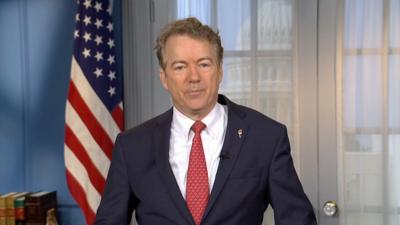
LOUISVILLE, Ky. (WDRB) -- U.S. Senator Rand Paul called House Speaker Nancy Pelosi "childish" for ripping up a transcript of President Trump's State of the Union address at the end of the ceremony Tuesday night.
Paul made the comment during a satellite interview with WDRB's Lawrence Smith Wednesday morning.
Paul also went on to express his fears that the impeachment process might be used as a political weapon on the future, and vowed never to vote to impeach a president without evidence of "treason, bribery or other high crimes."
Below is a transcript of Smith's interview.
EDITORIAL NOTE: During the interview, Paul mentions several names, one of which is the name of the alleged whistleblower who brought the impeachment allegations against President Trump. Those names have been redacted from this transcript.
Transcript begins:
SMITH: Hey Senator. How are you?
PAUL: Very good.
SMITH: Good, good. We’re [reaching] the end of this impeachment process. Obviously, the President is going to be acquitted. First question: you know, what, if anything, has this whole thing accomplished?
PAUL: You know, I think it’s done more to divide us than bring us together. I think one thing that hopefully is a lesson that people will learn is that impeachments shouldn’t be brought forward because you disagree with somebody. That’s what elections are about. This all started with a phone call the President made to the President of Ukraine. Probably 400 people listened to that phone call, but probably 390 of them thought that there was nothing wrong. A handful of people who were actually partisans, who didn’t like the President, didn’t like his policies disagreed.
But even Vindman – this Lt. Col. who was the most prominent one going after the President – his boss is a Lt. Gen. Kellogg. He didn’t think there was anything wrong with the phone call. So that sounds like a difference of opinion.
We had this same problem in the Clinton impeachment – that the Democrats back then said we shouldn’t do this when it’s completely partisan. That impeachment still did have some Democrats voting for impeachment. This one – it turned out to be even more partisan in the senses that no Republican voted in the House, and I don’t think any Republican is going to vote for impeachment in the Senate. So I think the lesson learned is we shouldn’t use impeachment for political purposes.
SMITH: You have tried on a couple of occasions – once unsuccessfully on the Senate floor during the trial, and then during your speech yesterday – to identify the alleged whistleblower. Why has that been such an important thing to you?
PAUL: Well it’s actually technically not that I was trying to reveal anyone. My question didn’t identify or allege that anybody was a whistleblower. My question named two individuals. One of them works for Adam Schiff on his team, and used to work at the National Security Council. This individual knows another guy named [NAME REDACTED]. I’ve made no accusations about him, just that he worked with Adam Schiff’s team. And that there were six people – basically the [NAMES REDACTED], [NAME REDACTED], this guy named [NAME REDACTED], as well as two other folks who all knew each other at the Security Council, and there are stories that they were plotting the impeachment a year or two in advance.
If that is true, the American people need to know that this wasn’t something spontaneous that came up with a phone call, but this was a group of people who had political differences with the President, who had been plotting to concoct this thing, and then they used the whistleblower statute.
I think that the whistleblower statute is a good thing. You shouldn’t be fired for bringing forward the truth. You shouldn’t be punished at work. I think Edward Snowden is the greatest whistleblower of all time because he brought forward that the entire intelligence community was breaking the Fourth Amendment and spying on Americans. And yet many of these people who like the current whistleblower and want to protect him want to put Edward Snowden in jail for life. So there is a certain amount of selective outrage on this thing.
But I do think that we should look at the origins, because so far we’ve found that when the President – the investigation of the President started during the campaign, which is extraordinary. It started at the behest of money from the Clinton campaign going to a British spy. And I don’t think we should allow our secret court system -- FISA, the FBI -- to go after political campaigns, Republican or Democrat. So one of the things I’m going to try to do out of this is to bring forward some reform, and the reform will be this: that the secret courts, the intelligence courts, the ones that meet in secret with no representation, they shouldn’t get involved in politics.
If you want to accuse somebody who’s in a political campaign, it needs to be done in an open, Article 3 Constitutional court.
SMITH: Do you think by putting these names out there that you’ve in any way endangered them, A, and B, endangered or weakened the whistleblower law?
PAUL: No, not at all. The whistleblower law doesn’t actually require anonymity. It doesn’t have any requirements on anyone other than your immediate boss. And so I don’t think this changes the whistleblower statute. I’m still in favor of the whistleblower statutes.
As far as endangering anyone, I’m absolutely opposed to that. I don’t want anybody to be harmed. Look, I’ve been shot at and assaulted. I know what political violence is like, so I’m not for that for anyone.
But I would say that being an opponent of the President doesn’t mean that you’re subject to political violence. Really, what we’ve seen so far in the last year has been the left wing attacking Republican officeholders in restaurants. I don’t think we’ve seen anybody on the Republican side attacking left-wing politicians in restaurants. So really, if there’s a concern with violence, I think we have to be concerned with the other side being outlandish and attacking officeholders when they see them in public.
SMITH: Part of Congress’ job is holding the President accountable. Do you think that by not approving any articles of impeachment, by not convicting the President – and this is the Democratic argument that I’ve heard – that somehow Congress is abdicating its responsibility to hold the President accountable.
PAUL: I think there are different ways you find and hold the President accountable. I was a critic of President Obama for usurping authority on immigration law, but I’ve also been a critic of President Trump for usurping authority and power that wasn’t his to take money out of the budget and spend it on that wall. I am for security of the southern border, but I don’t think the President has the prerogative or right to take that money. So I have voted on the other side of that issue to say that the constitutional power of the purse remains in the Senate. And that’s a policy difference. But that’s not something we impeach the President on.
On issues of war, I think we don’t go to war without a declaration, and I’ve sided with people on the other side of the aisle to say, ‘You know what? If a war is to occur with Iran – if we’re going to have a major confrontation with Iran – there has to be a vote in Congress.’ So I haven’t been shy about standing up to the President. I just think that impeachment isn’t the way you stand up. You stand up to somebody, either through elections, or though voting against or voting for the position you advocate. But impeachment just, for the most part, is not the route to go. It didn’t work here, and it turned out to be a completely partisan exercise.
SMITH: Do you think impeachment is now a partisan exercise going forward? Are you concerned that this will be used as a weapon in the future?
PAUL: You know I think there’s a danger of that. One of our senators pointed out that if Biden were to win, someone could offer to impeach him over the Burisma thing with his son Hunter. But I can tell you this, while I think that should be investigated and talked about, I’m not voting for impeachment for anybody unless they’re guilty of treason, bribery or other high crimes. And what they mean by ‘other high crimes’ is high crimes that are equivalent or of a high enough level to be equivalent with treason or bribery. Policy differences isn’t it. I may not like the Bidens but I’m not gonna say, ‘Oh, I’m going to impeach the Bidens if they win.’ I think that’s the wrong way to go about it. I think there’s a danger that the Democrats by doing this to Trump will make it such that another party will come back someday and be bitter over what happened and simply do it for bitter politics. I hope that’s not the answer, and I’m not going to be a part of it.
SMITH: Do you think, in the wake of this, Congress can get back together and get things done, or is the split irreparable?
PAUL: You know, you’d be surprised how quickly people do come back to the table and start talking with each other. I think that on issues of war, you know, I’ve sided with people on the other side of the aisle. On issues of privacy, on issues of trying to constrain the intelligence community so they can’t spy on Americans, I’ve sided with people on the other side of the aisle. On criminal justice, I’ve sided with people on the other side of the aisle. On issues of whether spending originates in Congress, I’ve sided with people. So there are a lot of things that I’ve been willing to work with people across the aisle and will continue to do. Impeachment hasn’t made it easier, I can tell you that, but my hope is that this will now …the animosity and acrimony will dissipate and we will get together and start talking about doing some good things.
SMITH: Real quick: your thoughts on the State of the Union speech last night – the speech itself, but also a lot of attention on Nancy Pelosi and her ripping up the speech after it was done.
PAUL: I would say childish. You know, it looked kind of childish to me. I didn’t notice it at the time because I was sitting over to the side, but I thought one of the President’s most important points that he made was, he recognized the young soldier who surprised his wife and their small children that were there last night who came home from Afghanistan. He did say that he was for bringing the troops home – and three-fourths of the audience stood up. I think this is something that Republicans and Democrats could come together on. Let’s end America’s longest war in Afghanistan. It’s not gonna be perfect over there. It was not perfect before we came. It’s not gonna be perfect when we leave. But it’s time to come home. There is no clear-cut mission for our kids over there, and I don’t want to see one more soldier die over there. So I will work with anyone – Republican, Democrat, or Independent, with the President, or even with another President – I will work with them to try to bring our troops home. But I was proud of our President for bringing that up and I think that is a real possible bipartisan path.
SMITH: Last question: Just your thoughts – your message – to the people of Kentucky, now that this whole impeachment thing is ending.
PAUL: You know, we’re doing really well. Kentucky is doing great. Lowest unemployment in my lifetime, no matter what category or group you look at – black, white, Hispanic, men, women and teenagers – unemployment is really, really low. As I travel around Kentucky, the biggest complaint I hear from people in business is, ‘We can’t find enough workers’ or ‘We need more training.’ It’s a good problem to have when you need more workers. So I’m excited about how well we’re doing. Kentucky is booming. I love Bowling Green: booming. Louisville: booming. I mean, there’s a lot of stuff going on, and for young people I say, ‘Look, there’s never been a better time to be alive. If you get out of high school and want to have a skill and be a technical worker, of if you want to go to college and get a college degree, either way there are lots and lots of jobs out there.
SMITH: Alright Senator. Thank you much. Appreciate it.
PAUL: Thank you.
Transcript ends.
Copyright 2020 by WDRB Media. All rights reserved.


