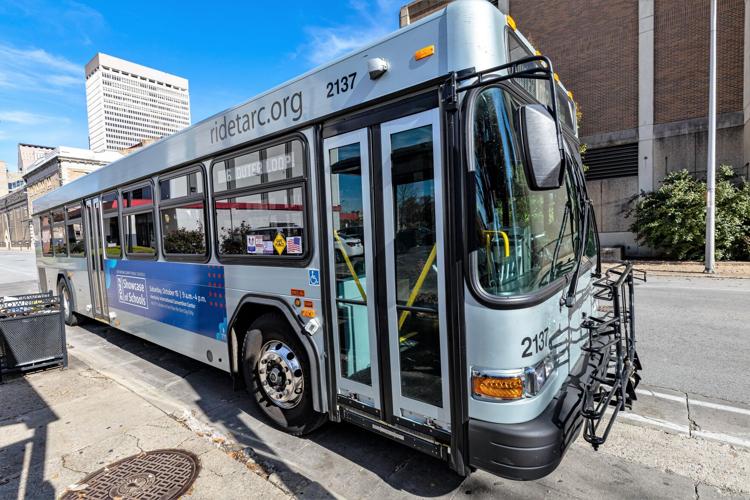

TARC is heading toward a fiscal cliff.
Since 2020, when the COVID-19 pandemic hit and ridership plummeted, Louisville's transit agency has been kept afloat by the federal government's American Rescue Plan funding. In its 2024 budget, 25% of TARC's revenue is projected to come from ARP funds, while only 6% will come from fares. The vast majority of the remaining revenue (60%) will be generated by an occupational tax paid by people employed in Jefferson County.

Chris Glasser is president of Streets for People, a nonprofit organization that advocates for improvements to the safety and reliability of transit, biking, and walking networks in Louisville.
This ARP funding is set to run out in the next few years, at which point TARC will no longer have enough funds to maintain its level of service. In a budget of over $100 million, it is looking at a $30 million annual deficit.
With the resignation of TARC Executive Director Carrie Butler in late 2023 and the search for a new ED underway, Mayor Craig Greenberg will need to hire a leader who has the vision and political wherewithal to navigate TARC out of this financial crisis.
To be clear: This is a funding gap that even wildly optimistic ridership increases will not be able to cover. Fare revenue could increase twofold and TARC would still have an annual deficit of more than $15 million.
Something — undoubtedly multiple things — will need to change.
As an advocacy organization that pushes for vibrant, accessible neighborhoods citywide, my nonprofit organization, Streets for People, wholeheartedly believes in the importance of a dependable, viable transit system.
But to make this a reality for the city, Metro Government, TARC and the citizens of Jefferson County are going to face difficult choices. We at S4P believe there is an attainable path forward.
First and foremost, TARC needs to commit to a network redesign, and in the process, it will need to cut a number of routes with low ridership and infrequent service. This will be unpopular, but it is necessary. Many lines run with buses coming only once every 45 minutes or less, and have dismal ridership numbers. These are the routes TARC should consider cutting.
Secondly, TARC needs to commit to maintaining and improving its high frequency, high ridership network. Currently, TARC runs four high-frequency lines: the 4 (4th Street), the 10 (Dixie Hwy), the 23 (Broadway and Bardstown Road), and the 28 (Preston Highway). Buses on these lines come once every 15 minutes (four times an hour). TARC should aim to improve that — to 12-minute headways, or five buses an hour.
Thirdly, Metro Government and the citizens of Jefferson County must engage in a serious debate on raising the occupational tax to meet the funding deficit that will come with the loss of federal relief funds. Currently, the Mass Transit Trust Fund (MTTF) tax is 0.2% — the equivalent of a $1 tax on every $500 in earnings. Simply raising this tax by 0.05% would deliver $18 million in new revenue.
Lastly, TARC should embrace pilot programs and innovation the way other US cities have with their transit systems. Boston and Cincinnati have experimented with making individual lines fare-free. This is something TARC could do with, for example, the 23 — a route that goes from Shawnee Park to Buechel, and travels along Broadway and Bardstown Road.
Move Louisville, Metro's transportation master plan published in 2016, proposed investing in Premium Transit Corridors on Broadway, Dixie, Preston, Bardstown, and Shelbyville roads. |

TARC should also test out other high frequency lines. Metro's 2016 Move Louisville plan proposed making the 31 (Shelbyville Rd and Frankfort Ave) into a “premium transit corridor”. These kinds of ideas should be seriously tested.
TARC will experience profound changes in the next few years. The status quo won't last for much longer. Metro Government needs to address TARC's challenges head-on, by having honest conversations about which lines it can no longer afford to service, about how new revenue sources can be found, and about how the experience can be improved to make transit more viable and desirable.
Until we as a city engage in that conversation, we're asleep at the wheel.


