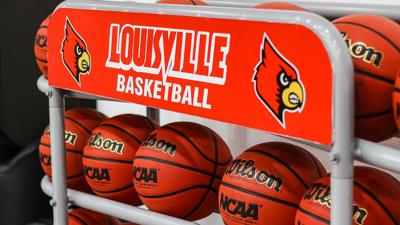
LOUISVILLE, Ky. (WDRB) -- There are three potential outcomes for the University of Louisville basketball program as the school navigates its defense against another round of allegations that it broke NCAA rules.
I try to remember that as the back-and-forth between the $1,000-an-hour lawyers continues and the U of L case slogs through the mysterious NCAA system, this is a negotiation.
That explains why a program that fired Rick Pitino defended him in its latest NCAA filing.
That explains why the school’s defense team took the curious words of dismissed assistant coaches Kenny Johnson and Jordan Fair and stretched them beyond basic dictionary definitions.
That explains why Louisville has contested many of these allegations after the school gained little by punishing itself the last time the program went through this meat-grinder.
This time, to borrow a marketing phrase you might have heard, it just means more.
Option one is another year, or likely more, of NCAA probation that would also carry the stinging reality of missing an NCAA Tournament or two. That would damage recruiting considerably more than the current uncertainty about the program already has. That is something the school is determined to avoid.
Option two is worse. Option two is the death penalty, a complete shutdown of the program. Considering the NCAA has not delivered a death penalty ruling in Power Five men’s basketball or football in 33 years, I’ll file that under unlikely.
But, breaking the rules while you’re on probation always puts the death penalty in play. Laugh at the possibility at your own risk. Louisville broke the rules while on probation. The death penalty is in play, especially if the folks who judge this case consider it the perfect opportunity to deliver a law and order message. You never know.
There is option three: a wrist slap. A stern reminder not to do something like this again, the NCAA’s version of a warning ticket that would carry no additional penalties.
That seems more unlikely than the unlikeliness of the death penalty. In other words, focus on option one.
Get the death penalty off the table. Keep the punishment to the minimum. Try to avoid being bounced from the NCAA Tournament. Protect recruiting. Protect the program. Rally the fan base.
That’s my best explanation for the most head-shaking sections of the school’s response.
Where to begin?
Louisville defended Pitino and actually credited him with a push to maintain an atmosphere of compliance during a “six-day period” in 2017 when five-star recruit Brian Bowen II dropped through the recruiting cracks to be successfully recruited by Cardinals.
Louisville also fired Pitino, which explains why he drew extensive airtime last weekend while hosting U.S. Open watch parties from his home that adjoins the Winged Food Golf Club north of New York City. There must be some reason Pitino will be coaching at Iona this season.
Then there is Johnson, also out of a job, dismissed by La Salle after he was dismissed by Louisville.
Johnson, Pitino’s top assistant, said he did not make a cash payment to Brian Bowen of $1,300 on Aug. 23, 2017.
On page 37 of the U of L response, the schools said that Johnson’s August 2017 bank statements “do not contain evidence” of a payment that day. But, in the same paragraph, the school says that Johnson’s bank statements do show cash withdrawals of $610.49; $203.75; $340; $2,000; $100; $580; $300 and $1,700 between July 31 and Aug. 24.
Anybody got a calculator? Those withdrawals total $5,834.24, which is more than four times $1,300.
Next.
According to the Cambridge Dictionary, the phrase to “square up” means: “to pay somebody the money that you owe them.”
Unless you are defending yourself against NCAA allegation, then it doesn’t mean what Bowen’s father, Brian, said what it meant while under oath during a trial in New York City — that Johnson gave him the $1,300.
To Johnson, getting “squared up,” meant resolving questions about Bowen’s training. Somebody advise Cambridge Dictionary.
And when you’ve got them on the line, ask if they have expanded the meaning of the term “low-key.”
Currently, Cambridge defines the term low-key as “simple and not attracting attention.”
As in, possibly, if you’re going to funnel money to a basketball recruit, keep it low-key.
Fair, the other dismissed U of L assistant, told the NCAA Enforcement staff that when he made the statement about keeping the work “low-key” around another recruit that he actually meant this:
“(k)eep me out of it because I’m not making any payments. I’m not touching any money. I don’t want to know about any money you guys pass out or whatever you do. I’m not going to have any involvement in that.”
Would that be considered a “low-key” answer?
Eventually, the NCAA will decide everything. Just remember that Louisville is working overtime to convince the NCAA to decide as generously as possible.
Copyright 2020 WDRB Media. All Rights Reserved.


