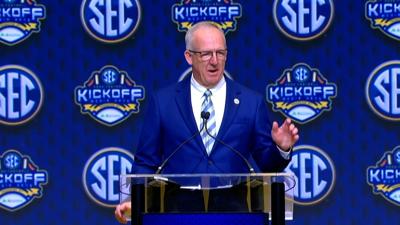

LOUISVILLE, Ky. (WDRB) — Kings don't usually begin speeches by reminding everyone they're kings.
They don't recite attendance figures. They don't count television viewers. They don't inventory trophies.
They simply wear the crown.
Greg Sankey did all of those things Monday in Tampa.
The commissioner of the Southeastern Conference opened SEC Media Days with what he called "the stat of the summer." SEC football, he noted, averages more than 80,000 fans per game, the highest attendance of any sports league in the world.
Then came another statistic. SEC football accounts for more than 40 percent of the live television audience among the Power 4 conferences.
Then another. A conference-record 13 NCAA team national championships during the 2025-26 academic year.
By the time Sankey reached congressional legislation, College Football Playoff expansion and the future of college athletics, he'd already spent nearly 10 minutes making a different argument.
Before we discuss where college sports are headed, remember who built the biggest stage.
It sounded less like arrogance than advocacy. Sankey wasn't asking anyone to give the SEC special treatment. He was arguing that, by almost every measurable standard, the conference continues to be the most influential entity in college athletics.
There is, however, one measurement where the SEC no longer stands alone.
It hasn't played for a College Football Playoff championship since Georgia routed TCU to cap the 2022 season.
Since then, Michigan, Ohio State and Indiana have claimed the sport's biggest prize.
Indiana.
That last one matters.
The Hoosiers didn't simply win a national championship. They dismantled Alabama on the way there, delivering one of those victories that quietly changes what everyone assumes to be true.
For two decades, college football has largely operated under one assumption: if you wanted to be the best, sooner or later you had to go through the SEC.
Today, that assumption isn't quite so automatic.
The SEC remains the biggest brand in college athletics. It remains the sport's television engine. It still packs more fans into stadiums than any sports league in the world.
What has changed isn't the league.
It's the certainty.
Which makes Sankey's speech far more interesting than a routine state-of-the-conference address.
Later, Sankey distilled the speech into a single sentence: "We believe we're the best conference in college football."
Everything else flowed from that premise. The nine-game schedule was Exhibit A.
"We're not necessarily interested in finding the easiest path," Sankey said, calling the SEC's new nine-game league schedule "the right path for college football."
That's more than scheduling philosophy. It's a challenge. To his own coaches. To the playoff selection committee. To every conference that claims it plays equally difficult football.
It also plants a flag before the first kickoff of the season.
If the committee says strength of schedule matters, Sankey is essentially saying, then prove it.
That frustration — his word, used later in the Q&A to describe years of stalled playoff conversations — surfaced even more directly when he was asked whether the committee would properly value a nine-game SEC schedule.
Sankey referenced an "unsatisfactory conversation" with playoff officials during conference meetings in the spring and questioned whether they fully appreciated "the strength and rigor associated with competing in the Southeastern Conference."
Commissioners rarely talk that way unless they're sending a message.
The same confidence surfaced later when Sankey acknowledged that conversations about an SEC breakaway from the NCAA structure are "real." He quickly added that the preference remains to compete for national championships within a national system. Even there, the point wasn't separation as much as influence: if college athletics is going to have one framework, Sankey made clear the SEC expects to help write it.
His lengthy discussion of federal legislation followed the same pattern. At its core, Sankey said, the goal is "one national standard, a national framework with rules that can be consistently enforced."
Sankey was equally blunt about what comes next. If Congress acts, he said, the SEC has no interest in "returning to D.C. in a year or two" to repair an incomplete bill.
The conference's position is straightforward: if college athletics is going to establish one national framework, one set of standards and one way of doing business, the conference that has demonstrated the greatest competitive success, financial strength and public interest believes it should have the loudest voice in shaping that future.
Whether everyone agrees is beside the point.
Greg Sankey wasn't trying to win a debate on Monday. He was trying to establish standing before the next one begins.
Kings don't usually remind people they're kings.
Leaders, however, sometimes have to remind people why they're worth following.
Copyright 2026 WDRB Media. All Rights Reserved.


