


LOUISVILLE, Ky. (WDRB) — Racehorses at Churchill Downs (and Ellis Park) have carried something just a bit extra into the starting gate since racing began in April.
Along with the jockey, tack and saddle, thoroughbreds have carried a small sensor, weighing just 3 ounces but delivering a vast amount of data, as part of a research project that state racing officials and designers of the technology hope will play an important part in reducing equine fatalities.
StrideSafe, a technology developed by Dr. David Lambert and based on a system called StrideMaster out of Australia, is designed to sense acceleration, movement and impact in horses at high speed, returning data after races to tell when a horse may be troubled in its movement.
After being in use for some time in Australia, it has been tested and studied at racetracks in New York and now, through a grant from the Kentucky Horse Racing Commission and a study at Washington State University, has been used on every starter in every race for Churchill Downs’ spring meet, including the Kentucky Derby last May, and races at Ellis Park, where Churchill relocated the final weeks of its meet.

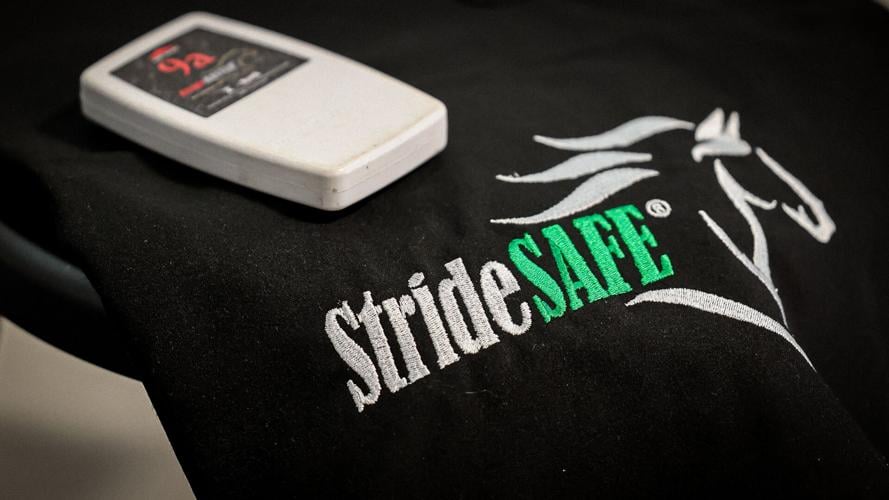
A StrideSafe sensor of the type worn by every horse in every race of the Churchill Downs Spring Meet.
The sensor is slipped into the horse’s saddlecloth. Inside it is an accelerometer which measures forces in three dimensions, laterally, up and down and forward and back, and a GPS system.
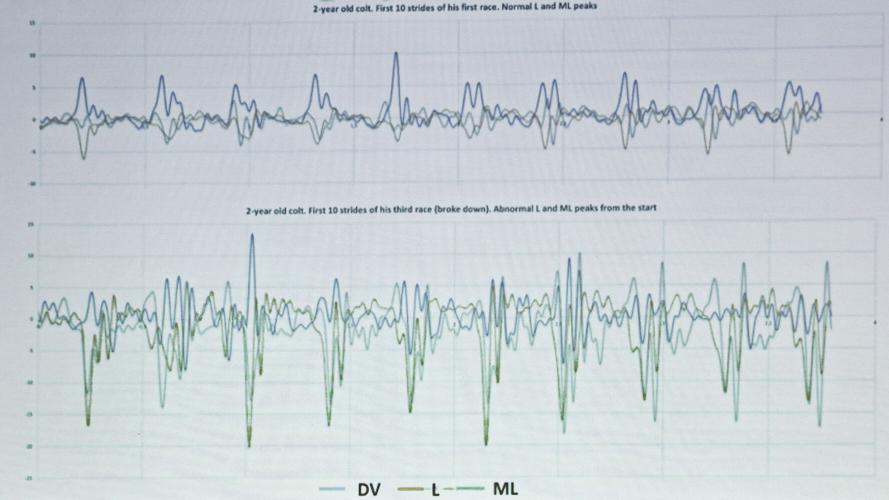
From that, and with the help of data from more than 35,000 races, researchers have been able to come up with the baseline motion of a healthy thoroughbred, and similar digital “footprints” for troubled horses or those who broke down.
StrideSafe returns data that is converted into assessments of red, yellow and green, which then can be shared with trainers and vets, along with the full data, to help spot animals who are struggling at high speed. A red rating means that a horse needs immediate attention, while yellow bears some observation, and green means little running discomfort at all.
A limited number of trainers, including Louisville’s Dale Romans, also have agreed to have the sensors placed on horses in training.
Promoters of the technology hope it will become a widespread tool to help reduce the recent rash of equine fatalities that is threatening the existence of the sport.
In the face of a variety of efforts to stem the number of equine breakdowns Lambert believes that this technology could be a primary tool.
During a meeting with horsemen at Churchill Downs on Monday, Lambert noted that the technology could not stop all horse fatalities or predict every injury. He also told them that a horse that returned a red reading was 300 times more likely to suffer a breakdown than a horse who tested in the green.

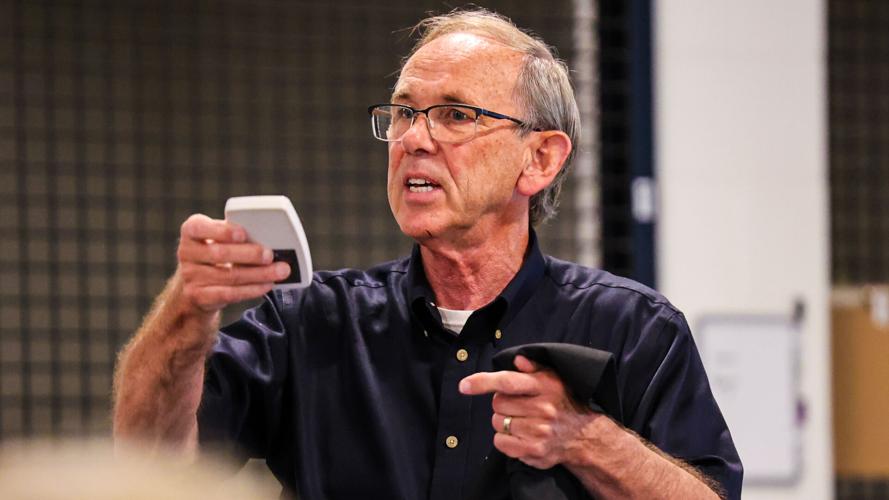
Dr. David Lambert holds a StrideSafe sensor as he talks to Churchill Downs trainers about the new technology.
“I'm extremely confident that this is the right answer,” he said. “Very, very confident. We've seen thousands of cases. It works very, very well. The basic technology, the basic engineering, the basic mathematics is really good. Getting data from the athlete itself while it's running at high speed just puts us on a par with all human athletics. So, we're not treading a new path. We're just trying to catch humans. Everything is in place for it to be used. Whether or not the industry will take it on board, I have no way of knowing.”
Like all new technology, the SafeStride program has met with some skepticism and many questions among horsemen.
They’ve seen new technologies before, some of them helpful, some less so, and have had to accept many rule changes in recent years, some of which they would argue are counterproductive, and some outright backwards.
On Monday, several trainers expressed concerns about how the data would be used, and whether the company has a large enough database to make its conclusions about horse performance accurate.
“With regard to StrideSafe, I. have a very positive outlook, because I think anytime technology is used to improve equine health and welfare, it's a positive,” said Eric Hamelback, CEO of the National Horseman’s Benevolent and Protective Association. “There are always going to be concerns about the data being collected. And at what point you have enough data to use it effectively in the field, as we would like to say. So, again, I think I remain positive about how this project is moving forward. And hopefully if we get to that point, it'll be beneficial for horseman and equine health and welfare.”
Churchill Downs had to move its races to Ellis Park after numerous horse deaths.
At the same time Hamelback and trainers want to be clear that it won’t solve everything.
“We'll need to be up front that this is a tool, right?” he said. “This is not an end-all, be-all. Whatever definitive information comes out of here, it's never going to be exact. It's never going to eliminate risk. And I think the biggest issue that many of us in this industry have is that there's a lack of recognition of that risk. You know, we don't stop driving cars because there are car crashes, right? We are going to continue with the agri-based business that horse racing is. But we all know that there are inherent risks that go with that. If we can utilize technology in the future to help mitigate and certainly lessen the risk, we as horsemen are always going to be on the forefront and trying to do so. We just want to make sure it's known to the public, it's a tool, it is not going to save . . . everything, it's only going to mitigate the risk.”
So far at Churchill Downs, the data has been collected for the purposes of a study at Washington State, and some information has been shared with trainers and their vets on individual horses.
Will Farmer, the equine medical director at Churchill Downs, said the track stepped up to be a part of the study “because we want to be at the forefront of efforts to make the industry safer."

Graphs of a thoroughbred's strides as returned from the StrideSafe sensors. Top, 10 strides of a 2-year-old who finished a race normally. Bottom, 10 strides from a 2-year-old thoroughbred who broke down.
Farmer said the Churchill study, which was green-lighted by the KHRC last October -- months before a spate of a dozen horse deaths in the opening week of Churchill's meet -- is geared toward two things. First, identifying the red flags and the best ways to convey that information to trainers and vets, and second, comparing the data from high-speed training to actual race data to see if there’s any correlation, should the track decide to use the technology in training as well as races.
In the end, Lambert told horsemen, the tool enables them to see things from a high-speed race performance that a vet can’t catch in a pre-race exam, no matter how thorough it is.
“This is the nature of the whole problem,” he said. “There's no heat, there's no swelling, there's no pain, it comes right past you. It comes right past your veterinarian. It comes right past the state veterinarian. It comes right past the jockey getting on the horse that day to ride him. And the first time you see something happen is when the leg breaks and the horse breaks down. And then the pathologists get to see it. And lo and behold, down there by the origins of these fractures, these cracks, these fractures, there's pre-existing disease. The stuff has been there a long time. The real challenge to us is how do we spot it? . . .
“Now we have sitting underneath the saddle, plopping into a pocket in the back so that it's not immediately visible, a sensor that allows us to take data from the horse 800 times every second in three dimensions. . . . So that's 2,400 data points every second that the horse is running. This is a massive amount of new information that nobody has ever experienced before.”
Lambert described the search for that one horse in a thousand that is destined to break down and die of a racing injury like looking for “a needle in a haystack.” The StrideSafe technology, he said, helps make the haystack much smaller.
“If we’ve got information that's coming off the horse 2,400 times a second, if we can all learn what to do with it, then we stand a chance of spotting these things and fixing them,” he said. “And the good news is if you spot them soon enough, the fix is easy. You just give them off for a while and the bones heal on their own and the problem is gone. . . . This is 21st century horsemanship. The best horsemen have good hands. They have good eyes. They watch. They're attentive. They're sensitive. They feel their horses. That's what horsemanship is. And all I'm saying now is take this as well, it's seeing things 2,400 times a second. You can only see him 20 times a second. This is going to help our horsemanship.”
Horse sense, however, is a slow-changing thing. For Lambert, this question remains: If he leads horse racing to a better way, can it be made to drink?
Copyright 2023 WDRB Media. All rights reserved.


