


LOUISVILLE, Ky. (WDRB) — You probably didn't wake up this morning worried about federal antitrust law.
Louisville did.
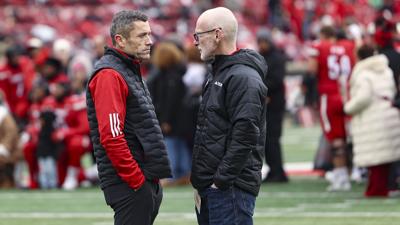
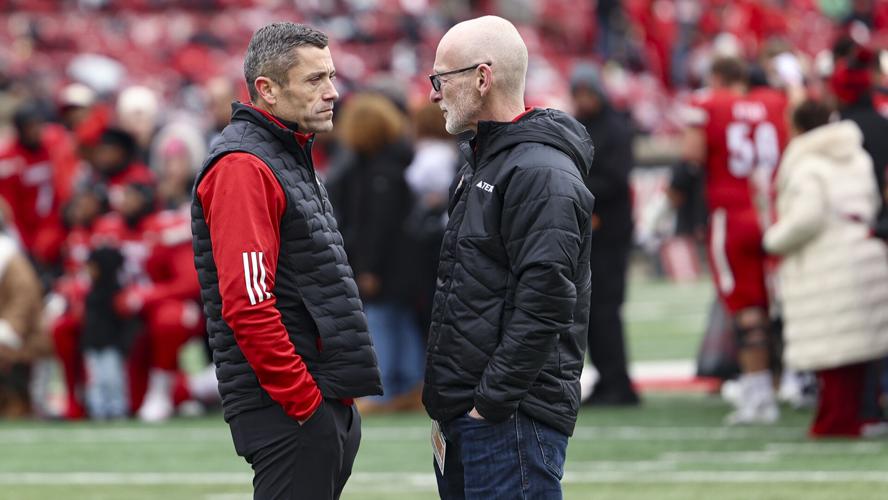
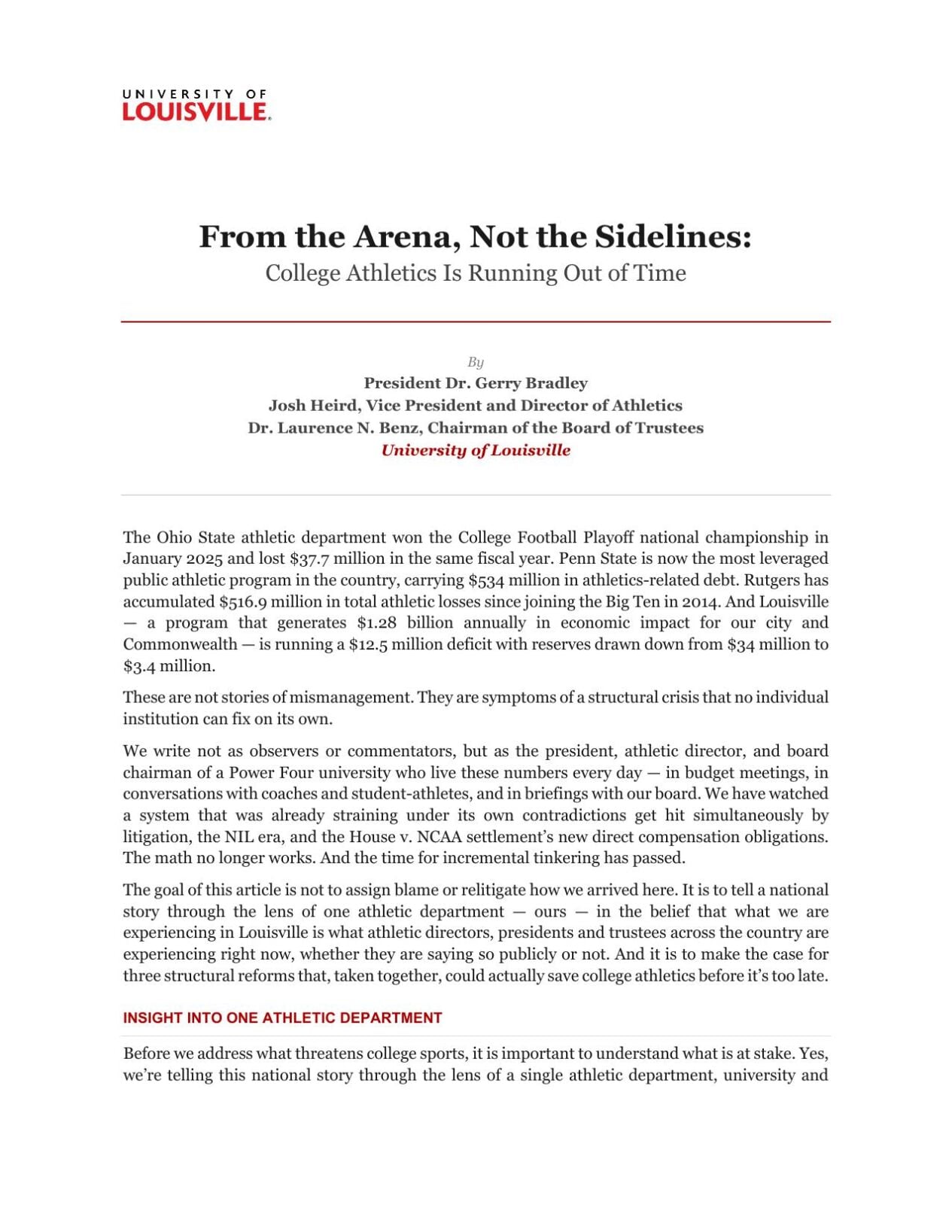
This week, University of Louisville president Gerry Bradley, athletics director Josh Heird and trustees chair Laurence Benz released a lengthy statement with a blunt title: "College Athletics Is Running Out of Time."
It reads like something between a policy paper and a balance sheet with a siren attached.
The message is simple: The math no longer works.
Louisville athletics spends about $167 million a year. It brings in about $155 million. That's a recurring deficit. Reserves that once stood at $34 million are now down to about $3.4 million. To deal with $20.5 million in new revenue sharing to pay athletes, the school took out a $25 million line of credit before this season. It's supposed to help get them through next season.
Then what?
This letter was not written because of Louisville’s financial situation. What is happening at Louisville is more the norm than the exception. Ohio State reportedly lost $37.7 million the same year it won a national title. Penn State is carrying more than half a billion dollars in athletics-related debt. The arms race hasn't slowed. It's just gotten more expensive.
The issue has now moved beyond athletic departments. President Donald Trump is scheduled to host a March 6 roundtable at the White House with NCAA leaders and conference commissioners from the ACC, Big 12, Big Ten and SEC to discuss NIL, transfer rules and governance.
College sports, in other words, are now a federal conversation.
The Louisville letter argues this isn't mismanagement. It's structural. Name, image and likeness rules differ from state to state. Just this week, Mississippi passed a bill to exempt NIL earnings from state income tax, a recruiting advantage built directly into the tax code. Other SEC states already have no income tax at all.
That's the landscape Louisville says is unsustainable: 50 states, 30-plus NIL laws, constant litigation and no central authority with real enforcement power.
So what are they asking for?
Three things.
First, congressional action to create uniform national NIL rules and legal protections. Second, a governing body that can actually govern, whether that's a strengthened NCAA or something new. Third, a hard and enforceable spending cap, modeled after professional sports leagues, to slow what they describe as an escalating financial arms race.
And there is one more idea tucked inside the letter that would fundamentally reshape the system.
Louisville suggests Congress consider amending the 1961 Sports Broadcasting Act — the law that allows the NFL to bundle all of its television rights together and sell them as one national package.
College sports don't work that way. The SEC negotiates its own television deal. The Big Ten negotiates its own. The ACC negotiates its own. Everyone is selling separate inventory in the same marketplace.
Louisville's argument is that this fragmented system is widening the financial gap between the richest conferences and everyone else. If media rights could be negotiated more collectively — even partially — the overall revenue pie might grow and the financial floor might rise for schools outside the Big Ten and SEC.
In simple terms: Louisville is asking to change the rules of the television lottery.
But that idea already faces resistance. Just last week, the Big Ten and SEC sent a joint letter to Congress opposing efforts to create a federally backed single-seller media structure. Their argument is that conference-level control preserves flexibility and innovation, and from their perspective, that makes sense. The current model works exceptionally well for them. They already capture the dominant share of college sports media revenue, and a unified negotiating structure would dilute that advantage. For schools in the ACC and Big 12, however, fragmentation looks less like flexibility and more like a widening gap that becomes harder to close each year.
The letter never mentions cutting sports. It never threatens reductions. It never names specific consequences, eliminated rosters, gutted Olympic programs, the end of opportunities for athletes who don't play football or men's basketball.
It doesn't have to.
When administrators begin talking about "structural reform" and "sustainability," everyone in college athletics understands what usually follows if reform doesn't come.
Louisville is not declaring an emergency. But it is warning of one. It has bought time. It has absorbed deficits. It has adjusted spending. It has trimmed around the edges.
But this document makes clear something important: treading water is not a long-term plan.
If Washington changes the rules, Louisville hopes the current model can survive, broad-based athletics, Olympic sports, competitive football and basketball.
If Washington doesn't?
That's the question the letter leaves hanging.
And that's the one that matters most.
Copyright 2026 WDRB Media. All Rights Reserved.


