LOUISVILLE, Ky. (WDRB) -- Worried that she wasn't being charged correctly for crossing the Ohio River toll bridges, Susan Cochran, of New Albany, Indiana, said she tried to get help from RiverLink's customer service center.
But those attempts failed, she recalled, forcing her to file a complaint in January with the local Better Business Bureau.
"I tried a couple of days to call them, and nobody answered," Cochran said in a recent interview. "I got put on hold. And, you know, you can only wait on hold for so long without giving up."
Kentucky and Indiana officials agreed last month to spend $3.3 million in toll revenue to improve RiverLink operations, acknowledging long call wait times and other concerns during the transition to a new provider, Texas-based Electronic Transaction Consultants. The company, known as ETC, took over the day-to-day toll collection and billing work last September.
But, in the months that followed, ETC increasingly fell behind on its performance targets for the toll system, according to documents obtained in public records requests. The reports, internal memos, spreadsheets and other notes provide the first publicly available look at how RiverLink has fared under its new operator.
WDRB News analyzed records that detail how effectively the ETC-led team managed their two RiverLink responsibilities: The "back office" work processing toll transactions, including ensuring that the correct vehicles are charged; and handling customer service. Our review of the most recently available reports, from September through November, found:
• The share of customer service goals met by ETC fell over that time, from a success rate of about two-thirds in September and October to slightly more than half in November.
• Among the milestones that weren't met in November: ensuring that 80% of telephone calls are answered within one minute after a caller requests a representative; capping maximum phone wait times at 10 minutes; and responding to almost all emailed and other written requests within three business days.
• ETC's goal is to have no one wait longer than 10 minutes at the downtown Louisville or Jeffersonville, Indiana, customer service locations. From September through November, that goal wasn't achieved. (Subsequent data provided to WDRB show that during early February wait times of more than 10 minutes still are occurring at both places.)

In a news release announcing the RiverLink contract in 2021, ETC promised that its work with subcontractors WSP USA Services Inc. and TTEC Government Solutions LLC would "improve ease of website and mobile self-service, and facilitate speedy question and issue resolution" for drivers of the Ohio River bridges.
ETC did not respond to phone and email requests for an interview for this story.
'Trending in the right direction'
The state governments, which have the ultimate oversight over the privately operated toll network, directed questions about RiverLink to Mindy Peterson of Parsons Corp., the firm that handles public relations for the toll system under a contract with Kentucky and Indiana.
Thus far, Peterson acknowledged that customer service is "not where we want to be. But we are absolutely trending in the right direction. So we are seeing a lot of improvement.
"It's going to take more time. We're going to need more patience from folks. And we are certainly taking steps in the right direction. But we have a ways to go on that front."
Peterson cited data showing that about 46% of calls to customer service agents had a hold time of more than 10 minutes during the week of Feb. 5, down from 89% of calls with that wait time during the week of Jan. 22.
In late January, less than 2% of phone calls had a wait time of less than one minute, the data show, but by the week of Feb. 5 nearly 28% of those calls were being picked up in that 60-second window.
Meanwhile, there were 58 customer service representatives answering calls on Feb. 12, up from 24 workers two months before.
At the local walk-in locations the bulk of the wait times remain higher than the goal of 10 minutes. During the week of Feb. 5, 682 of the 989 people who went to the Indiana center on Quartermaster Court in Jeffersonville waited longer than 15 minutes; 161 people waited longer than 45 minutes.
At the South Floyd Street location in Louisville, the wait times during that week were drastically better: Of the 467 people who used the center, 341 waited for less than one minute — or 73%.
In an interview with WDRB last week, Peterson said a "perfect storm" led to "extremely high customer service needs."
Those include, she said, the transition of an "incredibly complex system" from Kapsch TrafficCom — RiverLink's initial operator — to ETC. The states' decision to pause bills in 2023 for people without prepaid accounts also led to a surge in questions from those drivers when billing resumed, she added.
Asked why the demands weren't expected, she said: "We did certainly anticipate a lot of needs. We did not anticipate needs as high as what we are seeing. I mean, the volume of calls just soared. And we are talking about receiving thousands of phone calls every day, incredibly heavy needs. People have a lot of questions, and you have this backlog that starts to create."
The documents obtained under Kentucky's open records law also shed light on areas besides customer service.
A memo from December listed a "mismatch issue" for some vehicle classes, referring to the RiverLink practice of tolls being assessed differently based on the number of axles. The document doesn't elaborate.
It also mentions some customers getting first and second toll invoices at the same time, a move that would mean a $5 late fee charged to drivers who haven't had an opportunity to pay. A similar batch of flawed bills was mailed in 2017.
The report doesn't say how many erroneous invoices were sent in late November, but Peterson said less than 250 people were affected and the late fees were dismissed.

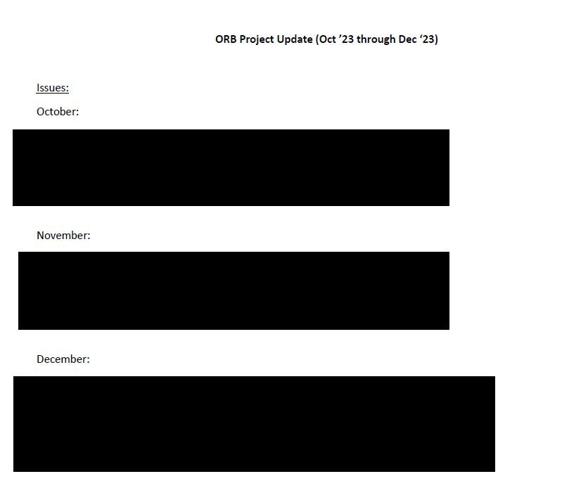
An example of redactions included in records provided to WDRB under the Kentucky Open Records Act (Kentucky Transportation Cabinet document)
Another issue involved duplicate transactions that resulted in refunded payments. The report did not show how many of those instances occurred.
Indeed, the reports often fail to give details of certain issues confronting the toll system, including some "challenges" and "risks" conveyed to the states' management teams. In a reversal from years of precedent, the Kentucky Transportation Cabinet redacted key portions of reports that show, for instance, how many calls aren't answered and emails returned.
The cabinet cited part of the open records law that allows confidential or proprietary information to be withheld if making it public could create an unfair advantage to an entity's competitors.
Kentucky withheld ETC's "actual performance" on goals such as wait times for people who call RiverLink representatives or use the customer service locations, even though Peterson later gave those figures.
A "project update" memo spanning October through December listed "issues" for all three months, but the description was completely blacked out. And a 29-page "program discussion" dated Jan. 23-24 had every page except the cover page entirely redacted.
WDRB is preparing to appeal the redactions to Kentucky Attorney General Russell Coleman's office, which rules on open records disputes.
Not an 'overnight fix'
Tolls have been in place since late 2016 on three bridges connecting Louisville and Clark County, Indiana: the I-65 Lincoln and Kennedy crossings, and the upriver Lewis and Clark Bridge.
Kentucky and Indiana officials agreed on the fees as part of the financing plan for the $2.3 billion Ohio River Bridges Project, which included the new Lincoln and Lewis and Clark bridges and a rebuilt Spaghetti Junction interchange near downtown Louisville.
The states hired Austrian-based Kapsch to manage the toll network they named RiverLink. Almost immediately after tolling began drivers started to face long call wait times and encounter other billing concerns.
Since ETC took over last September, the Better Business Bureau's Louisville area office has logged 65 complaints, or roughly 28% of all toll-related complaints over the past three years. There were six complaints filed with Kentucky Attorney General Coleman's office and six sent to Indiana Attorney General Todd Rokita's office as of late last year. Other complaints have popped up on social media pages.

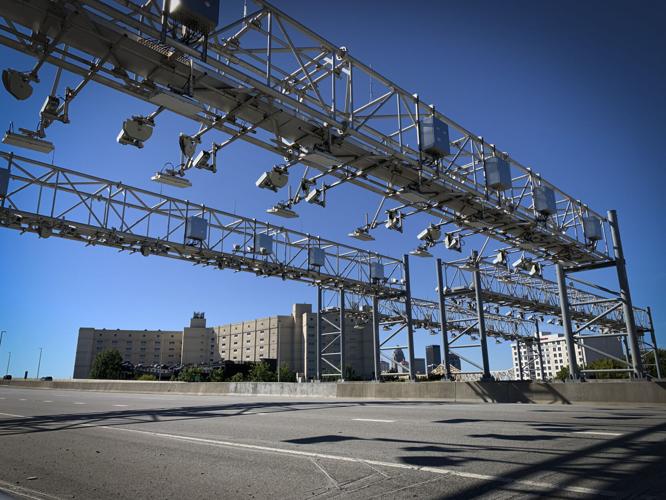
Pictured: this image dated Oct. 4, 2022, shows RiverLink cameras and sensors on one of its three tolled bridges. (WDRB/archive)
For Bronson Barth of Charlestown, Indiana, a source of frustration has been the time it's taken for bridge crossings to appear online so drivers can accurately track them. In an email to WDRB in January, he recalled previously being able to see tolls within hours.
At the time, he wrote, tolls were being posted to his account up to 20 days after a crossing. "That makes it quite difficult to match up actual crossing(s) with my bill and verify the billings are correct."
He sent a follow-up email last Friday. "The late postings continue. Yesterday, a charge was posted to my account with a crossing date of Dec 12, 2023."
(Peterson said there was a lag time when ETC took over but that it has "resolved itself.")
Another driver who contacted WDRB, Marylea Mattingly of La Grange, said she waited for 45 minutes to try and resolve a billing question on Jan. 31. In a follow-up message on Feb. 15, she said she tried to use the website's chat feature but hadn't gotten a reply.
"No one's responding -- the same as the phone," she said. "I've been on hold forever. You know, I have a life. I can't just wait for them to decide to contact me."
Asked when the RiverLink operations will be functioning at an acceptable level, Peterson said, "I think it's going to take weeks and probably months to get there, in a very honest assessment."
She insisted that customer service trends are moving in the right direction.
"It's not going to be an overnight fix. We certainly know that we have a lot of work to do," she said. "But the states have made the investment. We're getting additional help and support. We have more people answering phone calls all the time."
Copyright 2024 WDRB Media. All rights reserved.

WDRB News analyzed records that detail how effectively the ETC-led team managed their two RiverLink responsibilities.


